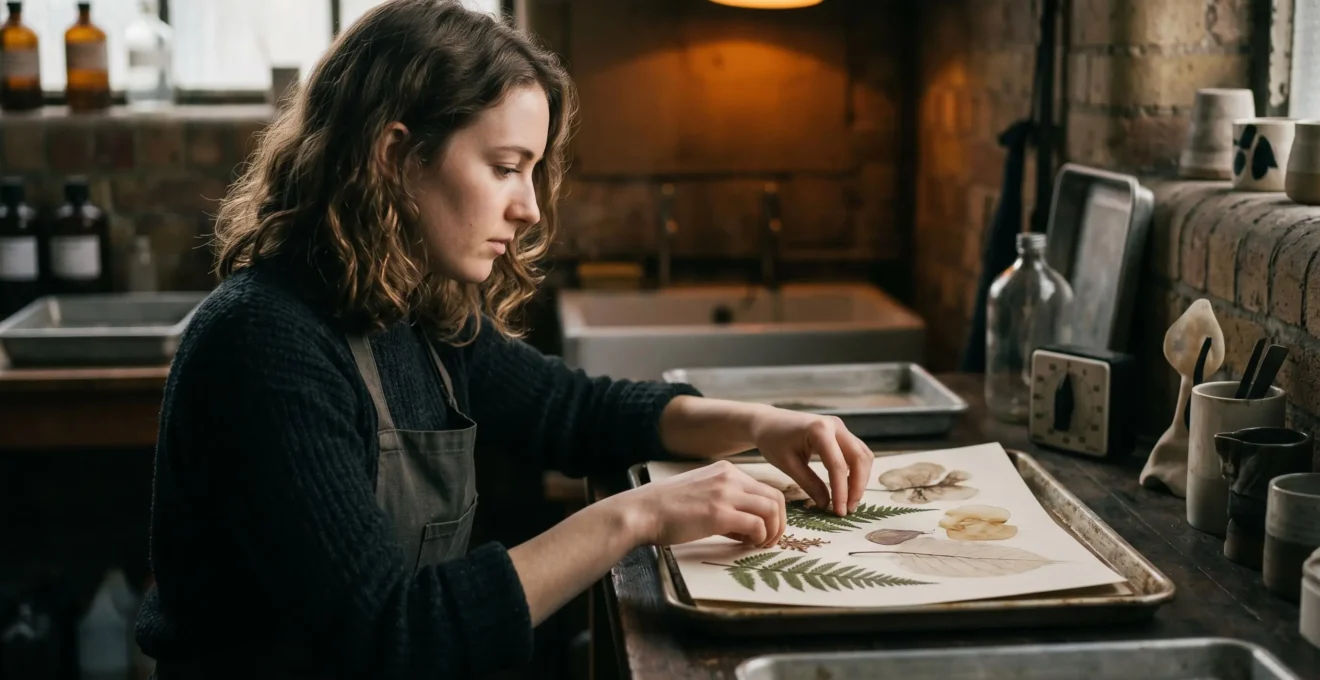
Camera-less photography’s resurgence is not about nostalgia; it’s a movement of material mastery, valuing the artwork as a unique physical object over a reproducible image.
- Artists are acting as alchemists, using chemistry and light to “paint” and sculpt unique works, making each piece a non-repeatable event.
- This focus on “objecthood” and archival permanence gives camera-less works value akin to paintings, attracting collectors tired of digital ephemerality.
Recommendation: For artists, the key is mastering chemical processes to control the chaos. For collectors, it’s recognizing that the value lies in the unique, physical trace left on the paper.
In the quiet of the darkroom, or even out in the open sun, a different kind of image-making is happening. It’s a process that sidesteps the lens, the sensor, and the shutter. This is the world of camera-less photography, a practice as old as the medium itself. Many discussions of the art form begin and end with historical figures like Man Ray or Anna Atkins, framing it as a charming relic of a bygone era. The common perception reduces it to simple photograms—placing objects on light-sensitive paper—and sees it as a nostalgic rebellion against our hyper-digital world.
But to dismiss it as mere nostalgia is to miss the point entirely. What if the real story isn’t about looking backward, but about a profound engagement with the very materials of photography? A new generation of artists, particularly in the UK, is embracing these techniques not to escape the present, but to redefine what a photograph can be. They are not just image-makers; they are alchemists, sculptors, and chemists. They are exploring the “objecthood” of the print, its texture, its permanence, and its unique existence in a world of infinite digital copies.
This article dives into the technical and conceptual heart of this resurgence. We will explore how to create these works, from cyanotype “blueprints” to painting with developer on photo paper. We will unpack why these unique objects are valued like paintings and examine the crucial techniques for ensuring their archival permanence. This is not a history lesson; it is a technical and passionate look at a contemporary art movement that is fundamentally about the power of materiality.
Summary: The Resurgence of Material Photography
- Sun and Chemicals: How to Create Blueprints without a Darkroom?
- Resist and Developer: How to Paint with Chemistry on Photo Paper?
- UV Glass or Dark Room: How to Display Light-Sensitive Art Safely?
- The Mistake of Thinking Analog is Just Nostalgia: The Tactile Advantage
- Monoprint vs Edition: Why Are Camera-less Works Valued Like Paintings?
- Sun or UV Box: How to Calibrate Exposure Times for Crisp Lines?
- How to Collect Digital Art When the Software Might Become Obsolete in 10 Years?
- Giclée or C-Type: Which Printing Method Is Best for Selling Fine Art Photography?
Sun and Chemicals: How to Create Blueprints without a Darkroom?
The cyanotype is often the gateway into the camera-less world. Its iconic Prussian blue, created by the reaction of ferric salts to UV light, is instantly recognizable. While the process can be as simple as placing a leaf on coated paper in the sun, true mastery lies in controlling the variables. This is especially true for artists in climates like the UK, where consistent sunlight is a luxury. The challenge is not a barrier but an invitation to innovate, moving the process from a dependence on weather to a controlled studio practice. This control is where artistry begins.
Modern practitioners build their own UV exposure units, using calibrated LED strips to achieve consistent, repeatable results year-round. This allows for the creation of crisp, well-defined lines and deep, rich blues that are impossible to achieve with the unpredictable intensity of a cloudy sky. It transforms the medium from a simple craft into a precise artistic tool, allowing for the exploration of tone, density, and detail. The focus shifts from merely capturing a shadow to orchestrating a chemical performance.
Case Study: Julie McMahon, UK Cyanotype Artist
Julie McMahon, a Shrewsbury-based photographic artist, exemplifies how British artists have adapted cyanotype processes to overcome unpredictable weather. She transforms cyanotype’s inherent unpredictability into bespoke art, creating botanical lampshades and silk prints by combining controlled UV exposure systems with experimental alchemy. Her work demonstrates how young British artists are making camera-less photography viable year-round, turning a climatic challenge into an artistic advantage and a sustainable practice.
Resist and Developer: How to Paint with Chemistry on Photo Paper?
If the cyanotype is a dialogue with light, the chemigram is a full-blown act of chemical painting. This is where the artist steps away from representation entirely and collaborates directly with the raw materials of photography. The process involves applying “resist” materials—like varnish, oil, or honey—to traditional black and white photographic paper and then subjecting it to developer and fixer. The chemicals react with the paper’s emulsion only where it’s unprotected, creating organic, fluid patterns that are utterly unique. This isn’t about capturing an image of something; it’s about making the chemical reaction itself the image.
The pioneer of the technique, Pierre Cordier, articulated this beautiful duality perfectly:
The chemigram combines the physics of painting (varnish, oil, wax) with the chemistry of photography (photosensitive emulsion, developer, and fixer), without the use of a camera, enlarger or darkroom, and in broad daylight.
– Pierre Cordier, Aesthetics of Photography
This is the essence of controlled chaos. The artist chooses the paper, the resist, and the chemicals, but the final image is born from the interaction between them—a permanent record of a fleeting chemical dance.
As you can see in the intricate patterns formed, the process is a collaboration between artist and material. The result is a work with infinite detail, where viscous resists create hard edges and liquid developers bloom into soft gradients, all captured on the silver-rich surface of the paper.
UV Glass or Dark Room: How to Display Light-Sensitive Art Safely?
Creating a unique, light-sensitive object is only half the battle; ensuring it survives for collectors to appreciate is the other. The very materials that make these works beautiful—organic compounds, iron salts, silver halides—are often vulnerable to the very thing that created them: light. The history of photography is littered with faded masterpieces. A stark reminder of this fragility is that only 20 known copies of Anna Atkins’ pioneering 1843 book of cyanotypes still exist, with many incomplete due to degradation.
For contemporary artists and collectors, this history informs a rigorous approach to conservation and presentation. The first line of defense is archival processing. This often involves toning, a chemical process that replaces the less stable metallic silver or iron in the print with a more inert metal like gold, selenium, or platinum. Toning not only drastically increases the archival permanence of a print but also offers a powerful creative tool, allowing the artist to shift the color and tonality of the work. A simple cyanotype can be transformed into a rich eggplant purple with selenium or a warm brown with tea.
The following table, based on extensive research in photographic chemistry, outlines how different toners impact longevity and aesthetics, a critical consideration for any artist selling fine art prints.
| Toner Type | Archival Permanence Increase | Color Shift Effect | Best Use Case |
|---|---|---|---|
| Selenium | 300+ years | Enriches blacks, adds purple undertone | Black & white photograms with deep shadows |
| Gold | 500+ years | Warms tones, adds red-brown shift | Cyanotypes seeking warmer palette |
| Sepia (sulfide) | 200+ years | Converts to brown tones | Creating vintage aesthetic in contemporary work |
| Tea/Coffee | 50-100 years | Subtle warming, organic variation | Eco-conscious artists seeking natural methods |
Beyond toning, proper display is paramount. This means using UV-filtering glass or acrylic in frames and displaying works away from direct sunlight. For collectors, it means understanding that these are living objects that require a thoughtful environment, much like a watercolor painting or a delicate textile. The care required is part of the work’s inherent value.
The Mistake of Thinking Analog is Just Nostalgia: The Tactile Advantage
To view the analog revival as simple nostalgia is a fundamental misunderstanding. It’s not about rejecting the digital; it’s about embracing the physical. Camera-less photography offers a tactile advantage that a screen-based image can never replicate. The work is not just an image; it is an object with weight, texture, and a physical presence. It is an indexical trace—a direct, one-to-one record of an object’s interaction with light and paper. The ghost of a fern on a cyanotype is not a picture of a fern; it is the shadow of that specific fern, at that specific moment. This creates an authenticity and a connection to the real world that is deeply compelling.
This is where the practice transcends simple image-making and enters the realm of sculpture and conceptual art. The paper is not just a substrate; it can be creased, folded, or replaced with fabric, glass, or wood. The photographic image becomes a dimensional object, its meaning intrinsically tied to its form.
This sculptural quality demonstrates how the photograph’s surface and form become as important as the image it holds. It is a direct refutation of the idea that a photograph is just a flat, reproducible window onto the world. Here, the photograph *is* the world.
Case Study: Luke Evans and the ‘Grey Area’
Young British photographer Luke Evans, with his collaborator Josh Lake, gained recognition for the camera-less series ‘Inside Out.’ Evans describes the medium as existing in “the grey area, that space in the middle where printmaking, sculpture, and photography mix.” His work, which often involves the direct physical trace of objects, exemplifies how contemporary British artists are using the indexical nature of photograms to challenge the boundaries between photographic representation and sculptural presence. This exploration of materiality moves far beyond nostalgic motivations to ask philosophical questions about authenticity and evidence.
Monoprint vs Edition: Why Are Camera-less Works Valued Like Paintings?
In a world of infinite digital duplication, what makes a single image valuable? For camera-less photography, the answer lies in its inherent uniqueness. Most camera-less processes, particularly chemigrams and lumen prints, are fundamentally monoprints. They are singular, unrepeatable events. You can place the same objects on a new piece of paper, but the subtle shift in light, the minute variation in chemical application, or the ambient humidity will ensure the result is different. This makes each successful print a unique art object, not one of a numbered edition.
This singularity is why the art market is beginning to value these works in the same way it values paintings or sculptures. A collector isn’t just buying an image; they are acquiring the one-and-only physical artifact of an artistic and chemical event. It possesses what Walter Benjamin called the “aura” of the original artwork—its unique presence in time and space. This is a powerful differentiator from traditional photography, where value is often tied to the reputation of the photographer and the scarcity of a limited edition.
The value is embedded in the objecthood of the work itself. As one artist eloquently stated, it is a process where the core elements are both the tools and the subject.
Cameraless photography is really a distillation of the essence of the photographic process. The primary elements of photography–light, paper, and chemical– are both the tools, and the subjects that create the image. Medium and object are one and the same.
– Artist quoted in Blind Magazine
This fusion of medium and object means the artist’s hand, their choices, and the chance reactions are all permanently recorded on the surface. A collector can see the brushstroke of the resist, the paper’s texture, the crystalline structure of the fixer. It’s a direct connection to the moment of creation, and that is a rare and valuable thing.
Sun or UV Box: How to Calibrate Exposure Times for Crisp Lines?
The leap from enthusiast to artist in camera-less photography is often measured in one’s ability to control exposure. While the romantic notion of “sun printing” is appealing, professional results demand precision. Achieving crisp lines, a full range of tones, and repeatable outcomes requires a methodical approach to calibration. Whether you are using the sun or a custom-built UV exposure box, you are not just timing; you are measuring a precise dose of UV radiation. This is less like baking a cake and more like conducting a scientific experiment.
The industry-standard tool for this is the Stouffer 21-step grayscale wedge. This is a small, transparent strip with 21 patches of increasing density. By placing this on your sensitized paper during a test exposure, you can precisely determine the exact exposure time needed to achieve pure white, deep black (or blue), and every tone in between. It removes all the guesswork. A British winter sun might feel weak, but a Stouffer test can tell you that a 30 minutes exposure required on a clear winter’s day can still yield a perfect print, according to the Royal Botanic Gardens, Kew.
This level of technical control is not about stifling creativity; it’s about enabling it. Once you know exactly how your materials will react with a specific dose of light, you are free to experiment with intention. You can choose to deliberately overexpose for solarization effects or underexpose for delicate high-key images. Mastery of calibration is the foundation upon which creative expression is built.
Action Plan: Professional Calibration Using a Stouffer Scale
- Purchase a 21-step Stouffer grayscale wedge calibrated for the UV/blue light sensitivity range (300-400nm).
- Coat test strips of your chosen paper with sensitizer and allow them to dry completely in darkness.
- Place the Stouffer scale on the sensitized paper with a piece of clean glass to ensure perfect contact.
- Expose in 30-second increments (for a UV box) or 5-minute increments (for sunlight), creating multiple test strips.
- Develop all test strips, then identify the exposure time that produces visible separation through steps 18-19 for optimal density and crisp shadow detail.
How to Collect Digital Art When the Software Might Become Obsolete in 10 Years?
This question, focused on the fragility of digital art, paradoxically highlights the immense appeal of camera-less photography to modern collectors. As digital files corrupt, servers go offline, and software becomes obsolete, the tangible, physical objecthood of a well-made photogram or chemigram represents a compelling form of permanence. An artwork that is a simple combination of paper, stable chemistry, and light has an archival simplicity that a complex digital file, reliant on a chain of technology to be viewed, can never match.
This is not a luddite fantasy. Major art institutions are actively validating this idea. The Getty Museum’s recent exhibition of contemporary camera-less photography is a prime example. By strategically placing works by living artists like James Welling alongside historical masters like Man Ray, the museum sends a clear signal to the art market: this is not a historical curiosity but a continuous, evolving, and vital artistic tradition. This institutional support provides collectors with the confidence that the work has enduring, museum-quality value.
Case Study: The Getty Museum’s Validation Strategy
The Getty Museum’s Center for Photographs’ landmark exhibition featuring contemporary artists working with camera-less techniques demonstrated powerful institutional validation. Virginia Heckert, curator and department head, explained that this approach provides “an excellent opportunity to feature the work of living artists alongside earlier photographs from our permanent collection.” By doing so, the Getty established a clear lineage, positioning contemporary camera-less photography as having enduring value rather than being an obsolescent historical practice, directly addressing collector concerns about long-term relevance.
The investment in a physical, unique object made with archival materials is seen by many as a safer bet than investing in a digital file. It’s an investment in materiality itself, a vote of confidence in an artwork that can be held, examined, and displayed without the need for a power source or a software update. It exists in the real world, and for many collectors, that is the ultimate assurance of value.
Key Takeaways
- Materiality Over Nostalgia: The revival of camera-less photography is driven by a deep engagement with physical materials and chemical processes, not a simple longing for the past.
- The Value of Uniqueness: Most camera-less works are monoprints, making them unique objects valued like paintings for their “aura” and singularity in a digital world of copies.
- Control is Creativity: Mastery in this field comes from a scientific, methodical control over light and chemistry, which enables, rather than stifles, artistic expression.
Giclée or C-Type: Which Printing Method Is Best for Selling Fine Art Photography?
While the primary value of a camera-less work lies in its uniqueness, there is often a need to create high-quality reproductions for portfolios, publications, or even limited-edition prints that document the original. This presents a unique challenge: how do you faithfully capture the materiality of the original object? The choice of printing method is not merely technical; it’s an interpretive act. You must decide whether to prioritize the work’s surface texture, its tonal depth, or its “wet” chemical look.
The two dominant methods are archival pigment prints (Giclée) and chromogenic prints (C-Type). A Giclée print on matte cotton rag paper is superb at reproducing the texture of handmade paper, the subtle variations of a hand-coated emulsion, or the tooth of a watercolor paper. It captures the feel of the object. A C-Type print, on the other hand, is a true photographic print made by exposing light-sensitive paper. It excels at capturing deep, rich blacks (a high Dmax) and the luminous, wet-in-wet look of a chemigram or a glossy silver gelatin photogram. It captures the light of the object.
As the Victoria and Albert Museum notes, “Recent advances in photographic technology… seem only to have increased both the inventiveness of artists who use camerless techniques and the growing public fascination for camerless photography.” This fascination extends to how these unique works are translated into reproducible forms. The choice of documentation method is the final step in the artist’s process of controlling how their work is seen and valued.
| Documentation Method | Best Captures | Paper Recommendation | Ideal for Original Type |
|---|---|---|---|
| Archival Pigment Giclée (Matte) | Surface texture, paper fiber, hand-coating variations | Museum-grade cotton rag with subtle texture | Cyanotypes on watercolor paper, Van Dyke prints, any work with visible paper tooth |
| C-Type (Glossy/Lustre) | Deep tonal range, wet chemical look, high Dmax | Fuji Crystal Archive or equivalent | Chemigrams on RC paper, silver gelatin photograms, high-gloss processes |
| Hybrid Giclée on Baryta | Balance of texture and tonal depth | Hahnemühle Photo Rag Baryta | Platinum/palladium prints, toned cyanotypes requiring both texture and luminosity |
| High-res Digital Scan Only | Archival record, color-calibrated reference | N/A (digital file for portfolio/insurance) | All unique camera-less works before exhibition/sale |
The chemistry is waiting. The paper is a blank slate for a conversation between you and the light. Pick a process, gather your materials, and begin your own dialogue with the fundamental elements of photography. The time to experiment is now.