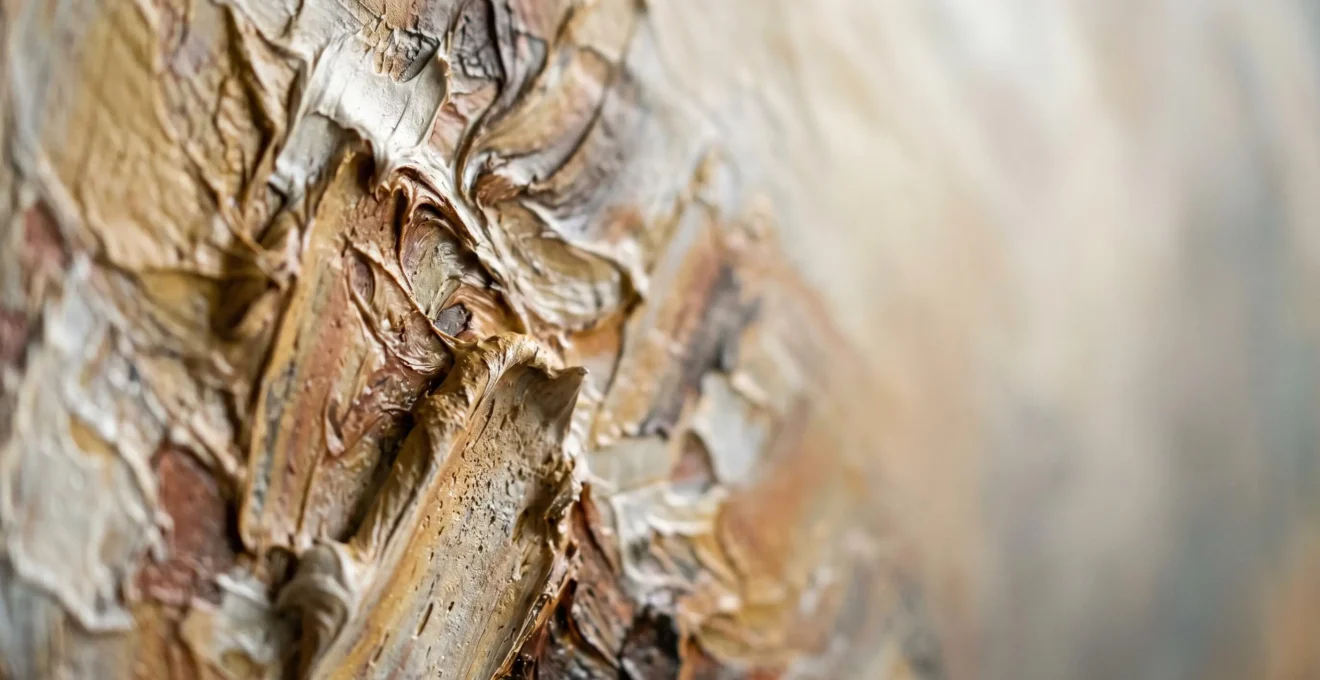
Adding cold wax to oil paint isn’t about creating texture; it’s about transforming paint into a sculptural medium you can excavate.
- The stability of your work depends on respecting a strict wax-to-paint ratio, beyond which the paint film becomes fragile.
- True depth comes from subtractive methods—scraping and digging back through layers—as much as from additive ones.
Recommendation: Shift your mindset from ‘painting’ to ‘sculpting’. Treat your surface as a topography to be explored, not just a canvas to be covered.
For oil painters drawn to the siren call of texture, cold wax medium often appears as a simple thickening agent. The common advice is to mix it in, build up some impasto, and enjoy a faster drying time. This approach, however, barely scratches the surface. It treats the wax as a mere additive, a servant to the paint, and misses its true potential as an artistic partner. This perspective often leads to predictable surfaces and, worse, potential long-term structural problems.
The real shift happens when you stop thinking about adding texture and start thinking about building history. What if the key wasn’t simply to apply more paint, but to engage in a physical dialogue with the material? A dialogue of adding, yes, but also of removing, scraping, and revealing—turning the painting process into a form of archaeology. This is where cold wax transcends its role as a medium and becomes a catalyst for a more intuitive, tactile, and expressive way of working.
This guide moves beyond the basic recipes. We will explore the structural limits of the medium, the language of different tools, and the philosophy of revealing layers rather than just applying them. By understanding the material’s properties—from its ideal ratios to its unique curing process—you will learn to build not just texture, but a rich, physical narrative on your panel, turning each piece into a tangible record of its own creation.
This article will guide you through the structural, practical, and philosophical aspects of working with cold wax. The following sections offer a comprehensive look at how to master this versatile medium, from the chemistry of its mixture to the poetry of its finish.
Summary: Building Sculptural Narratives with Cold Wax and Oil
- 50/50 or More: How Much Wax Can You Add before the Paint Crumbles?
- Squeegee or Knife: Which Tools Create the Best Abstract Marks?
- Reveal the History: How to Scrape Back Layers for Depth?
- The Mistake of Framing a Wax Painting Under Glass
- Citrus or Mineral Spirits: How to Clean Wax Tools without Toxicity?
- Why Is the Old Master Glazing Technique Still Relevant for Contemporary Oil Painters?
- Acrylic or Oil: Which Hyperrealist Medium Is More Susceptible to Damage?
- How to Distinguish Hand-Painted Hyperrealism from High-Res Photography?
50/50 or More: How Much Wax Can You Add before the Paint Crumbles?
The allure of creating thick, buttery impasto with cold wax is strong, but this freedom has a critical technical boundary. The question isn’t just about feel, but about archival stability. While it’s tempting to load up your paint with wax to achieve a stiff, sculptural consistency, exceeding a certain ratio can compromise the structural integrity of your paint film, leading to cracking and instability over time. It’s a dialogue between your creative impulse and the physical limits of the materials.
The generally accepted rule for archival safety comes directly from manufacturers who have extensively tested these materials. They recommend a maximum of 1/3 cold wax to 2/3 oil paint by volume. Beyond this threshold, the binder (linseed oil) becomes too dispersed to properly lock the pigment and wax into a stable, durable film. The resulting paint layer may feel firm to the touch but can remain vulnerable. As Gamblin Artists Colors warns, « Beyond this amount, there is cracking potential. » This ratio ensures the oil can still form a cohesive and strong network around the wax particles.
This concern is not merely theoretical. An analysis of material science in painting highlights that while oil sticks may contain a small amount of wax (under 15%), the higher concentrations used in cold wax painting introduce unique challenges. According to a report on painting best practices, conservators have documented cases where wax-heavy layers soften or become structurally weak years after completion, complicating future conservation efforts. For this reason, it’s also crucial to work on a rigid support like a wood panel, as the flexing of a canvas can place additional stress on the less-flexible wax-oil film. Respecting the ratio is the first step in ensuring your tactile creation lasts for generations.
Your Action Plan for Structurally Sound Layers
- Measure Your Mix: Start by pre-mixing small, measured batches on your palette. Use palette knives to approximate a 1:2 volume ratio of wax to paint. Observe how the consistency changes.
- Document Your Ratios: Keep a small notebook. When you find a mix with a texture you love, jot down the approximate ratio you used and the paint brand/color. This builds your haptic knowledge.
- Conduct a Stress Test: Create a small test painting on a panel with varying ratios, including one that you know exceeds the 1/3 limit. After it dries, gently flex the panel to see how the paint film responds.
- Check Support Rigidity: Before starting a new piece, ensure your support (panel, cradled board) has zero flex. Press on the center; if it gives, it’s not suitable for heavy wax applications.
- Plan for Layering: Instead of creating one extremely thick layer, plan to build up your topography with multiple, moderately thick layers, allowing each to set before adding the next. This creates a more stable structure.
Squeegee or Knife: Which Tools Create the Best Abstract Marks?
In cold wax painting, your tools are not just applicators; they are extensions of your hand that speak a language of texture and gesture. The choice between a hard-edged palette knife and a flexible rubber squeegee is not about which is « better, » but about what you want to say. Each tool engages in a different dialogue with the viscous, heavy-bodied paint, creating a unique topography on the surface. Understanding this relationship is key to moving from random marks to intentional, expressive statements.
The palette knife is a tool of precision and control. Its rigid metal edge carves, cuts, and scrapes. It allows you to create sharp lines, build up distinct facets like a sculptor, and trowel on thick, opaque layers of paint. A knife gives you the power to define edges and construct form. It’s assertive. In contrast, the squeegee or a silicone bowl scraper is a tool of surrender and surprise. Its flexible edge glides and drags across the surface, pulling thin, translucent veils of color, blending edges softly, and creating unpredictable marks that respond to the slightest variations in pressure and surface texture. It’s responsive.
Thinking about your tools in this way opens up a world of mark-making possibilities. An artist’s toolset for cold wax is a curated collection of mark-making voices.
As the image suggests, the variety is immense. Beyond traditional art supplies, unconventional implements like old credit cards, pieces of mat board, or textured rollers can be introduced. The magic happens when you combine them. You might lay down a thick, opaque field of color with a knife, then gently drag a squeegee across it to reveal subtle undertones. Or you could use the edge of a card to incise fine, sharp lines into a soft, squeegee-applied layer. The surface becomes a record of these interactions—a physical narrative of push and pull, construction and deconstruction.
Reveal the History: How to Scrape Back Layers for Depth?
With traditional oil painting, depth is an illusion created by adding layers of transparent glaze. With cold wax, depth is a physical reality you unearth. The most profound and compelling aspect of this medium is not what you add, but what you take away. The act of scraping, scratching, and gouging back through layers—a technique known as sgraffito—transforms the artist from a painter into an archaeologist. You are not just applying color; you are excavating the painting’s past, revealing the history of decisions, colors, and textures buried beneath the surface.
This process begins after you have applied at least two or three layers of color, allowing each to set but not fully cure. The top layer might be a cool, quiet grey, but you know that beneath it lies a vibrant field of ochre or a deep sienna. Taking a palette knife, a stylus, or even the sharp end of a brush, you incise the surface. As you carve away the top layer, the underlying colors burst forth, creating a sudden, dramatic interplay. This is not just about revealing color; it’s about creating a surface narrative. The scrape itself—its depth, its direction, its frayed edges—becomes a mark as important as any brushstroke.
This subtractive method is what gives cold wax paintings their unique sense of time and history. It’s a visual record of the artist’s journey.
This « archaeological » approach, as visualized above, fundamentally changes your relationship with the painting. You are no longer working towards a predetermined image. Instead, you are responding to what the layers reveal. A scrape might uncover an unexpected color combination that sends the painting in a new direction. You might dissolve a hard edge with a solvent-dampened cloth, creating a soft, atmospheric transition between strata. This constant give-and-take—adding and subtracting, hiding and revealing—is the intuitive dance at the core of cold wax painting. The final surface is not just a picture; it’s a rich, tactile map of its own creation.
The Mistake of Framing a Wax Painting Under Glass
Once your tactile masterpiece is complete, the instinct might be to protect it behind glass, as you would a watercolor or pastel. This is one of the most common and detrimental mistakes an artist can make with a cold wax painting. The very nature of the medium—its composition, its curing process, and its intended finish—demands that it be allowed to breathe. Framing a cold wax painting under glass is akin to suffocating it, trapping the very elements that need to escape for the film to achieve its final, durable state.
The reason lies in the extended curing process. Unlike acrylics that dry quickly through water evaporation, an oil and wax mixture cures through oxidation, a slow chemical reaction with the air. While the surface may feel touch-dry within a week, a full cure takes 6 to 12 months as the oil polymerizes throughout the entire paint film. During this time, the solvents used in the cold wax medium (like Gamsol or other mineral spirits) are slowly off-gassing. Trapping these solvent vapors behind glass can create a micro-environment that prevents proper curing and can even cause a cloudy or hazy film to develop on the paint surface or the inside of the glass.
The aesthetic of the medium also argues against glass. As a technical resource from Gamblin explains, the unique satin or matte finish of a cold wax painting is an intentional part of its appeal, avoiding the distracting glare of traditional gloss varnishes. This tactile surface is meant to be experienced directly. The professional standard for presenting these works is a floater frame. This style of frame leaves a gap between the edge of the painting and the frame, allowing for crucial air circulation while providing a clean, finished look. Once fully cured (after 6-12 months), the surface can be gently buffed with a soft, lint-free cloth to bring out a lustrous, hand-rubbed sheen—a final, intimate interaction with the finished piece.
A cold wax painting does not need to be framed behind glass.
– Jackson’s Art Supplies, Cold Wax Medium Review by Zoë Taylor
Citrus or Mineral Spirits: How to Clean Wax Tools without Toxicity?
The studio should be a sanctuary for creativity, not a hazardous environment. Given that cold wax medium is mixed with a solvent, and the resulting mixture is thick and sticky, tool cleanup can present a challenge. The default solution for many oil painters is Odorless Mineral Spirits (OMS) like Gamsol or Turpenoid. While effective, the desire for a less toxic, fume-free studio has led many artists to seek « natural » alternatives, with citrus-based thinners (d-Limonene) being a popular choice. However, the path to non-toxic cleaning requires a more nuanced understanding than simply swapping a petroleum product for a plant-based one.
The primary method for cleaning tools coated in a wax-oil mixture is mechanical. Before any solvent is used, the vast majority of the paint should be scraped off with a palette knife and wiped clean with a paper towel or rag. This removes 90% of the residue. For the final cleaning, a small amount of an oil-based medium can be effective. Simply working a bit of safflower or walnut oil into the remaining paint on a palette knife will thin it enough to be wiped away completely, leaving the tool clean and conditioned without any solvent fumes.
When considering solvent alternatives, it’s crucial to look past marketing labels. Citrus-based thinners, while derived from natural sources, are aggressive solvents that can cause skin irritation and respiratory issues in sensitive individuals. As one toxicologist notes, we should be cautious with assumptions: « Natural does not necessarily equate to safer – turpentine after all is an all-natural product. » Furthermore, these natural solvents can leave an oily residue that might interfere with paint layers if not thoroughly removed. For many artists, the safest and most effective solution remains a high-quality, slow-evaporating OMS like Gamsol, used sparingly and with good ventilation, or avoiding liquid solvents altogether in favor of oil-based cleaning.
Why Is the Old Master Glazing Technique Still Relevant for Contemporary Oil Painters?
To fully appreciate the revolutionary nature of cold wax layering, it helps to contrast it with the time-honored technique of the Old Masters: glazing. For centuries, artists like Rembrandt and Titian built luminosity by applying many thin, transparent layers of oil paint. Light would travel through these jewel-like glazes, bounce off the opaque ground layer, and reflect back to the viewer, creating an illusion of inner light. It was a pre-planned, additive process focused on achieving illusionistic depth. Cold wax layering turns this entire philosophy on its head.
Instead of building light through transparency, cold wax is about finding light within physical layers. It is an intuitive, responsive process that is both additive and subtractive. The working philosophy is not one of meticulous planning but of discovery. As contemporary artist Rebecca Crowell explains, « Using Cold Wax helped me to move beyond conscious rendering of abstract ideas into a way of working that felt much deeper and more intuitive. » You build up thicker, translucent-to-opaque layers, then excavate them to reveal the light and color trapped within. The depth is not an illusion; it’s a tangible, sculptural reality.
This fundamental difference in approach and outcome is best understood through a direct comparison, highlighting how each technique uses layers to achieve radically different aesthetic goals.
| Aspect | Old Master Glazing | Cold Wax Layering |
|---|---|---|
| Layer Thickness | Many thin, transparent layers | Fewer, thicker, translucent-to-opaque layers |
| Working Philosophy | Pre-planned, controlled, additive | Intuitive, responsive, additive and subtractive |
| Light Building Method | Building light through layers (transmission) | Finding light within layers (excavation) |
| Surface Quality | Smooth, illusionistic, invisible medium | Textured, tactile, hyper-visible medium |
| Drying Time | Weeks between layers | Touch-dry in days, workable in a week |
| Final Aesthetic | Luminous depth via transparency | Physical depth via sculptural texture |
Acrylic or Oil: Which Hyperrealist Medium Is More Susceptible to Damage?
When considering the longevity of a painting, the conversation often turns to the inherent differences between mediums. Acrylics are known for their flexibility and rapid drying, while oils have a centuries-long track record but can be prone to yellowing and cracking if not handled properly. Introducing wax into the oil medium might seem like adding a volatile, less-stable component. However, history and material science tell a different, more durable story. In fact, a properly formulated wax-oil paint film is exceptionally resilient.
The archival permanence of wax as a painting binder is not a modern discovery. The most powerful evidence comes from antiquity. The remarkable Fayum mummy portraits from Roman Egypt (1st-3rd century AD) were painted with pigmented beeswax (an encaustic technique) and remain vibrant and structurally intact after nearly two millennia. This demonstrates the incredible stability and protective qualities of wax when used as a primary component in a paint system. It is a natural barrier against moisture and environmental degradation.
In a modern cold wax and oil mixture, this protective principle still applies. As contemporary artist Peter Corr notes, « Once fully cured, the wax acts as a protective binder, encasing the pigment and providing a natural moisture barrier. » The wax, distributed throughout the oil binder, adds a degree of flexibility and water resistance to the final paint film. While a hyperrealist acrylic painting might be susceptible to damage if its plastic-like surface is punctured or torn, a thick, cured cold wax painting has a robust, semi-rigid structure that is more resistant to certain types of physical impact. The durability is not in a thin, perfect skin, but in a deep, integrated body of material.
Key Takeaways
- Cold wax is a sculptural partner, not just a texturizer; its true potential is in building physical layers you can excavate.
- Archival stability is paramount: never exceed a 1/3 wax to 2/3 oil paint ratio and always work on rigid supports to prevent cracking.
- The most profound depth in cold wax painting comes from subtractive methods—scraping, scratching, and revealing the history of layers beneath the surface.
How to Distinguish Hand-Painted Hyperrealism from High-Res Photography?
In an age of high-resolution digital imagery, hyperrealism pushes the boundaries of painting, striving to create an illusion so perfect it can be mistaken for a photograph. The artist’s hand is deliberately hidden, every brushstroke smoothed away to serve the flawless illusion. Cold wax painting stands as the philosophical antithesis to this pursuit. It is not about hiding the process, but about celebrating it. It is a medium unified by an interest in « experimentation, texture and the physicality of paint layers, » making the artist’s hand hyper-visible.
You can never confuse a cold wax painting with a photograph because its very essence is its three-dimensionality. The textured, sculptural surface—replete with visible tool marks, ridges of paint, and excavated channels—is the defining characteristic. This physical topography tells a story all its own, a concept known as « Surface Narrative. » It is a parallel story that exists alongside, or even supersedes, the subject matter. The narrative is not just *what* is painted, but the visible history of *how* it was painted. The viewer’s eye is invited to travel across this landscape, to feel the gritty texture and follow the path of the palette knife.
This approach profoundly embraces the « hand of the artist. » Every mark, every scrape, every gesture is a topographical record of a physical interaction with the material. Unlike hyperrealism, which seeks to erase any evidence of its own making, cold wax painting makes these marks its central theme. It is an honest medium, one that finds beauty in imperfection and meaning in the process. The final piece is not a window into an illusory world, but a tangible object, a physical artifact of creative exploration.
Frequently Asked Questions About How to Build Texture and Layers using Cold Wax Medium with Oils?
Why can’t cold wax paintings be confused with photography?
Cold wax paintings celebrate three-dimensionality and surface imperfection. The textured, sculptural surface with visible tool marks, scraped layers, and physical topography makes it impossible to mistake for a flat photographic image. The painting’s physicality is its defining characteristic.
What is ‘Surface Narrative’ in cold wax painting?
Surface Narrative refers to the story told by the painting’s physical surface itself—the visible history of its creation through layers, scrapes, textures, and mark-making. This second narrative exists alongside (or even supersedes) the subject matter, making the process of painting as important as what is painted.
How does cold wax painting embrace the ‘hand of the artist’?
Every tool mark, scrape, and layer in a cold wax painting is a topographical record of the artist’s physical gestures. Unlike hyperrealism which hides brushstrokes to achieve illusion, cold wax painting makes these marks hyper-visible, celebrating the honest evidence of artistic process and human touch.