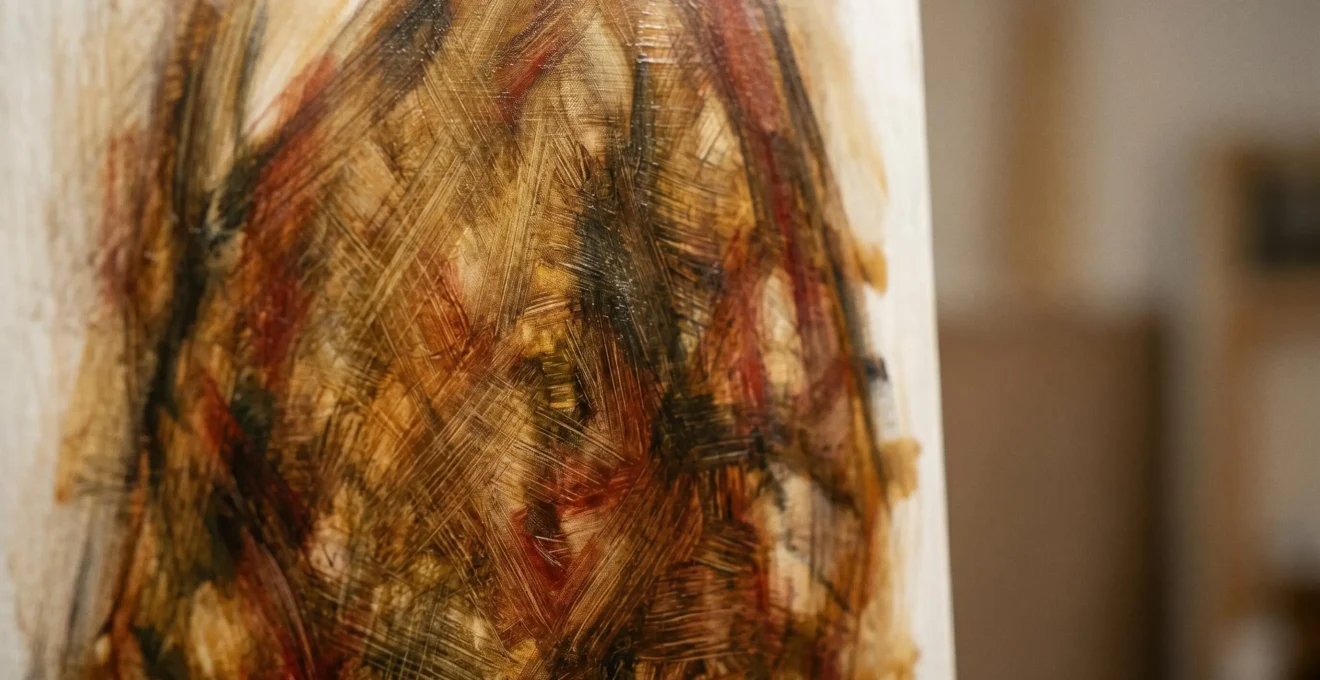
Egg tempera’s legendary luminosity is not an accident of history but the direct reward of a rigorous, unyielding artistic discipline.
- Unlike forgiving oils or acrylics, tempera’s fast-drying, non-blendable nature forces the painter to build colour through precise, hatched layers, creating unparalleled optical vibrancy.
- The medium’s structural integrity relies on an inflexible system of rigid panels and absorbent gesso, ensuring a longevity that modern polymer paints can only theorize about.
Recommendation: To truly master luminosity, painters should embrace tempera not as an alternative, but as a holistic discipline where the material’s limitations are the very source of its brilliance.
For centuries, the glow of early Renaissance masterpieces has captivated viewers. The radiant flesh tones and jewel-like colours in the works of Duccio, Fra Angelico, and Botticelli possess a light that seems to emanate from within the panel itself. Painters today, working with tubes of oil or acrylic, often seek to replicate this effect, yet find it elusive. The common understanding is that egg tempera, the medium behind this magic, is simply an archaic and difficult predecessor to modern paints, a historical curiosity left behind for good reason.
Many artists are told that tempera is fast-drying, brittle, and unforgiving. They learn the basic recipe—pigment mixed with egg yolk—and perhaps attempt a few frustrating strokes before returning to the familiar comfort of blendable, slow-drying media. The search for luminosity continues through complex glazing techniques in oil or the use of high-gloss acrylic mediums, treating the symptom rather than understanding the cause. But what if the perceived flaws of egg tempera—its speed, its inflexibility, its demanding preparation—are not flaws at all? What if they are the very pillars of its unique optical power?
This guide reframes the conversation. We will not treat tempera as a historical relic, but as a living, breathing discipline. The key to its unmatched luminosity and detail lies not in circumventing its rules, but in embracing them with the focus of a master craftsman. This is not about finding an easier way to paint; it is about understanding why the demanding path yields a superior result. We will explore the non-negotiable science behind preparing the medium, applying the strokes, choosing the support, and finishing the work, revealing how each rigorous step contributes to the final, brilliant whole.
To fully grasp this demanding yet rewarding medium, this article delves into the specific principles and historical practices that define its character. The following sections break down the essential knowledge required to move from appreciating tempera to truly understanding its power.
Summary: Unlocking the Secrets of Egg Tempera’s Brilliance
- Yolk and Water: How to Prepare Fresh Egg Medium Daily?
- Stroke by Stroke: Why You Can’t Blend Tempera Like Oil?
- True Gesso: Why Canvas Cracks Tempera and Rigid Panels are Mandatory?
- The Mistake of Varnishing Tempera Too Soon
- Natural vs Plastic: Why Choose Tempera over Modern Acrylics?
- Why Is the Old Master Glazing Technique Still Relevant for Contemporary Oil Painters?
- Gold and Green Underpainting: Why Did Icons Look That Way?
- Byzantine vs Renaissance: How Did Tempera Techniques Evolve in History?
Yolk and Water: How to Prepare Fresh Egg Medium Daily?
The journey into tempera begins not with a brush, but with an egg. Unlike modern paints that can sit in a tube for months, egg tempera is a living medium that must be prepared fresh for each painting session. This daily ritual is the first step in the tempera discipline, a moment of connection with the fundamental materials. The magic lies within the yolk, a perfect natural binder. According to technical documentation, egg yolk contains natural emulsifiers (lecithin), oils, and proteins that bind pigment into a durable, water-resistant film upon drying.
The preparation is a precise, tactile process. The goal is to isolate the pure yolk from the egg white and the fragile membrane, or sac, that encloses it. The traditional method involves carefully passing the whole yolk from one clean palm to the other, drying the hands between each pass to gently remove any adhering albumen. Once dry to the touch, the yolk is held over a clean jar, its membrane is pierced with a pin or knife, and the liquid gold within is allowed to flow out, leaving the empty sac behind. This pure yolk is the heart of the medium.
At this point, the yolk can be mixed with an equal part of distilled water and shaken vigorously to create a stable emulsion. This ‘egg-water’ mixture becomes the standard vehicle to which dry, ground pigments are added. A few drops of clove oil or even white wine can be added, not for chemistry, but for craft—it retards spoilage and imparts a pleasant aroma to the studio. This daily act instills a profound material consciousness in the painter, a stark contrast to the impersonal act of squeezing paint from a manufactured tube. It is a reminder that the resulting painting is built from elemental, organic substances.
Stroke by Stroke: Why You Can’t Blend Tempera Like Oil?
Perhaps the greatest shock for a painter accustomed to oil or acrylic is the realization that egg tempera cannot be blended. The medium dries within seconds of application, making the soft, wet-into-wet transitions of oil painting impossible. This is not a limitation to be overcome; it is the central principle of the tempera technique. Where oil painting models form by pushing and pulling pigment on the surface, tempera builds form by layering precise, fine strokes of translucent color. This method is known as hatching and cross-hatching.
This technique forces a completely different way of thinking about color and form. Instead of physically mixing a green on the palette, a tempera painter might lay down a field of fine yellow strokes, let it dry instantly, and then apply a series of blue strokes over it. The result is a vibrant, shimmering green that is mixed not on the panel, but in the viewer’s eye. This is optical mixing, a more scientific and deliberate way of building color.
The brilliance achieved through this method is physically superior to that of mixed pigments. As technical documentation explains, this is because each layer retains its own chromatic identity, creating a more complex and luminous visual sensation.
Optical mixing produces more vibrant colours than physical pigment mixing because each pigment layer retains its full chroma.
– Youblob Technical Documentation, Making Egg Tempera Paint — The Medieval Panel Painting Medium
Historically, some artists sought a middle ground. The “Tempera Grassa” or fatty tempera technique, used by artists like Pietro Annigoni, involved adding a small amount of oil and varnish to the egg emulsion. As one analysis of historical recipes shows, this hybrid technique created a ‘fatty tempera’ that extends working time while preserving much of the medium’s luminosity. However, the purist form of tempera relies solely on the rapid-fire application of distinct strokes, a meditative process that demands patience and precision, rewarding the painter with unparalleled clarity and vibrancy.
True Gesso: Why Canvas Cracks Tempera and Rigid Panels are Mandatory?
The structural integrity of an egg tempera painting is an architectural system, not just a surface application. While an oil painter can work on flexible canvas, such a support would be a death sentence for a tempera painting. The egg yolk binder cures to a hard, brittle, and inflexible film. Any movement in the support—from humidity changes, temperature shifts, or physical handling—will cause this delicate paint layer to crack and flake away. Therefore, a perfectly rigid support is not just recommended; it is mandatory.
Historically, this meant well-seasoned poplar or linden wood panels. Today, modern painters use high-quality hardwood plywoods or advanced composite materials. The goal is the same: absolute stability. This requirement is stated unequivocally by contemporary masters of the medium.
The nature of egg tempera paint requires that it be applied on a rigid support, unlike other painting mediums which can be painted on a flexible surface such as canvas or paper.
– Daniel Ambrose, The Art of Egg Tempera Painting: Preparing Panels
Equally important is the ground, or “gesso,” applied to the panel. This is not the acrylic “gesso” found in modern art stores. True gesso, as prescribed by Cennino Cennini in his 15th-century treatise, is made from rabbit-skin glue and a white inert pigment like gypsum or chalk. It is applied in numerous thin layers and sanded to a brilliant white, ivory-smooth, and highly absorbent surface. This absorbency is crucial, as it allows the first layers of tempera to physically lock into the ground, creating a permanent bond. Modern alternatives like Ampersand Claybord are designed to replicate this essential quality, featuring a kaolin clay ground that provides the necessary absorbency for the tempera to adhere properly. For ultimate stability, some artists now turn to materials like Tempanel, a 3mm thick aluminum composite material (ACM) that offers virtually no response to environmental changes.
The Mistake of Varnishing Tempera Too Soon
In the world of fast-drying acrylics, a painting can be dry to the touch in minutes and varnished the same day. Applying this logic to egg tempera is one of the most catastrophic mistakes a painter can make. While tempera feels dry almost instantly, this is merely the evaporation of its water content. The true strength of the paint film develops over a much longer period through a chemical process called oxidative polymerization. The oils and proteins in the egg yolk slowly react with oxygen in the air, cross-linking to form a tough, insoluble, and permanent matrix. This “curing” process is invisible and can take months to complete.
Varnishing the painting before this process is finished is disastrous. The varnish layer will trap residual moisture and interfere with the oxygen supply, preventing the paint film from ever reaching its full hardness and durability. The standard, conservation-grade recommendation is to wait a minimum of three to six months before any varnish is applied. This extended waiting period is another core tenet of the tempera discipline, demanding a level of patience entirely foreign to the immediacy of modern painting practices.
The chemistry is complex but fascinating. As art conservation scientist Rhiannon Piper explains, during curing, “the lipid components undergo oxidative polymerisation, cross-linking into a hard, insoluble, glassy film,” while the proteins simultaneously “denature and coagulate, adding further mechanical strength.” This dual process is what gives tempera its legendary endurance, but it cannot be rushed. Once fully cured, a modern, reversible conservation varnish system should be used to protect the surface, allowing for future cleaning without ever touching the original paint layer.
Your Action Plan: Modern Varnishing Protocol for Egg Tempera
- Wait for Complete Curing: Allow the egg tempera painting to cure for a minimum of 3-6 months in a stable environment.
- Apply an Isolating Coat: Use a polymeric varnish like a Paraloid B-72 or Laropal A81-based solution as the first protective barrier. This separates the original paint from the final varnish.
- Apply the Final Varnish: Once the isolating coat is dry, apply a final, removable picture varnish, such as one based on Regalrez 1094.
- Ensure Reversibility: This two-layer system is critical for conservation. It allows future conservators to remove a yellowed or dirty final varnish using mild solvents that will not damage the isolating coat or the tempera paint itself.
- Document Your Materials: Keep a record of the specific varnishes used on the back of the panel for future reference.
Natural vs Plastic: Why Choose Tempera over Modern Acrylics?
The choice between egg tempera and acrylics is more than a technical decision; it is a philosophical one. At its core, it is a choice between a natural, biodegradable medium with millennia of history and a petroleum-based plastic polymer invented less than a century ago. Tempera is composed of the most elemental materials: earth (pigment), water, and life (egg yolk). It is a medium that is intimately connected to the natural world, both in its composition and its environmental impact.
Acrylic paint, by contrast, is a product of industrial chemistry. Its binder is a plastic polymer dispersion. While convenient and versatile, it contributes to microplastic pollution as brushes are washed, and its long-term behaviour over centuries is still largely theoretical. Egg tempera, on the other hand, has a proven track record; panels from the 14th and 15th centuries remain vibrant and structurally sound, a testament to the medium’s incredible longevity. The colours in a tempera painting do not yellow or darken with age in the same way some oil or acrylic formulations can.
The unique luminosity of tempera is also a direct result of its natural composition. Scientific analysis reveals that egg tempera’s characteristic inner glow comes from its low refractive index, allowing light to penetrate deeper into the paint layers and reflect off the brilliant white gesso ground. This creates a soft, complex light that cannot be replicated by the more plastic, surface-sheen of acrylic polymers. The following table highlights the fundamental differences:
| Property | Egg Tempera | Acrylic Paint |
|---|---|---|
| Binder Composition | Natural egg yolk (lecithin, proteins, oils) | Petroleum-based plastic polymer |
| Environmental Impact | Biodegradable, locally sourceable, natural materials | Contributes to microplastic pollution, petroleum-derived |
| Proven Longevity | 700+ years (physical evidence from medieval panels) | 70-80 years (engineered for permanence but long-term behavior still theoretical) |
| Color Stability | Resistant to light, colors do not darken or change with age | Generally lightfast but some formulations prone to yellowing |
| Luminosity Mechanism | Low refractive index (1.47-1.50) creates characteristic inner glow | Higher refractive index can create surface sheen or ‘plasticky’ appearance |
Why Is the Old Master Glazing Technique Still Relevant for Contemporary Oil Painters?
The transition from tempera to oil painting in the 15th century was not an abrupt replacement but a gradual integration. For a time, the most sophisticated artists like Masaccio, Piero della Francesca, and later, Giovanni Bellini, used a hybrid technique that combined the best qualities of both media. This practice is not merely a historical footnote; it offers a powerful and relevant methodology for contemporary painters seeking both precision and richness.
The logic is simple and brilliant. These masters exploited egg tempera’s rapid drying time and crisp detail to create a complete, detailed underpainting. This foundational layer, often monochromatic (a technique known as ‘grisaille’) or done with a limited palette, allowed them to establish the drawing, composition, and full value structure of the painting with immense precision. Because tempera dries instantly, they could work quickly and build complex forms without the risk of muddying colors. They were essentially creating a permanent, luminous scaffold for the final image.
Once this tempera underpainting was complete, they would apply thin, translucent layers of oil color, known as glazes, on top. The oil glazes provided a depth of color, a richness of saturation, and a subtle blending capability that pure tempera lacked. The light would travel through the jewel-like oil glazes, strike the bright, detailed tempera underpainting, and reflect back to the viewer’s eye, creating an effect of unparalleled luminosity and depth. It was a systematic, layered approach that combined the linear clarity of tempera with the chromatic depth of oil. This technique is still alive today, as noted by Ampersand Art, which observed that contemporary master Mark Meunier “had begun incorporating an oil glaze to create more saturated color over his egg tempera underpainting in his trademark crisp and incredibly detailed paintings.”
Gold and Green Underpainting: Why Did Icons Look That Way?
The haunting, ethereal faces in Byzantine icons and early Sienese altarpieces seem to glow with an otherworldly light. This effect is not an accident, but the result of a highly systematic and symbolic underpainting technique. Before applying flesh tones, these artists would first create a complete monochrome underpainting of the face and hands using a dull, olive-green color. This green layer, known as “verdaccio,” was traditionally made from green earth pigment (terre verte), mixed with black and white. It served a critical dual purpose: technical and theological.
Technically, verdaccio was the perfect foundation for building warm flesh tones. Green is the complementary color to red. By laying thin, translucent layers of pinks, ochres, and whites over the green underpainting, artists could create incredibly nuanced and lifelike skin tones. The underlying green would subtly cool the shadows and mid-tones, preventing the warmer top layers from becoming too ruddy or simplistic. The green, peeking through the thinnest layers of flesh color, created a visual vibration that gave the skin a sense of life and volume. This structured approach, building from a cool, dark foundation to warm, light highlights, was a core part of the tempera discipline.
Symbolically, the green underpainting held deep meaning. Green earth, or *terre verte*, was seen as representing the earthly, mortal flesh—the “clay” of humanity. By building the luminous, warm colors of the sanctified flesh upon this green foundation, the iconographer was visually representing the transfiguration of the mortal into the divine. The gold leaf background, or “assyst,” represented the uncreated light of heaven. The entire painting process was a liturgical act, a visual prayer where the mortal (green) was progressively imbued with divine light (warm tones and gold). This methodical layering was not just a painting technique; it was a form of meditation and theology made visible.
Key Takeaways
- Egg tempera is a discipline, not just a material. Its “limitations” are the source of its unique brilliance.
- Luminosity is achieved through optical mixing with hatched strokes, not physical blending on a palette.
- The entire painting is an architectural system requiring a rigid panel and absorbent true gesso for structural integrity and permanence.
- The medium requires patience, with a mandatory 3-6 month curing period before varnishing to ensure chemical stability.
Byzantine vs Renaissance: How Did Tempera Techniques Evolve in History?
For thousands of years, tempera was the dominant painting medium in the Western world, the vehicle for everything from Egyptian mummy portraits to Byzantine icons and the glowing panels of the Early Renaissance. Historical records confirm that egg tempera was the primary painting medium of European art from the medieval period through the 15th century. However, the technique was not static; it evolved significantly, reflecting the changing artistic and intellectual currents of the time.
In the Byzantine era and the Italo-Byzantine style of the 13th century, tempera painting was highly stylized and symbolic. Guided by strict iconographic traditions, artists used flat fields of color, strong outlines, and the verdaccio underpainting system to create divine, otherworldly figures. The emphasis was not on realism but on theological truth, with gold leaf backgrounds representing the light of God. The technique was a sacred craft, passed down through workshop traditions with a focus on repetition and adherence to established formulas.
The shift came with artists like Giotto di Bondone in the early 14th century, who began to use tempera to model more naturalistic, three-dimensional forms and create a greater sense of emotional weight and human drama. This marked the beginning of the Renaissance. The peak of tempera’s technical codification arrived around 1400 with the publication of Cennino Cennini’s *Il libro dell’arte* (The Craftsman’s Handbook). This seminal text documented the entire, highly sophisticated process of panel painting, from preparing the wood panel and making true gesso to grinding pigments, laying gold leaf, and applying the tempera paint in methodical layers. Cennini’s book standardized the best practices of the Giotto school and disseminated this high craft throughout Renaissance workshops, marking the zenith of tempera methodology just before the rise of oil painting began to change everything.
Embracing egg tempera is to engage in a dialogue with history, chemistry, and light itself. It demands patience, precision, and a deep respect for the material. For the dedicated painter willing to accept its rigorous discipline, the reward is access to a level of luminosity, permanence, and detail that no modern medium can truly replicate. Begin your own journey by sourcing quality pigments, preparing your first panel, and committing to the timeless ritual of the craft.