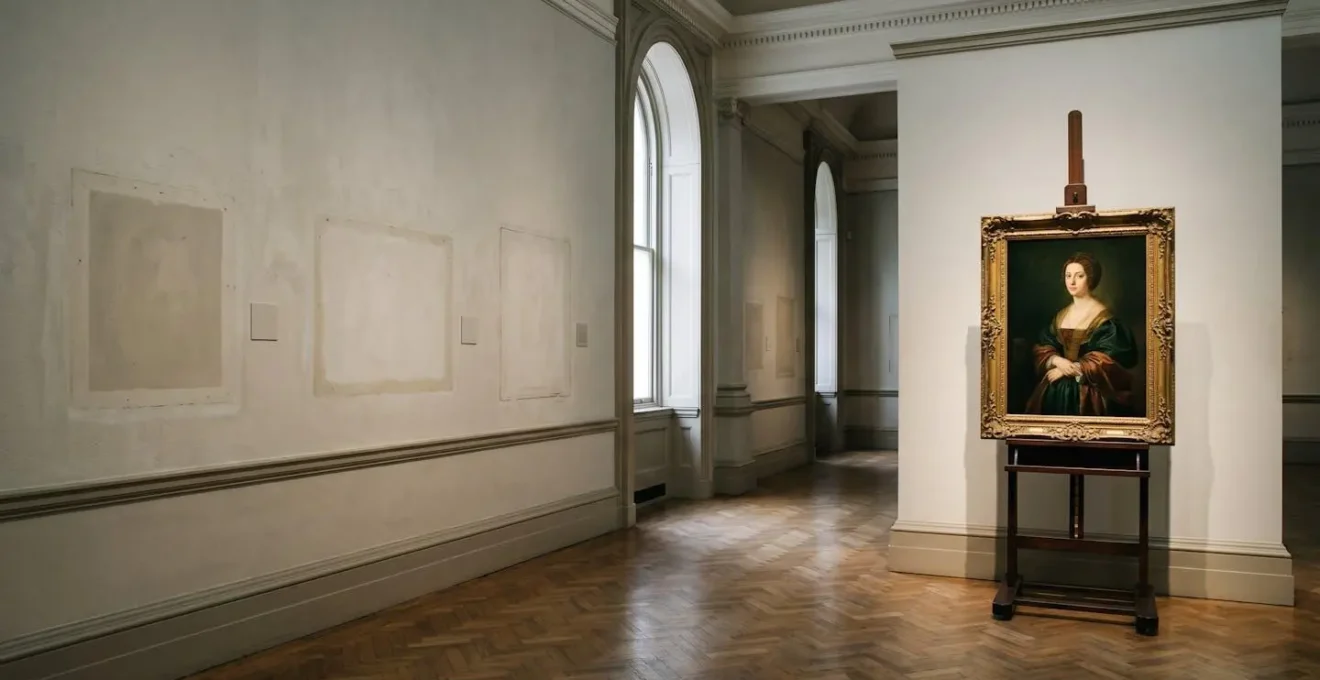
Selling museum art to pay the bills isn’t a lifeline; it’s a Faustian bargain that trades temporary financial relief for the permanent loss of institutional integrity.
- Ethical frameworks and UK law strictly forbid selling collections to cover operational deficits, viewing it as a breach of public trust.
- The real-world consequences, seen in cases like the Northampton Sekhemka statue, include loss of accreditation, donor flight, and long-term reputational ruin.
Recommendation: The focus must shift from selling assets to exploring sustainable funding and alternative models that preserve the collection’s integrity.
The lights are flickering in the halls of Britain’s museums. Faced with crippling budget cuts and soaring operational costs, a seemingly pragmatic solution presents itself: selling a single, high-value piece from the permanent collection to secure the institution’s future. It is framed as a painful but necessary choice, a sacrifice of one for the good of the many. This logic, however, is a siren song leading towards an ethical abyss. The act of deaccessioning an artwork to cover a financial shortfall is not merely a transaction; it is a fundamental betrayal of a museum’s core purpose.
This is not a simple debate about balancing the books. It is a profound question about the very soul of these institutions. When a museum sells a piece of its collection, it is not just liquidating an asset. It is severing a bond of public trust that was forged over generations, a trust predicated on the principle of permanence. The real question is not whether a museum *can* sell its collection to survive, but whether what survives is still a museum in the truest sense of the word. The cure, in this case, may be far more destructive than the disease itself.
This article will not simply lament the loss of funding. Instead, it will dissect the intricate legal, ethical, and reputational consequences of using permanent collections as a financial safety net. By examining the stringent rules, the catastrophic case studies, and the deep community bonds at stake, we will explore why this path, once taken, leads not to salvation, but to a permanent hollowing out of our cultural institutions.
Summary: Why UK Museums Selling Art Is More Than a Financial Decision
- Can a Public Museum Legally Sell a Donated Painting in the UK?
- Does Selling One Masterpiece Lead to Emptying the Whole Gallery?
- Electricity Bills vs Art: Is Selling Justified to Keep the Lights On?
- The Mistake of Ignoring Local Community Attachment to Specific Works
- Shared Ownership: Could Museums Co-Own Works Instead of Selling Them?
- Saving National Treasures: Which Artworks Are Being Blocked from Leaving the UK?
- Sackler and BP: How Toxic Philanthropy Is Being Removed from the Arts?
- How Do Curators Decide Which Artists Enter National Collections Permanently?
Can a Public Museum Legally Sell a Donated Painting in the UK?
In the United Kingdom, the legal framework governing the sale of collection items is exceptionally stringent, especially for national institutions. These museums are not private corporations with assets to liquidate; they are stewards of a national collection held in public trust. Most are governed by their own specific Acts of Parliament that severely restrict their power to dispose of objects. While the Charities Act 2022 introduced provisions for some charities to restitute objects on moral grounds, it was made clear that this would not apply to the UK’s major national museums.
This position was reinforced in a letter from the government’s culture minister, Lord Parkinson of Whitley Bay, to the Charity Commission. As he stated, the government’s policy is firm:
The policy of HM Government is that national museums and galleries should continue to be bound by their governing legislation, precluding them from resolving to restitute objects from their collections other than in the limited and specific circumstances expressly provided for in legislation.
– Lord Parkinson of Whitley Bay, Department for Culture, Media and Sport
This legal firewall exists to protect the integrity and permanence of the national collection. While non-national museums have slightly more flexibility, any sale is still governed by strict ethical codes that forbid deaccessioning for financial or operational reasons. Therefore, while legally complex, the overarching principle is clear: the collection is not a piggy bank.
Does Selling One Masterpiece Lead to Emptying the Whole Gallery?
The fear is not merely about one empty space on a gallery wall; it is about the “reputational cascade” that follows. The “slippery slope” argument is not a hypothetical fallacy in the museum world; it is a documented reality. When a museum breaches the fundamental trust that it will care for its collection in perpetuity, the consequences are swift, severe, and long-lasting. There is no clearer cautionary tale in the UK than the 2014 sale of the Sekhemka statue by Northampton Borough Council.
Case Study: The Reputational Cost of the Northampton Sekhemka Statue Sale
In July 2014, Northampton Borough Council sold a 4,000-year-old Egyptian statue of Sekhemka for £15.76 million, citing the need to fund museum modernisation. The sector’s response was immediate and unified condemnation. Just weeks later, Arts Council England (ACE) stripped the museum of its accredited status, a devastating blow. This ruling, which lasted eight years, effectively made the institution a pariah. It was barred from applying for grants from ACE, the Art Fund, and other major funders, crippling its ability to acquire new works, fund educational programs, or undertake capital projects. The short-term financial gain resulted in long-term institutional isolation, proving that the cost of such a sale is measured not just in pounds, but in credibility and future potential.
This event shattered the delicate ecosystem of trust between museums, donors, and funding bodies. A collection is built on the promise of permanence, a promise made to artists, donors, and the public. When that promise is broken, it creates a chill that affects the entire sector. Potential donors become wary, rightly questioning whether their gift will be cared for or simply sold off to the highest bidder when the next budget crisis hits.
The visual of an empty plinth is powerful, but the invisible damage—the evaporated goodwill, the withdrawn philanthropic support, the closed doors of funding bodies—is far more catastrophic. It suggests that emptying a gallery begins not with the last picture being sold, but with the first promise being broken.
Electricity Bills vs Art: Is Selling Justified to Keep the Lights On?
The argument seems pragmatic: if the choice is between selling a painting and closing the doors forever, isn’t the decision obvious? This binary choice, however, is a false dichotomy that ignores the foundational ethics of the museum sector. The purpose of a museum is not simply to “keep the lights on”; it is to preserve and interpret a collection in public trust. Using that very collection to pay for operational costs like electricity bills is a direct contradiction of that purpose.
The Museums Association’s Code of Ethics is unequivocal on this point. It allows for deaccessioning only under very specific, curatorially-led circumstances, such as when an object is a duplicate, in poor condition, or no longer fits the museum’s mission. Crucially, as one report notes, the ethical considerations prevent the sale of the core collection and strictly prohibit using any proceeds to cover short-term deficits. This isn’t an arbitrary rule; it’s a structural safeguard to prevent collections from being treated as convertible assets.
Furthermore, the narrative of absolute financial desperation can be misleading. While local council funding has been decimated, structural support systems still exist. Arts Council England, for instance, continues to invest heavily in the sector. This long-term investment framework demonstrates that the goal is to build sustainable institutions, not to provide a backstop for those who choose to sell off their most valuable, non-renewable resource. To sell an artwork to pay a utility bill is to trade a permanent cultural asset for a temporary financial fix—a bargain that no responsible steward could ever justify.
The Mistake of Ignoring Local Community Attachment to Specific Works
An artwork’s value is not solely determined by an auctioneer’s gavel; it is also measured in the intangible currency of community identity, memory, and pride. To a museum’s administration, a painting might be an entry on a balance sheet. To the community it serves, it can be a landmark, a point of local pride, or the backdrop to a thousand school trips and family visits. Ignoring this deep, emotional attachment is one of the most profound mistakes a museum can make.
The public’s connection to these institutions remains incredibly strong. In the UK, the sustained interest is clear, with 3.5 million visits to DCMS-sponsored museums in March 2024 alone. This demonstrates that collections are not gathering dust in empty halls; they are living parts of the community. When a decision to sell is made behind closed doors, it is perceived as an act of profound disrespect to this engaged public.
The Voice of the Community: The Northampton Sekhemka Statue
The public backlash against the sale of the Sekhemka statue was not an afterthought; it was a powerful, organised campaign. The “Save Sekhemka Action Group” conducted its own survey which revealed overwhelming local support for keeping the statue to protect the museum’s accredited status. A local newspaper poll found the same majority sentiment. Despite this clear expression of community will, the council proceeded with the sale, treating public opinion as an inconvenient obstacle rather than a vital consideration. This alienation of the very community the museum is meant to serve is a recurring feature in controversial deaccessioning cases, leaving a legacy of bitterness that can last for decades.
This disconnect reveals a dangerous managerial mindset: one that sees the public as passive consumers rather than active stakeholders. The financial cost of losing accreditation is quantifiable, but the cost of losing the public’s trust and affection is incalculable. A museum that severs its ties with its community to secure a short-term financial gain is a museum that has forgotten whom it exists to serve.
Shared Ownership: Could Museums Co-Own Works Instead of Selling Them?
If the outright sale of artworks is an ethical minefield, then the crisis demands more creative and collaborative thinking. Instead of permanent alienation, could models of shared ownership or long-term loans provide a lifeline? The UK is uniquely positioned to pioneer such solutions. The British art market is not a minor player; it is a global powerhouse. With 17% of the global art market and $10.9 billion in sales in 2023, the nation possesses an unparalleled network of expertise, logistics, and institutional relationships.
This sophisticated ecosystem, comprising thousands of businesses and professionals, provides the necessary infrastructure to facilitate complex arrangements. Imagine a scenario where a struggling regional museum, instead of selling a masterpiece, partners with a larger national institution or a consortium of international museums. This could take the form of a fractional ownership sale, where the museum retains a partial stake and curatorial rights while receiving a cash infusion. Alternatively, a paid long-term loan could see the work travel to other institutions, generating income and raising the profile of its home museum without severing the tie of ownership.
These models transform an artwork from a static asset to be liquidated into a dynamic one that can build partnerships and generate revenue while remaining part of the national heritage. They require a shift in mindset from “own or sell” to “partner and share.” In an interconnected world, leveraging the UK’s market strength to build collaborative networks is a far more sustainable and ethically sound strategy than slowly dismantling collections piece by piece.
Saving National Treasures: Which Artworks Are Being Blocked from Leaving the UK?
The deaccessioning debate is tragically ironic when viewed alongside the UK’s robust mechanisms for *preventing* art from leaving the country. Each year, the Reviewing Committee on the Export of Works of Art and Objects of Cultural Interest (RCEWA) places temporary export bars on “national treasures” sold to overseas buyers, providing a window for UK institutions to raise matching funds. This system is a powerful statement of national policy: that some cultural objects are too important to be lost. Yet, this policy of retention sits in awkward tension with the reality of deaccessioning at a local level.
We are witnessing a system working at cross-purposes. On one hand, the government actively tries to keep masterpieces within our borders. On the other, chronic underfunding pressures some institutions to consider selling their own treasures. The crisis is not just one of selling, but also of buying. Many UK museums, even when an export bar is issued, are simply unable to raise the funds to acquire new works. The “chilling effect” of the Northampton debacle has made the entire sector reticent to engage in deaccessioning, but it has not solved the underlying financial pressures.
As the Institute of Art and Law noted, the sector has been noticeably cautious since Northampton. This caution is a double-edged sword. While it has prevented a flood of unethical sales, it also means institutions are trapped, unable to strategically refine their collections or respond to acquisition opportunities. They are frozen, unable to sell and unable to buy, leading to a slow, creeping stagnation that is its own form of collection degradation.
Sackler and BP: How Toxic Philanthropy Is Being Removed from the Arts?
The debate over deaccessioning does not exist in a vacuum. It is part of a wider, urgent conversation within the arts about ethical integrity and the source of museum funding. In recent years, institutions worldwide have grappled with the moral stain of “toxic philanthropy”—donations from individuals or corporations, like the Sackler family or BP, whose wealth is seen as derived from social or environmental harm. The decision by major museums, including the Tate and the National Portrait Gallery, to sever ties with these donors was a landmark moment.
This movement to “cleanse” the museum of tainted money provides a crucial parallel to the deaccessioning debate. Both issues force an institution to ask a fundamental question: what compromises are we willing to make for financial stability? Rejecting a multi-million-pound donation on ethical grounds is a financially painful act, but it is one taken to protect the museum’s reputation and moral standing. It is a declaration that the institution’s values are not for sale.
How, then, can a museum that righteously rejects “dirty money” from an external source justify the sale of an artwork, an object from its own “clean” and protected core? The logic is inconsistent. If the ethical integrity of the institution is paramount when accepting funds, it must be even more so when considering the disposal of the very collection it is sworn to protect. The struggle against toxic philanthropy has forced museums to define their ethical red lines. Deaccessioning for operational gain crosses the exact same line.
Key Takeaways
- Deaccessioning for operational costs violates core museum ethics and UK policy, viewing the collection as a non-renewable public trust.
- The reputational damage from a controversial sale—including loss of accreditation and donor trust—can far outweigh any short-term financial gain.
- Community attachment is an intangible but critical asset that is permanently destroyed by sales that ignore local sentiment and heritage.
How Do Curators Decide Which Artists Enter National Collections Permanently?
To fully comprehend the tragedy of a sale, one must first appreciate the miracle of an acquisition. An artwork does not simply arrive in a national collection by chance. Its entry is the culmination of a rigorous, scholarly, and deeply considered process that can take years. Curators, as specialists in their field, are engaged in a constant, strategic effort to build a collection that is not just a random assortment of beautiful objects, but a coherent and meaningful narrative of our culture.
The decision to acquire a work involves a multi-layered assessment. First, there is the question of art-historical significance: Does this work fill a gap in the collection? Does it represent a key moment in an artist’s career or a wider cultural movement? Second, there is the issue of provenance and condition: Is its history known and its physical state stable enough for long-term preservation? Third, and perhaps most importantly, there is the strategic vision: How does this work speak to the existing collection? What new conversations and connections will it spark? This process involves peer review, trustee approval, and painstaking research.
This careful, long-term thinking is the absolute antithesis of the short-term, reactive logic of selling for cash. The acquisition process is an act of profound optimism—a belief that this object has something to say to future generations. Deaccessioning to cover a deficit is an act of pessimism—a declaration that the present financial emergency is more important than that future conversation. It disrespects the careful work of generations of curators who built the collection, and it robs future curators of the tools with which they can tell our story.
The challenge for every museum director, trustee, and policymaker today is to look beyond the immediate pressures of the balance sheet. They must reaffirm their institution’s fundamental purpose: to be a permanent steward of our shared culture, not a temporary holder of disposable assets. The Faustian bargain of selling a piece of the soul to keep the body alive is one that our cultural heritage cannot afford.