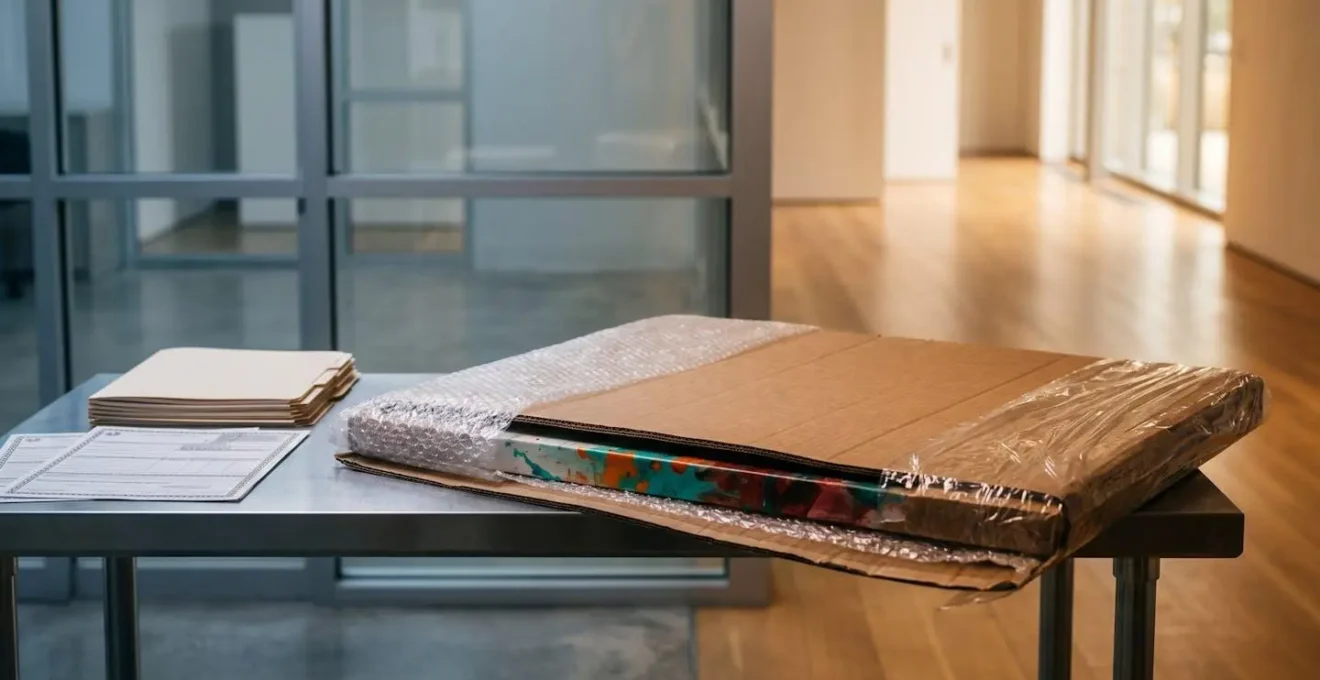
In summary:
- Brexit has added significant costs (VAT, tariffs) and paperwork (ATA Carnets), but these are manageable with proper planning.
- Strategic scheduling, including time buffers and exploring alternative routes to Dover, is now non-negotiable for meeting deadlines.
- Mastering the new rules, from freeport storage to understanding hidden license requirements, is key to retaining and growing your European collector base.
For UK artists and gallerists, the dream of a seamless European art market feels like a distant memory. What was once a simple matter of booking a courier has morphed into a daunting mountain of paperwork, unexpected costs, and logistical nightmares. Many are experiencing a deep-seated “paperwork fatigue,” tempted to retreat from the complexities of shipping work to collectors and fairs across the Channel. The common refrains are familiar: it’s too expensive, the delays are unpredictable, and the rules are hopelessly complex.
But while these challenges are real, viewing them as insurmountable roadblocks is a strategic error. The new landscape of UK-EU art logistics is not just a series of bureaucratic hurdles; it’s a new system with its own logic. The key isn’t to simply ‘deal with’ the paperwork, but to understand the underlying mechanics of the system. This is no longer a purely logistical task; it has become a crucial element of your business strategy.
This guide reframes the problem. Instead of a list of complaints, it offers a functional roadmap. We will break down each major point of “strategic friction”—from VAT and tariffs to customs bottlenecks—and provide actionable solutions. By mastering these new rules, you can not only mitigate costs and delays but also turn your logistical competence into a competitive advantage, ensuring your work continues to reach its European audience.
This article provides a comprehensive overview of the new logistical landscape for UK artists. Below is a summary of the key areas we will cover to help you build a robust shipping strategy for the European Union.
Contents: Your guide to mastering UK-EU art logistics
- VAT and Tariffs: How Much Extra Will It Cost to Ship a Painting to Paris?
- Carnet ATA: What Documents Do Artists Need to Exhibit Temporarily in the EU?
- Dover Bottlenecks: How to Plan Shipping Times for Art Fairs?
- The Mistake of Ignoring European Collectors due to Paperwork Fatigue
- Freeports and Warehouses: Where to Store Art to Avoid Double Taxation?
- When to Start Negotiating International Art Loans for a Major Retrospective?
- The Error of Ignoring New Export Licenses for Contemporary Works Post-Brexit
- Why Is the UK Visual Arts Market Outperforming Europe despite Economic Headwinds?
VAT and Tariffs: How Much Extra Will It Cost to Ship a Painting to Paris?
The most immediate and painful change for UK artists selling to the EU is the sudden appearance of new taxes. Before Brexit, shipping a painting to Paris was a simple domestic transaction within the Single Market. Now, it’s an international export, and that means dealing with import Value Added Tax (VAT) and potential customs fees. This isn’t just an administrative task; it’s a direct, new cost that must be factored into your pricing and negotiations with buyers. Ignoring this can erode your profit margin or, worse, lead to a piece of art being held at customs, creating a frustrating experience for your collector.
The core issue is that your artwork is now subject to the import VAT rate of the destination country. These rates vary across the EU. For example, as a case study in post-Brexit costs shows, France applies a reduced rate on imported art. While the UK also has a low rate, the crucial difference is this tax is now an additional cross-border cost that simply didn’t exist before. For a £5,000 painting shipped to France, this could mean an extra £286 in VAT, on top of which you must add customs broker fees, which can range from £50 to £150. This new financial burden makes understanding the specific rules of your target market absolutely essential.
It’s crucial to be transparent with your European buyers about these costs. Clearly state on your invoice that the client is responsible for any import duties and taxes in their home country. Better yet, work with a customs broker or specialist art shipper who can provide an accurate quote for all “landed costs” upfront. This professionalises the transaction and prevents any unwelcome financial surprises for your collector, preserving a vital relationship.
Carnet ATA: What Documents Do Artists Need to Exhibit Temporarily in the EU?
If you’re not selling a work but moving it temporarily for an exhibition, art fair, or loan, the ATA Carnet is your most critical tool. Think of it as a passport for your art, a single document that allows goods to pass through customs in multiple countries without paying import duties or taxes. Since Brexit, the UK is no longer part of the EU customs union, making the ATA Carnet a non-negotiable requirement for temporary movements into Europe. Attempting to travel without one is a recipe for disaster, risking severe delays, fines, or even the seizure of your work at the border.
The Carnet simplifies customs procedures by providing a single set of documents for the entire journey. However, obtaining one involves more than just filling out a form. You must provide a detailed list of all items, including descriptions, weights, and commercial values. The most significant and often overlooked requirement is the security deposit. To obtain a Carnet, you must provide a guarantee to the issuing body, typically the Chamber of Commerce. This is to cover any customs duties that would be due if the goods were not re-exported. According to British Chambers of Commerce requirements, this security can be as high as 40% of the goods’ total value, which can be a substantial upfront cost for high-value artworks.
This image highlights the tactile, official nature of the documentation you’ll be handling. Each page of the Carnet must be stamped by customs officials upon entering and exiting each country. A missed stamp can invalidate the entire document and lead to significant financial penalties. Therefore, it is crucial that you or your driver understands the process and ensures every necessary validation is obtained. This meticulous attention to detail is the price of smooth passage in the post-Brexit era.
Dover Bottlenecks: How to Plan Shipping Times for Art Fairs?
Time is a luxury artists and galleries can no longer afford when shipping to EU art fairs. The days of a predictable 24-hour journey from a London studio to a Parisian gallery are over. The port of Dover, the main artery for UK-EU trade, has become a notorious symbol of post-Brexit “strategic friction.” Increased customs checks, paperwork discrepancies, and sheer volume have created a volatile environment where delays are the norm, not the exception. For an artist with a strict installation deadline for Art Basel or Frieze, this unpredictability is a major source of stress and financial risk.
A proactive, defensive planning strategy is the only solution. You must now think in terms of weeks, not days, and build significant buffers into your timeline. Forgetting to do so can result in your work arriving after the fair has already opened, a costly and embarrassing failure. Specialist art shippers have had to completely rewrite their timetables. One key insight is the need to evaluate alternative routes to bypass the congestion at the Dover-Calais crossing. The Hull-Rotterdam route, for example, offers proximity to Dutch art handling specialists, while Portsmouth-Le Havre provides more direct access to France with fewer commercial truck delays. This is a form of logistical arbitrage—using knowledge of the new system to find a more efficient path.
Your Shipping Plan Audit: A Post-Brexit Checklist
- Points of Contact: List every party involved in the shipment—your studio, the customs broker, the freight forwarder, the receiving gallery, and the art fair’s logistics team. Ensure you have 24/7 contact details for each.
- Document Collection: Inventory every piece of paper needed. Is the ATA Carnet complete and correct? Do you have proof of valuation, high-resolution images of the work, and the exhibition invitation letter? This is your “Shipper’s Emergency Packet.”
- Timeline Coherence: Review your schedule. Have you confronted it with the new reality? Add a buffer of at least 30-40% extra time for potential customs delays compared to pre-Brexit timelines. A 3-day crossing is the new baseline.
- Risk Assessment: Identify your biggest vulnerabilities. Is your driver inexperienced with Carnet stamping? Is the artwork’s valuation ambiguous? Pinpoint the most likely points of failure and create a contingency plan for each.
- Integration Plan: Create a final reverse timetable, starting from the fair’s installation day and working backward. Integrate your time buffers and contingency plans into this master schedule. Share it with all points of contact.
The case study below illustrates the necessity of this new mindset, where extended transit times and the need for enhanced climate control on vehicles idling in queues are now standard operational considerations.
Case Study: Alternative Port Routes Analysis
Art logistics specialists now recommend evaluating alternative routes to avoid Dover-Calais congestion. Hull-Rotterdam offers less congestion with proximity to specialist art handling facilities in the Netherlands, while Portsmouth-Le Havre provides direct access to France with fewer commercial vehicle delays. Shipping times increased significantly post-Brexit: officials stated customs queues at Dover would be longer, requiring shippers to have multiple drivers per truck to comply with workers’ hours regulations, and vehicles need enhanced climate control for extended idle periods during customs processing.
The Mistake of Ignoring European Collectors due to Paperwork Fatigue
The cumulative effect of new taxes, complex documents, and shipping delays has created a widespread “paperwork fatigue” among UK artists and galleries. The process can feel so overwhelming and costly that the path of least resistance—focusing solely on the domestic market and disengaging from Europe—can seem tempting. This is, however, a profound strategic mistake. The European Union remains a deep, knowledgeable, and enthusiastic market for British art. Willfully cutting yourself off from this network of collectors, curators, and institutions is a form of self-imposed isolation that can severely limit your career’s trajectory.
The frustration is understandable. The financial impact is not trivial; as reported by Artsy, some dealers have seen logistics costs become more than four times higher than before Brexit. This sharp increase in the cost of doing business is a powerful deterrent. But the solution isn’t to retreat; it’s to adapt and professionalise. The artists and galleries who thrive in this new environment will be those who see mastering logistics not as a chore, but as a key part of their client service. Providing a seamless, transparent, and hassle-free buying experience for a European collector is now a powerful differentiator.
Remember what’s at stake: the human connection. The image above isn’t just about a transaction; it’s about a collector engaging thoughtfully with your work. Every bureaucratic hurdle you overcome is in service of making this moment possible. Instead of being discouraged by the paperwork, reframe it as the necessary scaffolding that supports your creative and commercial relationships across Europe. Your willingness to navigate this complexity signals a commitment to your European audience that they will recognise and value.
Freeports and Warehouses: Where to Store Art to Avoid Double Taxation?
For artists and galleries with significant EU sales or exhibition schedules, a more advanced strategy involves rethinking the very location of their inventory. Shipping art back and forth across the UK-EU border for every sale or show is inefficient and costly, triggering potential tax events with each crossing. This is where strategic storage solutions like freeports and bonded warehouses come into play. These facilities are secure zones where goods can be stored, bought, and sold without incurring immediate import VAT or customs duties.
This is a prime example of “logistical arbitrage.” By placing your work inside an EU-based freeport, such as those in Luxembourg or Geneva, you can make it available for sale to European collectors as if it were already in the Single Market. A sale from the freeport to a buyer in Germany, for instance, avoids UK export and German import procedures, simplifying the process and deferring the VAT payment until the work is finally delivered to the collector. This strategy transforms a logistical headache into a competitive advantage, offering EU clients a frictionless buying experience.
Case Study: UK and EU Freeport Strategic Positioning
Before and since Brexit, gallery owners, auction houses and collectors have moved a large part of their inventory within the EU to capitalize on strategic storage locations. Luxembourg and Geneva freeports offer consolidated storage options for emerging artists at shared facility rates, allowing works to remain available for EU sales without immediate VAT payment. The new UK freeports (Teesside, Liverpool) can serve as global hubs—not just European—for receiving art from the EU for UK shows or consolidation before shipping to the US or Asia, repositioning the UK as a strategic intermediary rather than solely an EU market player.
The new UK freeports add another layer to this strategy. An artist could, for example, consolidate works from various EU exhibitions at a UK freeport before shipping them to an art fair in the United States or Asia, using the UK as a strategic global hub rather than just a domestic base. This approach requires forward-thinking and a solid relationship with a logistics partner, but it represents the pinnacle of adapting to the post-Brexit reality: using the new system’s rules to create a more efficient and globally competitive business model.
When to Start Negotiating International Art Loans for a Major Retrospective?
The complexity of post-Brexit logistics is magnified tenfold when dealing with institutional loans for major exhibitions. A retrospective involving dozens of works from public and private collections across Europe is a multi-year undertaking, and Brexit has injected a new layer of legal and logistical risk that demands a significantly longer planning horizon. The old timelines are obsolete. Curators and registrars must now work in lockstep from the very beginning, as logistical feasibility is as important as curatorial vision.
The new benchmark for initiating these negotiations is a full 24 months before the exhibition opening. This extended lead time is necessary to accommodate the new realities of border friction. A crucial new element in loan agreements is the ‘Brexit Clause’. This clause must be meticulously negotiated to specify who bears the financial and logistical liability for customs delays, unexpected storage costs resulting from border hold-ups, or penalties arising from paperwork errors. Leaving this ambiguous can lead to serious disputes and financial losses for either the lending or borrowing institution.
Engaging customs brokers and specialist shippers at least a year and a half out is now standard practice. This entire process—from legal negotiation to insurance finalisation and customs valuation agreements—can take 6-8 months longer than it did before Brexit. Here is a condensed timeline for the modern international loan process:
- 24 Months Out: Begin parallel conversations with both the curator (for artistic selection) and the registrar (for logistical viability). Early engagement with the logistics team is now critical.
- 18-20 Months Out: Negotiate the ‘Brexit Clause’ in the loan agreement. Clearly define liability for any and all border-related delays or costs.
- 12-16 Months Out: Formally engage your customs broker and specialist art shipper. Start the long process of legal, insurance, and customs negotiations.
- 8-10 Months Out: Finalise the insurance policy, ensuring it specifically covers ‘customs delays’. Agree on a fixed customs valuation with the borrowing institution to prevent border discrepancies.
- 4-6 Months Out: Prepare all export documentation, including ATA Carnets where applicable, and pre-schedule customs clearance appointments.
- 1-2 Months Out: Execute the shipment with generous time buffers and ensure the driver has the ‘Shipper’s Emergency Packet’ for real-time problem-solving.
The Error of Ignoring New Export Licenses for Contemporary Works Post-Brexit
One of the most insidious post-Brexit traps for artists lies not in the obvious paperwork, but in regulations that seem entirely unrelated to their practice. While most contemporary art does not require a standard cultural export license, artists can be caught out by rules governing the materials used in their work. The most common and costly oversight is the CITES (Convention on International Trade in Endangered Species) regulations. A work can be stopped, seized, and even destroyed at a border if it contains even a tiny, un-credentialed fragment of a regulated material.
This is a critical blind spot for many. An artist might be fully compliant with VAT and Carnet rules, only to have a sculpture impounded because it incorporates a piece of a specific wood, shell, or other protected material. The key thing to understand is that CITES is material-based, not age-based. The regulations apply just as much to a brand-new contemporary artwork as they do to an antique. The case study of musical instruments provides a powerful parallel: a modern guitar containing Brazilian rosewood requires a specific permit, and the same logic applies to visual art.
Case Study: CITES Regulations, The Hidden License Trap
Even contemporary works that don’t require standard cultural export licenses can be stopped at borders if they contain regulated materials under CITES. Musical instruments containing materials such as ivory or Brazilian rosewood require a Musical Instrument Certificate (MIC) in the UK, normally free and valid for three years. The same principle applies to visual art: works containing tiny amounts of certain woods, ivory, shells, or other protected materials require separate CITES permits. This is a common and costly oversight that catches many artists unprepared, as the requirement is material-based rather than artwork-age-based.
The consequences of these new barriers are tangible. For instance, in the music world, the number of UK artists booked for European festivals have fallen by nearly a third, a direct result of increased costs and administrative hurdles. For visual artists, failing to audit your own materials for CITES compliance is to risk becoming another such statistic. Before any international shipment, you must conduct a thorough material audit of your work and apply for any necessary permits well in advance. Ignorance is not a valid defence at a customs checkpoint.
Key Takeaways
- Mastering Post-Brexit logistics is no longer optional; it’s a core business strategy for retaining European market access.
- Proactive planning is everything: build generous time buffers, explore alternative shipping routes, and prepare a “Shipper’s Emergency Packet” for every shipment.
- Strategic use of EU-based freeports and a thorough understanding of hidden requirements like CITES are advanced tactics that separate successful international artists from those left behind.
Why Is the UK Visual Arts Market Outperforming Europe despite Economic Headwinds?
The question of the UK art market’s performance post-Brexit is complex, and the headline “outperforming Europe” deserves careful scrutiny. While London’s art market infrastructure remains formidable, with its concentration of world-class galleries, auction houses, and experts, the raw data presents a more nuanced picture. The idea of simple outperformance is challenged by the fact that, in terms of global market share, the UK has faced setbacks. A 2022 report highlighted that in 2021 the UK’s market share dropped to third place globally, falling behind both the US and Greater China, a significant shift from its previous position as the EU’s undisputed leader.
The “headwinds” are not just economic; they are the direct result of the strategic friction detailed throughout this guide. The increased costs, administrative burdens, and logistical complexities have made it harder for London to function as a frictionless gateway to Europe. This has, in turn, prompted a strategic response from EU art market hubs like Paris, which have actively courted galleries and collectors by positioning themselves as the new, stable entry point to the Single Market. The narrative of UK “outperformance” is therefore less about outpacing Europe in raw growth and more about the market’s resilience and strategic adaptation in the face of these new challenges.
Rather than simply competing with Europe, the UK market is repositioning itself. As seen with the development of new freeports, the strategy is shifting towards serving as a unique global hub, an intermediary connecting the EU, the Americas, and Asia. For individual artists and galleries, this macro trend holds a vital lesson. Success is no longer about relying on the old, easy channels. It’s about embodying this spirit of resilience and strategic adaptation. It means understanding the new rules of engagement so thoroughly that you can navigate them efficiently, allowing you to continue building relationships and selling work across Europe while others are still complaining about the paperwork.
Ultimately, navigating the post-Brexit landscape is not just a test of patience, but a test of professionalism. By embracing these challenges with a strategic, problem-solving mindset, you can ensure that borders and bureaucracy do not stand between your art and its audience. The next logical step is to audit your own practices against this new reality.