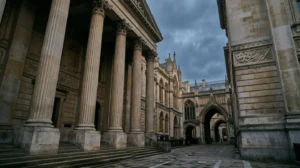
Beneath the headlines of funding cuts and diversity targets, a deliberate political recalibration of the UK’s cultural landscape is underway, forcing a high-stakes confrontation between institutional survival and ethical principles.
- The “Levelling Up” agenda promises geographic rebalancing but is undermined by precarious funding and political volatility, leaving regional arts in a state of uncertainty.
- Institutions face a pincer movement: state funding shrinks while public pressure mounts to reject “toxic” corporate sponsorship, creating profound ethical and financial fault lines.
Recommendation: Professionals must look beyond individual issues and analyze the systemic connections between funding, ethics, and access to strategically navigate this new, contested terrain.
The UK’s art world is in a state of profound flux. For industry professionals and engaged citizens, tracking the changes can feel like watching a series of disconnected crises unfold: a funding announcement here, a sponsorship controversy there, a new diversity report somewhere else. The typical response is to focus on each event in isolation, lamenting budget cuts or celebrating the removal of a controversial donor’s name from a gallery wall. This approach, however, misses the bigger picture and the deeper currents driving these changes.
But what if these are not isolated incidents? What if the struggle over “Levelling Up” funds, the debate on museum admission fees, and the push to detoxify philanthropy are all symptoms of the same fundamental shift? The true challenge lies not in reacting to each headline, but in understanding the underlying political and economic forces that are actively reshaping what culture means in the UK and, crucially, who it is for. This is not merely a financial adjustment; it is a cultural recalibration that is creating new ethical fault lines and policy paradoxes for every institution in the country.
This analysis moves beyond the surface-level news to dissect the interconnected nature of these policy shifts. We will explore the precarious reality of regional arts funding, scrutinise the effectiveness of diversity initiatives, and examine the existential threats to free museum access. By connecting these dots, we can reveal the coherent, if often contradictory, logic of the UK’s new cultural landscape and equip arts professionals to navigate it more effectively.
This article provides a critical overview of the most significant policy shifts impacting the UK arts sector this year. The following summary outlines the key areas of analysis we will explore in detail.
Summary: Decoding the New Battlegrounds of UK Arts Policy
- Levelling Up: Is Arts Funding Really Moving North of London?
- Quotas or Organic Change: How Are Institutions Meeting New Diversity Standards?
- Saving National Treasures: Which Artworks Are Being Blocked from Leaving the UK?
- Free Entry under Threat: Will Major Museums Reintroduce Ticket Fees?
- When Will Union Disputes Impact Gallery Opening Hours?
- The Mistake of Ignoring Sponsorship from Controversial Corporations
- Sackler and BP: How Toxic Philanthropy Is Being Removed from the Arts?
- Can Socially Conscious Art Actually Drive Political Change in the UK?
Levelling Up: Is Arts Funding Really Moving North of London?
The “Levelling Up” agenda has been promoted as a historic correction to the UK’s London-centric cultural funding model. On the surface, the figures seem to support this narrative. The 2023-26 funding allocations from Arts Council England show a nominal 21.8% increase in investment to regions outside London compared to the previous period. This represents a significant redistribution of resources intended to bolster cultural infrastructure across the country. However, a closer look reveals a far more precarious and politically volatile reality, turning this geographic rebalancing act into a high-wire performance without a reliable safety net.
The fragility of this commitment was starkly exposed by the government’s own fiscal statements. As the Campaign for the Arts noted in its analysis of the Autumn 2024 budget, the government was “minded to cancel” previously announced funds, sending a chill through the sector. This wasn’t an empty threat. The handling of the Levelling Up fund for culture provides a clear example of this policy’s instability.
Case Study: The £100 Million Levelling Up Fund’s Partial Cancellation
In Spring 2024, the government announced £100 million in Levelling Up funding for major cultural projects, including the British Library North and National Museums Liverpool. By the Autumn budget, this was under threat of cancellation. Ultimately, only £67 million was confirmed. Six local authorities—Maldon, Redditch, High Peak, Erewash, Mendip, and North Northamptonshire—had their funding withdrawn entirely. This case study reveals the precarious nature of regional arts investment, where grand announcements can be quietly reversed, raising critical questions about which communities are genuinely prioritized beyond short-term political rhetoric and demonstrating the gap between policy promises and on-the-ground delivery.
This pattern of announcement and retraction suggests that “Levelling Up” is less a long-term strategic investment and more a tool of political expediency. For arts organisations outside the capital, it creates an environment of profound uncertainty, making it nearly impossible to plan for the future with confidence. The policy creates the appearance of progress while retaining the power to withdraw support at a moment’s notice, leaving regional culture in a perpetual state of dependence and anxiety.
Quotas or Organic Change: How Are Institutions Meeting New Diversity Standards?
Alongside shifts in funding, there is increasing pressure on UK cultural institutions to address their historic lack of diversity. Policy is moving towards tying public funding to demonstrable progress in inclusion, both in the workforce and in programming. However, the data reveals a sector struggling to move beyond tokenism towards meaningful, structural change. The core question is whether new standards are driving organic transformation or simply creating a new bureaucracy of quota-filling.
The challenge is immense. Despite years of initiatives, the leadership and curatorial ranks of most major institutions remain overwhelmingly white. According to Arts Council England data, a mere 6% of museum workers identify as Black, Asian, or ethnically diverse. This statistic highlights a systemic failure in recruitment, retention, and promotion pipelines. The risk is that institutions respond with quick fixes—hiring for optics or creating junior roles without real power—rather than addressing the underlying cultural and structural barriers.
As the image above suggests, the goal is not just to have diverse faces in the room, but to foster an environment where diverse perspectives genuinely shape curatorial decisions and institutional strategy. True change requires more than meeting a percentage; it requires a fundamental shift in power structures, a re-evaluation of what expertise is valued, and a sustained commitment to nurturing talent from underrepresented communities. Without this deeper work, diversity standards risk becoming another metric to be managed rather than a catalyst for a more equitable and representative cultural sector.
Your Action Plan: Auditing Diversity Beyond the Numbers
- Pipeline Analysis: Map where diverse talent is sourced from, where applications drop off, and at what career stage employees from underrepresented backgrounds leave the organisation.
- Power Structures: Inventory who holds budget and decision-making power. Review the composition of boards, senior leadership teams, and key programming committees.
- Cultural Audit: Conduct anonymous staff surveys focused on psychological safety, feelings of inclusion, microaggressions, and perceived opportunities for professional growth.
- Content & Curation Review: Analyse the diversity of artists, historical narratives, and cultural perspectives represented in the public-facing programme over the last three years.
- Community Engagement Assessment: Evaluate whether partnerships and outreach programmes genuinely serve and build relationships with underrepresented local communities or function as tokenistic gestures.
Ultimately, the pressure of new standards forces a choice: will institutions perform diversity for the sake of funding, or will they undertake the difficult internal work required to build a truly inclusive culture from the ground up? The answer will determine the sector’s legitimacy for a generation.
Saving National Treasures: Which Artworks Are Being Blocked from Leaving the UK?
The UK’s art export control system, governed by the Waverley criteria established in 1952, is designed to prevent artworks of outstanding national importance from being sold abroad. When a work is deemed a “national treasure,” a temporary export bar is placed on it, giving UK institutions a window to raise funds to acquire it at a fair market price. In theory, this policy protects the nation’s heritage. In practice, it is a system on the verge of collapse, creating another policy paradox where the ambition to save treasures is consistently thwarted by a lack of financial capacity.
The system’s failure rate is alarming. A recent analysis revealed that more than half of items deemed national treasures end up leaving the country anyway. The reason is simple: UK museums, with their budgets squeezed by years of austerity, cannot compete with the global art market. The “fair market value” they are expected to match is often astronomical, set by international billionaires and state-backed institutions.
Case Study: The 31% Success Rate of 2024-25 Export Bans
The Arts Council’s annual report for 2024-25 paints a stark picture. Of 16 cases reviewed, 15 items were declared “national treasures.” However, UK institutions only managed to acquire five of them, including an Old French New Testament purchased by the Bodleian. This represents a success rate of just 31%. The system is identifying treasures but failing to keep them. As an editorial in The Art Newspaper pointed out, the previous year was even worse: “only six items were ‘saved for the nation’, at a total value of just over £500,000, a minuscule fraction of the numbers and values processed.” This highlights the growing chasm between the policy’s intent and its ability to function in a hyper-inflated art market.
This growing impotence raises fundamental questions about the policy’s future. Is it time to raise the financial threshold for what constitutes a “treasure” to focus resources on fewer, more significant works? Or does the state need to create a dedicated, substantially larger acquisition fund? Without a radical rethink, the UK will continue to watch its heritage drain away, piece by piece, blocked by a policy that has become more of a symbolic gesture than an effective safeguard.
Free Entry under Threat: Will Major Museums Reintroduce Ticket Fees?
The policy of free admission to national museums, introduced in 2001, is one of the most celebrated cultural achievements of the last quarter-century. It dramatically democratised access to the UK’s greatest collections. However, this cornerstone of public access is now under imminent threat, a victim of its own success and decades of declining state support. The debate over reintroducing admission fees, particularly for international tourists, has moved from the fringes to the centre of institutional strategy.
The financial pressure is undeniable. The 2001 policy led to an explosion in visitor numbers, with institutions like the V&A and National Museums Liverpool seeing attendance soar by 180% and 269% respectively. Yet, over the same period, government funding has failed to keep pace. Per-capita spending by the Department for Culture, Media and Sport (DCMS) has been slashed in real terms, leaving museums to manage crumbling infrastructure, like the British Museum’s leaking roofs that require a billion-pound renovation. This has created a state of managed decay, where doors remain open but buildings and collections are at risk.
The argument for charging certain visitors is becoming compelling. Official DCMS statistics show that 43% of UK national museum visitors are international tourists. Proponents argue that a modest fee or a broader hotel tax could generate vital revenue without compromising access for UK citizens. As V&A Director Tristram Hunt has argued, such a measure is critical for long-term viability. He stated his support for a hotel tax, suggesting “in London half of the resulting funds should be specifically allocated to free-entry institutions.” This represents a significant crack in the universal consensus around free entry, coming from the leader of a major national institution.
The shift is palpable. The question is no longer *if* the free entry model will be challenged, but *when* and *how*. The likely first step is the introduction of differential pricing for tourists, a model common in other European capitals. While this may seem like a pragmatic solution, it marks a profound departure from a universalist principle and could be the first step towards a future where access to national culture is once again determined by one’s ability to pay.
When Will Union Disputes Impact Gallery Opening Hours?
The visible impacts of policy shifts—funding cuts, building repairs, sponsorship debates—often overshadow a more latent but equally significant threat: workforce instability. As financial pressure on cultural institutions intensifies, the conditions for widespread industrial action are ripening. The question is not if union disputes will occur, but when they will begin to directly impact the public through reduced opening hours, gallery closures, and cancelled exhibitions.
The economic context is stark. While the government may announce nominal increases in arts funding, these figures often mask real-terms cuts when adjusted for inflation. For instance, the 2024 Autumn Budget revealed that DCMS day-to-day spending is projected to fall by 1.5% in real terms. This squeeze inevitably translates into pressure on the largest budget item for any museum or gallery: staffing. It leads to pay freezes, increased workloads, a reliance on insecure contracts, and redundancies, all of which fuel staff discontent and empower union action.
The atmosphere within many institutions is one of quiet precarity. The lone gallery attendant in a vast, empty space is a potent symbol of a workforce stretched thin, tasked with protecting priceless culture while facing an uncertain personal financial future. These are the front-line staff—technicians, curators, educators, and security personnel—whose passion and expertise are the lifeblood of the sector. As their goodwill erodes in the face of declining real wages and job security, the likelihood of coordinated industrial action grows. Past disputes at institutions like the National Gallery have provided a playbook, and unions are increasingly prepared to leverage public-facing disruption to achieve their goals.
For arts leaders, this represents a dangerous new front in the battle for survival. For the public, it could mean that access to culture is no longer just threatened by ticket prices, but by locked doors and picket lines. The simmering tension between institutional budgets and workforce rights is a direct consequence of long-term public defunding and is set to become a major disruptive force in the year ahead.
The Mistake of Ignoring Sponsorship from Controversial Corporations
In an era of intense ethical scrutiny, it has become common practice for arts professionals to publicly decry sponsorship from controversial corporations, particularly those in fossil fuels or pharmaceuticals. While this moral stance is understandable, ignoring the reasons why institutions accept this money is a strategic mistake. The reliance on corporate sponsorship is not a sign of moral failure but a direct symptom of a systemic funding crisis. To understand the problem, one must first acknowledge the desperation that drives these uncomfortable partnerships.
The context is one of radical state withdrawal. As parliamentary analysis shows, core grant-in-aid funding for UK arts organisations fell 18% in real terms between 2010 and 2023. This has created a massive financial vacuum that institutions have been forced to fill from other sources, primarily philanthropy and corporate sponsorship. The turn towards controversial donors is not a first choice; it is often the last resort to keep the lights on, fund major exhibitions, or run essential community outreach programmes.
This creates a profound ethical fault line for the sector. As one pragmatic analysis included in a parliamentary report noted, “without funding from sectors like oil and gas, many landmark exhibitions and community outreach programmes would simply cease to exist.” This is the stark reality that boards and directors face. The choice is often not between “clean” money and “dirty” money, but between “dirty” money and no money at all. Ignoring this dilemma allows for a simplistic narrative of corporate “artwashing” and institutional complicity, but it fails to address the root cause: a public funding model that is no longer fit for purpose.
Therefore, any meaningful critique of corporate sponsorship must be paired with a robust and realistic plan for alternative funding. Simply demanding that museums reject money without advocating for the large-scale public reinvestment needed to replace it is an incomplete and ultimately unhelpful position. It risks pushing institutions further into financial precarity while leaving the underlying problem of state defunding entirely unaddressed.
Sackler and BP: How Toxic Philanthropy Is Being Removed from the Arts?
The campaigns to remove the names of controversial donors like the Sackler family and BP from museum wings have been a major focus of arts activism. This process of “symbolic detoxification” is presented as a moral victory, cleansing institutions of their association with the opioid crisis or climate change. While significant, these high-profile removals are only the visible peak of a much larger and more complex shift in the ethics of fundraising. The definition of “toxic philanthropy” is rapidly expanding, creating new and unpredictable challenges for a sector already in a precarious financial state.
Institutions are caught in a pincer movement. On one side, public funding is shrinking. Research by the Art Fund found that while 51% of museums increased their earned income in 2023-24, 32% saw local authority funding decrease or stop entirely. On the other side, the pool of “acceptable” private and corporate donors is also shrinking under activist pressure. The battleground is moving beyond the obvious targets of oil and pharmaceuticals into new territory.
Case Study: The Baillie Gifford Precedent
In 2024, the Edinburgh Book Festival terminated its long-standing partnership with the investment firm Baillie Gifford. The move followed activist pressure over the firm’s investments in fossil fuels and companies linked to Israel. This case is critical because it extends the “toxic donor” label to a mainstream financial institution, far removed from the direct harm associated with Purdue Pharma or BP. It illustrates how activist scrutiny is now being applied to the entire investment portfolios of potential donors, creating a minefield of “guilt by association.” The decision left the festival with a significant funding gap and established a new, more stringent precedent for donor vetting across the entire arts sector.
The Baillie Gifford case signals the next frontier of the funding wars. As wealth from cryptocurrency, artificial intelligence, and social media platforms seeks the cultural legitimacy that art patronage provides, institutions will face even more complex due diligence. Without clear industry standards, they will be forced to make high-stakes decisions on a case-by-case basis, balancing the desperate need for funds against the ever-present risk of a public backlash. The removal of a name from a wall is the easy part; navigating the new, undefined landscape of ethical fundraising is the real challenge ahead.
Key Takeaways
- The “Levelling Up” agenda is more a precarious political balancing act than a stable funding reality, creating deep uncertainty for regional arts organisations.
- The crisis of “toxic philanthropy” is expanding beyond traditional targets, forcing institutions to vet a wider range of funders and confront the ethical cost of financial survival.
- The principle of free museum entry is at a breaking point, caught between its success in building audiences and the failure of state funding to keep pace with operational costs.
Can Socially Conscious Art Actually Drive Political Change in the UK?
In this contested landscape, many artists and institutions are turning to socially conscious work as a form of resistance and a tool for political change. But in a climate of increasing political polarisation and economic precarity, can this art truly make a difference? The power of the arts should not be underestimated. The cultural sector employs 703,000 people and contributes £30.6 billion to the UK economy, giving it a significant voice. However, its ability to use that voice for political critique is facing new and powerful constraints.
Art that engages with contentious political issues, from climate change to international conflicts, is increasingly finding itself in the crosshairs. Institutions that display such work risk being labelled as partisan, jeopardising their public funding and alienating potential donors. This creates a chilling effect, where self-censorship becomes a pragmatic survival strategy. As a recent Freemuse report noted, the conflict in Gaza has had a direct impact on artistic freedom in the UK. The report states, “The Israeli-Gaza war has also affected freedom of expression in some countries, most notably in Germany, the USA, and the UK, with visual arts most affected.” When political speech becomes a financial risk, the space for dissent narrows.
This does not mean that socially conscious art is powerless. Its strength often lies not in direct policy change, but in its ability to shape public conversation, foster empathy, and create spaces for dialogue outside the rigid confines of party politics. It can provide the emotional and intellectual context that news headlines lack, making complex issues feel personal and urgent. It can build solidarity among communities and offer new ways of imagining the future. The impact of art is rarely linear or immediate; it works by slowly shifting perceptions and values over time.
The challenge for socially conscious art in the UK today is to operate within these closing constraints without losing its critical edge. It must find new languages and strategies to navigate the ethical fault lines of a sector under pressure. Its power lies not in shouting louder, but in its unique ability to ask uncomfortable questions and to hold a mirror up to society, forcing a reflection that politics often seeks to avoid.
To effectively navigate this new terrain, professionals must move beyond reacting to individual crises and begin strategically analyzing these interconnected policy shifts to anticipate challenges and identify opportunities for resilient leadership.