Contrary to popular belief, the effectiveness of political art isn’t measured in headlines or shock value, but in its capacity for strategic subversion and genuine structural change.
- Disruptive protests, while publicly unpopular, successfully shift the political conversation and increase support for moderate factions (the “radical flank effect”).
- True impact comes from moving beyond performative gestures to embed change within institutions, from diversifying staff to rejecting toxic funding.
Recommendation: To enact real change, artists and activists must shift focus from simply representing a problem to becoming an active part of its solution through co-creation and institutional critique.
Does throwing soup on a masterpiece enact political change, or does it merely alienate the public? This question, ricocheting across the UK’s cultural landscape, reduces a complex debate to a simplistic binary. We are often told that art has the power to “raise awareness” or “spark dialogue,” but these platitudes fail to interrogate the mechanics of actual influence. They ignore the uncomfortable truth that much of what passes for political art is performative, a fleeting gesture easily absorbed and neutralised by the very systems it purports to challenge. The real conversation is not about whether art *can* be political, but about what makes it *effective*.
The assumption is that visibility equals impact. Yet, as we will explore, the most profound changes often occur away from the cameras. This is a philosophical inquiry into efficacy. What if the true power of socially conscious art lies not in the disruptive spectacle, but in a deeper, more strategic engagement with the structures of power? We must move beyond judging art by its declarative statements and start assessing it by its structural consequences. Does it challenge who gets to make art, who is seen, how institutions are funded, and who a public space truly belongs to? This analysis will dissect the paradoxes of art activism, from the counterintuitive success of radical protest to the quiet revolution happening in community-led projects. We will navigate the treacherous terrain of institutional hypocrisy and self-censorship to uncover where authentic change is being forged. The goal is not to provide a simple answer, but to equip you with a more critical framework for understanding art’s role in the fight for a different future.
This article delves into the core tensions defining art’s political agency in the United Kingdom. Below, the summary outlines our journey from the confrontational front lines of gallery protests to the intricate backrooms of institutional funding and community planning.
Summary: The Efficacy of Socially Conscious Art in the UK
- Soup on Sunflowers: Is Vandalism in Galleries Effective Protest or Alienation?
- Woke-Washing: How to Spot Institutions That Fake Social Commitment?
- Cancel Culture: Are Galleries Self-Censoring Controversial Works?
- The Mistake of Overloading Visitors with Guilt instead of Inspiration
- Sackler and BP: How Toxic Philanthropy Is Being Removed from the Arts?
- How Do Modern Portraits Critique British Class Structure differently than in the past?
- Consultation or Imposition: How to Get Locals on Board with Your Art?
- How to Propose and Execute a Public Installation Art Project in a UK City?
Soup on Sunflowers: Is Vandalism in Galleries Effective Protest or Alienation?
The spectacle of soup on Van Gogh’s Sunflowers immediately prompts a visceral reaction. It feels like a desecration, a nihilistic attack on culture itself. Unsurprisingly, the data appears to confirm this alienation. According to a 2023 YouGov poll, 68% of Britons disapprove of Just Stop Oil’s tactics, a figure that suggests such protests are a strategic dead end. But to stop here is to misread the chessboard. The goal of such actions is not to win a popularity contest; it is to shatter complacency and force an issue into the mainstream consciousness, a task at which it wildly succeeds. As one analysis notes, “the most disruptive and seemingly nonsensical actions—interrupting theatre, vandalising art—typically generate the most media coverage.”
This is where the paradox of the radical flank effect comes into play. While the radical group absorbs public condemnation, it simultaneously makes more moderate organisations appear eminently reasonable and worthy of support. The same public that reviles the soup-throwers may feel compelled to finally donate to a less confrontational environmental group. Indeed, research from the Social Change Lab revealed that after a period of intense Just Stop Oil activity, support for Friends of the Earth increased from 50.3% to 52.9%. The act of vandalism, therefore, is not an isolated tantrum but a calculated move in a larger ecosystem of activism. It violently resets the parameters of the debate, creating political space for others to operate more effectively.
The error is in judging the act in aesthetic or moral terms alone, rather than in strategic ones. It is not about whether the action is “good art” or “good behaviour.” It is about whether it functionally alters the political landscape. By this metric, despite widespread disapproval, these acts are undeniably effective. They sacrifice public goodwill for media oxygen and, in doing so, drag the Overton window of acceptable climate discourse forcefully towards the urgent and the radical.
Woke-Washing: How to Spot Institutions That Fake Social Commitment?
In the wake of social justice movements, cultural institutions across the UK have rushed to drape themselves in the language of diversity, equity, and inclusion. They issue statements, host panel discussions, and curate exhibitions on “unheard voices.” Yet, too often, this is mere “woke-washing”—a form of performative allyship designed to protect the institution’s brand without fundamentally altering its power structure. The most glaring tell is the chasm between external programming and internal reality. An institution might celebrate Black artists in a temporary exhibition while its permanent staff and board remain overwhelmingly white.
The data lays this hypocrisy bare. Recent Arts Council England NPO data shows that only 6% of museum workers identify as Black, Asian, or ethnically diverse. This statistic is a damning indictment of a sector that publicly champions diversity while systematically failing to build it. The grand, neoclassical architecture of many UK museums becomes a metaphor for the problem: a rigid, imposing structure that is difficult to change from within.
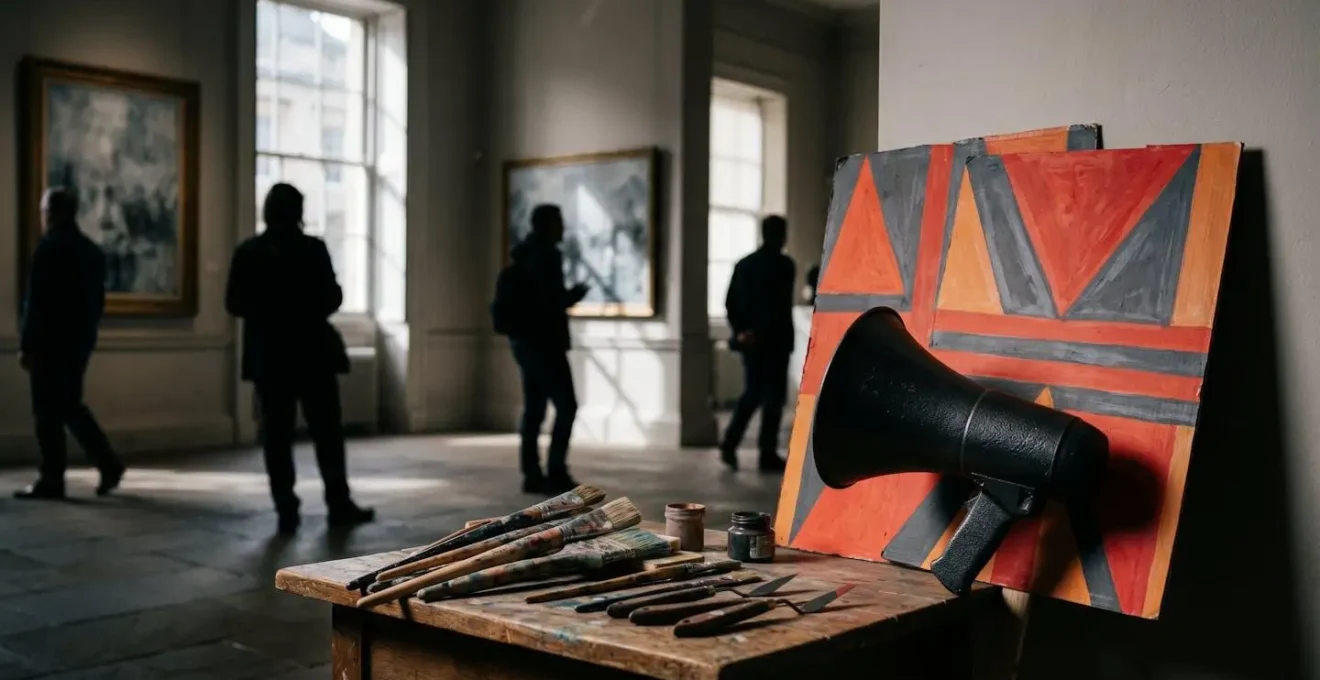
As the image suggests, the institutional space itself can feel hollow when its claims of inclusivity are not matched by lived reality. As V&A East director Gus Casely-Hayford lamented, “calls for action in the sector have long been heard but rarely answered, with talented curators lost to industries that are both more supportive and progressive.” Spotting woke-washing, therefore, requires looking past the exhibition posters and asking harder questions. Who is on the payroll? Who is on the board? Whose career is being nurtured? When an institution’s commitment to social justice applies only to its temporary programming and not to its permanent structure, it is not driving change; it is merely curating its own image.
Cancel Culture: Are Galleries Self-Censoring Controversial Works?
The term “cancel culture” is often deployed as a right-wing cudgel against accountability, but a more insidious form of censorship is quietly taking root within the UK’s art institutions. It is not a loud, public cancellation, but a silent, preemptive self-censorship born of fear. This fear is twofold: fear of public backlash and, more potently, fear of financial retribution from funders, both public and private. The result is a chilling effect that discourages galleries from taking genuine risks, leading to a landscape of politically safe, toothless art.
This is not paranoid speculation. A startling 2025 Arts Professional survey reveals that over 80% of UK arts workers believe sharing controversial opinions risks professional ostracism. This culture of fear is directly tied to funding precarity. The same research found that nearly 70% of arts workers would not dare criticize a funder for fear of jeopardizing future investment. This creates a feedback loop where art that might offend a corporate sponsor or a government body is simply never shown. The most effective censorship isn’t the removal of a work from a wall; it’s ensuring the work is never created or curated in the first place.
Case Study: Arts Council England’s “Reputational Risk” Guidelines
In 2025, Arts Council England (ACE), the largest public funder of the arts in the country, exemplified this trend. It updated its guidelines for nearly 1,000 funded organisations, classifying any activity deemed “overtly political or activist” as a potential “reputational risk.” The move was met with fierce backlash, with critics arguing the deliberately vague language created a grey area that amounted to state-sanctioned censorship. By failing to define what constitutes “controversial,” ACE effectively encouraged organisations to err on the side of caution, stifling politically engaged work to protect their funding lifeline.
This dynamic reveals the subtle co-optation of the arts. When survival depends on appeasing funders, the critical function of art is neutered. The gallery space, supposedly a forum for provocation and dissent, becomes a managed environment where the boundaries of acceptable discourse are quietly dictated by the sources of its capital. True political art cannot flourish under such conditions.
The Mistake of Overloading Visitors with Guilt instead of Inspiration
Much socially conscious art falls into a common trap: it lectures. It confronts the viewer with a litany of society’s ills—climate change, inequality, systemic injustice—and implicitly points a finger. While born of righteous anger, this approach often proves counterproductive. It can induce a state of “compassion fatigue” or defensive guilt in the audience, leaving them feeling overwhelmed and powerless rather than inspired to act. The gallery becomes a space of moral judgment, not of possibility. This is a fundamental strategic error, mistaking the representation of a problem for a step towards its solution.
A more powerful approach reframes the role of the artist from a critic to a catalyst. It moves from diagnosing the sickness to prototyping the cure. It is what the activist artist Tania Bruguera calls “art that is the thing, not art that points to a thing.” This is art as social infrastructure, as community-building, as a tangible intervention in the world. It doesn’t just show you a problem; it invites you to participate in its resolution. The focus shifts from what is wrong with the world to what a better one could look like, and how we might build it together.
Case Study: Assemble’s Turner Prize-Winning Regeneration
The London-based collective Assemble’s 2015 Turner Prize win is a landmark example of this ethos. Their project, Granby Four Streets, was not an artwork *about* urban decay in Liverpool. It was a direct, collaborative intervention *against* it. Working with long-term residents, Assemble helped refurbish derelict houses, established a local workshop creating handmade products from the debris, and revived public spaces. The project didn’t just highlight a problem; it created jobs, transferred skills, and built lasting social and economic value. It demonstrated that art’s greatest political power lies not in making viewers feel guilty, but in providing them with tools for transformation and a tangible sense of hope.
This represents a profound philosophical shift. It argues that the most radical political art may not hang on a gallery wall at all. It may be a community land trust, a worker’s cooperative, or a self-sustaining local enterprise. It is art that does, rather than art that says.
Sackler and BP: How Toxic Philanthropy Is Being Removed from the Arts?
For decades, the UK’s most prestigious cultural institutions bore the names of corporate giants like BP and philanthropic dynasties like the Sacklers. This relationship was presented as a civic virtue: benevolent patrons supporting high culture. But activism has forced a reckoning, exposing this as a transactional exchange where controversial entities purchase social legitimacy by branding our shared heritage. The removal of these names from gallery wings and sponsorship deals is not merely symbolic; it represents a hard-won victory in the fight for the ethical soul of the arts.
This victory was not achieved overnight. It was the result of sustained, strategic campaigns of institutional critique. Activist groups like Liberate Tate did not engage in destructive vandalism; instead, they used performance art and non-violent interventions to relentlessly highlight the hypocrisy of an oil giant sponsoring the same culture its business model threatens. Similarly, photographer Nan Goldin’s group P.A.I.N. (Prescription Addiction Intervention Now) targeted Sackler-funded institutions, combining emotional exhibitions with direct, strategic dialogue with museum trustees. Their success proves that persistent, well-aimed pressure can force institutions to choose between dirty money and their public reputation.
However, the battle is far from over. As the visible ties are cut, a more subtle influence remains. As an Index on Censorship analysis warns, “self-censorship is arguably a far harder nut to crack, and one that serves corporate sponsors’ purposes far more successfully than a sponsorship agreement.” Even after a toxic donor is gone, the fear of losing future funding can leave an institutional scar, leading to a risk-averse culture. Divorcing from toxic philanthropy requires more than just changing the name on the wall; it demands a deep, structural commitment to intellectual and curatorial freedom, ensuring that the institution’s agenda is set by its public mission, not the ghosts of its former patrons.
How Do Modern Portraits Critique British Class Structure differently than in the past?
Historically, British portraiture was a tool for reinforcing class hierarchy. The grand portraits of aristocrats and industrialists, rendered in oil on canvas, served to immortalise power, lineage, and ownership of land. The subject’s status was conveyed through formal poses, luxurious attire, and the sheer permanence of the medium itself. The working class was largely absent, or depicted as pastoral scenery rather than as individuals with interior lives. The critique, if any, was oblique and heavily coded.
Contemporary portraiture in the UK subverts this tradition entirely. The critique of class is now direct, confrontational, and embedded in the very choice of form and subject. As a Tate research paper on politically engaged art notes, for many artists today, “the choice of medium itself is a political act.” Instead of oil on canvas, artists may use ephemeral materials, digital media, or found objects, implicitly questioning the historical permanence and value associated with aristocratic portraiture. The focus has shifted dramatically from the powerful to the marginalised, from the landowner to the laborer.
Case Study: Portraying the ‘Unseen’ Subjects of Modern Britain
A significant trend in contemporary UK art involves portraying the “unseen” workers who form the backbone of the modern economy. Artists are creating portraits of gig economy couriers, migrant agricultural laborers, and care home staff, figures who are ubiquitous in daily life but invisible in the grand narrative of “Britishness.” This work stands in stark contrast to the historical focus on inherited wealth. It shows how artistic critique has moved from examining the privileges of the elite to exposing the precarity of the working class. Furthermore, many of these artists operate outside of London, deliberately challenging the metropolitan-centric view of British society and giving voice to regional identities often overlooked by the cultural establishment.
This shift represents a democratization of the portrait. It reclaims a genre once used to solidify power and turns it into a vehicle for questioning it. By choosing to dignify a care worker with the same artistic attention once reserved for a duchess, these artists are not just creating an image; they are making a profound political statement about who deserves to be seen, remembered, and valued in 21st-century Britain.
Consultation or Imposition: How to Get Locals on Board with Your Art?
The history of public art is littered with well-intentioned failures: sculptures dropped into communities with no local input, murals that reflect the artist’s vision but not the neighbourhood’s identity. This top-down approach, often disguised with a thin veneer of “consultation,” treats the community as a passive backdrop rather than an active partner. The result is art that feels like an imposition, an alien object that fails to resonate and, in the worst cases, breeds resentment. True community engagement is not a box-ticking exercise; it is a fundamental reordering of the creative process.
The alternative is a model of co-creation, where the artist acts as a facilitator and a resource, not a sole author. In this model, the project’s goals, aesthetics, and outcomes are developed collaboratively with residents from day one. It acknowledges that local people possess an invaluable, embodied expertise about their own environment. As Tate research concludes, the most effective “socially engaged practice has developed most effectively out of the real activities of communities.” This means the art project should emerge from and respond to the existing needs, desires, and activities of the community, rather than being imported from an external agenda.
Case Study: The Granby Four Streets Co-Creation Model
The Granby Four Streets project in Liverpool, which partnered with the Assemble collective, is a masterclass in genuine co-creation. The project’s instigator was not an arts organisation, but a Community Land Trust (CLT) established by residents in 2011 to save their neighbourhood from demolition. Assemble was brought in as a partner, not a director. The £14 million regeneration was driven by residents’ priorities, involving them directly in the design, fabrication, and curation of their own revitalised streets. This deep collaboration offered building jobs and training to local people and established a workshop that continues to provide economic benefit. It wasn’t consultation; it was shared ownership.
This approach transforms public art from a decorative afterthought into a tool for community empowerment and social change. It ensures the final work is not just *in* the community, but *of* the community, woven into its social and economic fabric. The process itself becomes as important as the final product, building relationships, skills, and collective confidence that long outlast the artwork.
Key Takeaways
- Art’s political efficacy is measured by structural change, not just media attention or public approval.
- Disruptive tactics can be strategically effective through the “radical flank effect,” even when they are unpopular.
- Institutions must move beyond performative “woke-washing” to enact real change in staffing, governance, and funding ethics.
- The most powerful socially engaged art inspires action and builds solutions, rather than simply inducing guilt.
How to Propose and Execute a Public Installation Art Project in a UK City?
Translating a powerful artistic concept into a physical reality within a UK city is a formidable challenge. It requires navigating a labyrinth of bureaucratic, financial, and community-related hurdles. Success is less about a single brilliant idea and more about a robust, meticulously planned process. The journey from proposal to execution is an art form in itself, blending creative vision with the pragmatic realities of project management, legal compliance, and public engagement. For an artist or collective aiming to make a real-world impact, mastering this process is non-negotiable.
Funding is the first major obstacle. Pathways are varied and require tailored approaches. Arts Council England is a primary source, offering National Portfolio Organisation status for established groups or project grants for individual works, both requiring clear alignment with its strategic principles. Beyond ACE, artists should explore the National Lottery Heritage Fund for projects connecting art with local history, or regional bodies like Creative Scotland and the Arts Council of Wales. An often-overlooked but crucial avenue is negotiating with local councils for Section 106 agreements, where property developers contribute funds for community cultural value. Finally, a constellation of private trusts and foundations exists, each with specific interests in public art and community initiatives.
Beyond funding, a successful project hinges on rigorous planning and compliance. This is not the glamorous side of art, but it is the bedrock upon which all public-facing work must be built. Failure to address these practicalities can derail a project or, worse, create a public hazard. The following checklist outlines the non-negotiable pillars of a viable public art proposal in the UK.
Action Plan: Auditing Your UK Public Art Project’s Viability
- Stakeholder & Legal Scrutiny: Identify all points of contact and legal frameworks. Navigate council planning permissions and understand the timelines for public consultation periods, treating them as opportunities for dialogue, not obstacles.
- Risk Assessment & Safety Planning: Inventory all potential hazards. Conduct and formally document comprehensive risk assessments for installation, maintenance, and public interaction, ensuring full compliance with Health & Safety Executive (HSE) standards.
- Ethical & Accessibility Coherence: Confront your project’s design with its social values. Ensure physical access and interpretive materials are fully compliant with the Equality Act 2010, accommodating D/deaf, disabled, and neurodiverse audiences from the outset.
- Impact & Legacy Measurement: Define what success looks like beyond aesthetics. Design a robust impact metrics framework, including pre- and post-installation community surveys, school partnerships, and qualitative resident interviews to demonstrate social value to funders.
- Operational & Financial Integration: Secure the practical foundations. Finalise public liability insurance that meets all local authority specifications and create a detailed, phased budget that accounts for installation, de-installation, and ongoing maintenance.
Executing a public art project is a testament to an artist’s ability to operate in two worlds simultaneously: the world of ideas and the world of regulations. True structural efficacy is born from this synthesis of radical imagination and pragmatic execution. It is here that art transcends representation and becomes a functional part of the civic landscape.
To truly drive change, the artist-activist must become a strategist, a community organiser, and a philosopher in action. The path forward lies in embracing the complexities and paradoxes of efficacy, moving beyond mere spectacle to engage in the difficult, necessary work of structural subversion and genuine co-creation.