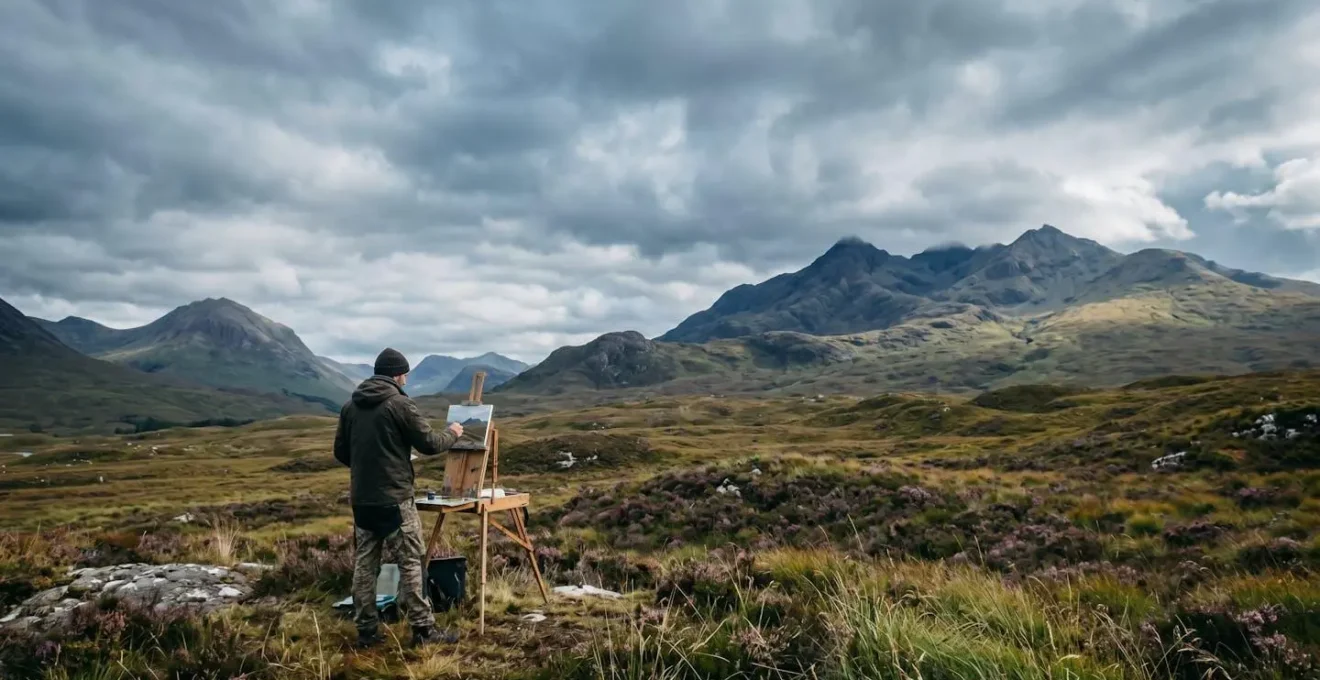
Contrary to the romantic ideal of capturing perfect, sun-drenched vistas, the true allure of the Scottish Highlands for contemporary artists lies elsewhere. It is not a passive landscape to be depicted, but an active collaborator in creation. This article explores how the region’s challenging weather, raw materiality, and vibrant peripheral art scene are forcing a profound shift, where the creative process itself—a dialogue with the elements—becomes more significant than the final image.
The image of an artist perched on a heather-strewn hill, capturing the majestic sweep of a Highland glen, is a powerful and enduring one. For generations, this land of mist, mountains, and melancholic light has been a muse. Many arrive seeking to translate its epic beauty onto canvas or film, chasing the fleeting golden hour across the moors. The common wisdom suggests finding the perfect viewpoint, waiting for the perfect light, and capturing a perfect, static moment of sublime nature. This pursuit has filled countless galleries and continues to draw creatives north.
But what if this approach, focused solely on depiction, misses the very soul of the place? What if the true creative potential of the Highlands is not found in its moments of serene beauty, but in its daily, dynamic challenges? A growing movement of artists, both local and international, is discovering that the Highlands are not a silent, passive subject. They are an active, and sometimes demanding, creative partner. The relentless rain, the gale-force winds, and the deep, resonant solitude are not obstacles to be overcome; they are the very tools of creation.
This shift in perspective redefines what it means to make art in this landscape. It is a move away from mere representation towards a deeper form of collaboration—an environmental dialogue. This article delves into this evolving relationship. We will explore how artists are adapting their practice to the elements, finding inspiration in local materials, and engaging with a thriving creative ecosystem that exists far from the established urban centres. It is a journey into a place where art is not just made *about* the Highlands, but *with* them.
This guide will navigate the practical and philosophical dimensions of this new creative haven, exploring the unique opportunities that await the artist willing to engage in a true dialogue with the Scottish landscape. The following sections offer insights into residencies, creative techniques, and the cultural fabric that make this region so compelling.
Summary: Why Are the Scottish Highlands Becoming the New Haven for Landscape Artists?
- Which Highland Residencies Offer the Best Solitude for Writers and Painters?
- Morning or Dusk: When to Photograph the Isle of Skye for Dramatic Effect?
- How to Protect Your Plein Air Painting Gear from Scottish Rain?
- Weaving and Pottery: Where to Buy Authentic Highland Crafts Direct from Makers?
- The Mistake of Ignoring Small Highland Galleries in Favor of Edinburgh Museums
- Sun and Chemicals: How to Create Blueprints without a Darkroom?
- Local Wool and Wood: Why Provenance Matters in Craft?
- Why Is Camera-less Photography Gaining Traction Among Young British Artists?
Which Highland Residencies Offer the Best Solitude for Writers and Painters?
The search for creative sanctuary often begins with a place to work. In the Highlands, a residency is less about a prestigious title and more about securing a space for profound focus. The ultimate luxury here is not convenience, but meaningful solitude. Options range from structured programmes to self-directed retreats, but all share a common thread: providing isolation as a creative catalyst. This isn’t about escaping the world, but about creating the mental space to engage with it more deeply, allowing the whisper of the wind to be louder than the noise of daily life.
Artists are given a rare degree of autonomy, a blank canvas of time to fill as their practice demands. Some residencies are intentionally disconnected, offering a digital detox that forces a return to analogue methods and introspection. Others provide a balance, pairing isolated studios with opportunities for community engagement, acknowledging that even in solitude, the exchange of ideas can be a powerful stimulant. The key is to choose an environment that aligns with your specific creative needs—be it absolute quiet for a writer or access to open land for a land artist.
Case Study: Eilean Shona Artist Residency
A prime example of this philosophy is the sculptor residency on the remote island of Eilean Shona. In partnership with the Royal Society of Sculptors, it offers artists a month of profound isolation. The core of the experience is a direct response to the elemental environment, with a unique focus on using abundant fallen wood from the island’s own trees. This model transforms a remote location from a simple backdrop into a material resource, where the artist’s work becomes intrinsically tied to the life cycle of the place itself, fostering both intense focus and creative transformation.
Your Action Plan: Planning a Self-Funded Highland Residency
- Accommodation Strategy: Research self-funded residency options or independently rent remote bothies and crofter cottages. Organisations like the Cromarty Arts Trust offer studio and en-suite room packages (e.g., £266/week as of 2025).
- Studio Access: Verify the availability of a dedicated workspace. Many organisations provide free studio space in beautifully converted historic buildings, such as old stables or railway stations.
- Materials Planning: Source supplies locally upon arrival or arrange for delivery in advance. Access to specialised art supplies in remote Highland locations is often very limited.
- Connectivity Decision: Determine your internet requirements beforehand. Some residencies offer full connectivity, while others are intentionally “off-grid” to facilitate deep, uninterrupted work.
- Community vs. Isolation Balance: Choose your ideal environment. Options range from hyper-isolated island stays to community-focused hubs that offer open studios and peer feedback sessions.
Morning or Dusk: When to Photograph the Isle of Skye for Dramatic Effect?
The question of timing for a photographer is ancient. The “golden hours” of dawn and dusk are universally lauded for their soft, warm light. On the Isle of Skye, these moments can be transcendent, painting the Cuillin ridge in hues of fire and rose. But to focus only on these fleeting periods of calm is to misunderstand the photographic soul of the Highlands. The most dramatic, emotionally resonant images are often born not from serene light, but from creative friction with the weather.
The true “dramatic effect” is found in the moments of transition: the lifting fog in a valley that reveals the bones of the land, the bruised purple of an approaching storm over the Trotternish ridge, or the way low, raking light after a downpour catches the sheen on wet basalt. This is the advantage of so-called “bad” weather. It provides texture, mood, and a sense of dynamic energy that clear blue skies can never offer. It tells a story of a land in constant flux.
Embracing this means shifting one’s mindset from a hunter of pretty light to a student of atmosphere. It requires patience and a willingness to work *with* the elements, not against them. A tripod might be rendered useless by the wind, forcing a more grounded, immediate approach. The goal is not to capture a postcard, but to convey the feeling of being present in a powerful, untamed environment. The resulting photograph is not just a picture of a place, but a record of a dialogue with the elements.
How to Protect Your Plein Air Painting Gear from Scottish Rain?
Working outdoors in the Highlands is an act of negotiation with the elements. The romantic notion of a painter serenely dabbing at a canvas often evaporates in the face of horizontal rain and gusts that can turn an easel into a sail. The question is not just how to protect your gear, but how to adapt your entire process. Success lies in accepting that the environment dictates the terms. In conditions described by seasoned artists as ’madness’ for traditional easels, the most radical and effective strategy is often to abandon the easel entirely.
This forced adaptation becomes a creative act. Working low to the ground, with a pochade box braced on your lap or a flat rock, changes your perspective and relationship to the landscape. It fosters an intimacy that a standing setup cannot. For days with less ferocious wind, simple tools become essential. The “tent peg technique”—anchoring your easel to the earth with pegs and string—is a classic Highland solution, but it only works on soil. On rock, the low-profile approach remains king. It’s a lesson in humility and ingenuity, where you learn to read the terrain as much as the light.
This environmental dialogue extends to the less dramatic but equally challenging presence of midges. The irony for plein air artists is that, as one experienced painter notes, the peak midge season from June to August coincides with the best painting weather. This forces a choice: brave the swarm for the light, or work in the crisper, insect-free air of the shoulder seasons. The solution often involves a pared-down kit, allowing for quick setups and retreats, embracing a philosophy where less gear means more energy and stability to focus on the work.
- Abandon the Easel: In high winds, work without one or use ultra-stable pochade boxes on flat, low surfaces.
- The Tent Peg Technique: On calmer days, carry tent pegs and string to anchor a traditional easel on soil or grass.
- Weight Your Setup: Place heavy items like pastel boxes or water containers at the base of your gear to create a low centre of gravity.
- Pare Down Your Kit: Less equipment means less surface area for the wind to catch and less to carry, preserving your energy for painting.
Weaving and Pottery: Where to Buy Authentic Highland Crafts Direct from Makers?
The creative spirit of the Highlands is not confined to landscape painting. It is woven, thrown, and carved into tangible objects by a community of dedicated craftspeople. For collectors and visitors, the challenge is to find authentic work that embodies the spirit of the place, moving beyond generic tourist trinkets. The key is to seek out the story behind the object, a concept deeply tied to material provenance. An authentic piece of Highland craft is a vessel of narrative; it speaks of the land from which its materials were sourced.
The best way to find these pieces is to go directly to the source. Many makers operate from small, often remote, studios that are open to the public. Following designated “Craft Trails” is an excellent strategy, turning the act of buying into a journey of discovery through the landscape. These trails, often marked on local tourist maps or online, lead you down single-track roads to hidden workshops where you can meet the artisans, see their process, and understand the context of their work. This direct connection is invaluable; you are not just buying a pot, you are acquiring a piece of a potter’s dialogue with the local clay and water.
Seasonal craft fairs and local farmers’ markets are other essential hubs. Here, you will find a curated selection of the region’s talent in one place. Look for makers who are passionate about their materials—weavers who can tell you which flock their wool came from, or woodturners who know the history of the fallen tree they have used. This is where the concept of provenance comes alive. Buying direct ensures that your investment supports the local creative economy and allows you to carry home an object with a soul, a tangible piece of the Highland landscape.
The Mistake of Ignoring Small Highland Galleries in Favor of Edinburgh Museums
For many art lovers visiting Scotland, the itinerary is predictable: the grand national museums of Edinburgh and Glasgow. While these institutions are world-class, to believe they represent the entirety of the Scottish art scene is a profound mistake. It is to ignore the vibrant, innovative work created across Scotland’s natural treasures and cultural heritage, shown in the most unexpected places. Adopting a sense of peripheral vision—looking away from the centre—reveals a network of small, independent galleries and creative hubs scattered throughout the Highlands.
As the North Coast 500’s cultural guide astutely observes, the landscape itself is a powerful engine for creativity. This is a truth best understood when you step into a gallery in a remote corner of the north. As they state in their guide, “Behind Hidden Doors: Arts & Crafts of the NC500”:
Our inspirational landscape and Highland way of life fuels creativity; it is little wonder that we have so many studios and galleries, even in the most remote corner of the North Highlands.
– North Coast 500 Cultural Guide, Behind Hidden Doors: Arts & Crafts of the NC500
These spaces are often more than just galleries; they are community centres, historical archives, and cafes, woven into the fabric of local life. They offer encounters with contemporary art that are intimate and contextualised. You might find a painter whose work is a direct response to the sea view from the gallery window, or a ceramicist using clay from the riverbank just meters away. This is where you find the pulse of the contemporary Highland art scene, raw and unfiltered.
Case Study: Gairloch Museum
Nothing exemplifies this innovative spirit more than the Gairloch Museum. This institution, which transformed from a Cold War-era nuclear bunker into the Art Fund Museum of the Year in 2020, is a testament to Highland ingenuity. Alongside its historical collections, the museum hosts a dynamic programme of rotating contemporary art exhibitions. It demonstrates how these peripheral venues serve multiple, vital functions, offering visitors a unique chance to experience emerging art in a context that is deeply connected to the history and community of the place—an experience unavailable in the formal halls of a city museum.
Sun and Chemicals: How to Create Blueprints without a Darkroom?
The dialogue between artist and environment finds one of its most literal expressions in the historic process of cyanotype. This camera-less technique, producing the iconic “blueprint” image, is experiencing a renaissance among artists in the Highlands precisely because it relies on the most fundamental elements of the place: sun, water, and flora. It is a form of photography that does not require a darkroom, making it perfectly suited for the field. The entire landscape becomes the studio.
The process is beautifully simple. Paper is coated with a mixture of two chemicals and dried in the dark. Objects are then placed on the paper, which is exposed to UV light. The magic of the Highlands is that even on its famously overcast days, the UV index is often high enough for a successful exposure. The final step is a simple rinse in water to fix the image, and what could be more fitting than using the cold, pure water of a Highland stream or loch? This act of rinsing a print in the very water that nourishes the landscape creates a profound, cyclical connection.
Artists can create a portable field kit to make these elemental impressions on-site. The process involves ethically foraging local specimens—a sprig of heather, a delicate fern frond, a piece of washed-up seaweed—and using them to create photograms. The resulting image is not a depiction of the plant, but its literal shadow, a direct impression captured by the sun. It is a piece of art made not just *in* the Highlands, but *by* the Highlands, a perfect collaboration between chemistry, light, and the unique botany of the land.
- Pre-Coated Paper: Carry pre-sensitized paper in light-proof bags to prevent exposure during your hike.
- Highland Flora: Ethically collect local specimens like ferns, mosses, or grasses to create unique photograms.
- Natural Rinsing Stations: Use the pure, cold water of Highland streams and lochs for the essential water-rinse step after UV exposure.
- Portable Press: A simple sheet of clear acrylic or glass with clips is enough to keep your specimens in contact with the paper during exposure.
Local Wool and Wood: Why Provenance Matters in Craft?
In a world of mass production, the concept of provenance—knowing exactly where something comes from—has become a quiet luxury. In Highland craft, it is not a luxury but the very foundation. When an artist or craftsperson chooses to work with local wool or wood, they are engaging in a practice that is about more than just aesthetics; it is about integrity, story, and a deep connection to a specific place. Material provenance elevates an object from a simple commodity to a cultural artefact.
Consider the wool of a Hebridean sheep, a hardy breed that has roamed these islands for centuries. Its fleece is not just a fibre; it is a record of the landscape—the coarse grasses it has grazed, the salty air, the harsh climate. When a weaver spins this wool and creates a textile, they are weaving that story into the cloth. The same is true for a bowl turned from a fallen Highland birch. The grain of the wood tells a tale of its life, of seasons of growth, of storms weathered. The artisan’s role is not to erase these histories, but to honour and reveal them.
This commitment to provenance is so integral to Scottish identity that in some cases, it is protected by law. The most famous example is Harris Tweed, which, as VisitScotland highlights, is the only fabric in the world guarded by its own Act of Parliament. This legislation dictates that it must be made from pure virgin wool, dyed and spun in the Outer Hebrides, and hand-woven at the homes of the islanders. It is the ultimate statement on why provenance matters. It guarantees not just quality, but authenticity, sustainability, and the preservation of a cultural lineage that is inextricably linked to the land itself.
Key Takeaways
- Embrace “Creative Friction”: The challenging Highland weather is not an obstacle but a creative tool that adds drama and forces innovative artistic solutions.
- Prioritize Material Provenance: The most authentic Highland art and craft is deeply connected to its source, using local wool, wood, and even plants as part of its story.
- Develop Peripheral Vision: The true heart of the contemporary Highland art scene often beats strongest in small, remote galleries and studios, not the major city museums.
Why Is Camera-less Photography Gaining Traction Among Young British Artists?
The turn towards processes like cyanotype in the Highlands is not an isolated, nostalgic trend. It is part of a significant, wider movement among a new generation of British artists who are questioning the very nature of photography by removing its most defining tool: the camera. This rise in camera-less photography is a direct response to a world saturated with digital images. In an age where every iconic landscape has been photographed millions of times, these artists are seeking a way to create unique, non-reproducible impressions that are about process and materiality as much as they are about the final image.
By working without a lens, artists engage with the absolute fundamentals of the medium: light, time, and a photosensitive surface. As Natasha Egan, Director of the Museum of Contemporary Photography, explains, this approach allows them to foreground the physical act of making. In an article for Artsy on this growing trend, she notes that “By removing or altering the camera, they engage photography at its most elemental—light, time, surface—while also questioning ideas of authorship, representation, and control,” a perspective that finds resonance in contemporary art circles. This is a shift from photography-as-documentation to photography-as-material-exploration.
Pioneering British artists like Garry Fabian Miller, who has worked in this mode since the 1980s, have paved the way, using light and chemistry to create abstract works that capture the intangible qualities of a place. For artists working in the Highlands today, this approach offers a powerful way to respond to an over-photographed landscape. Instead of creating another copy of a famous view, they can create a singular object, an “elemental impression” that holds a direct, physical trace of the environment. This movement affirms the Highlands not as a place for escaping into the past, but as a fertile ground for the future of artistic inquiry.
To truly connect with the creative spirit of this land, the next step is to move from observer to participant. Plan a visit not just to see the sights, but to engage with the makers, visit the small galleries, and perhaps even try your own hand at capturing an elemental impression of this incredible landscape.