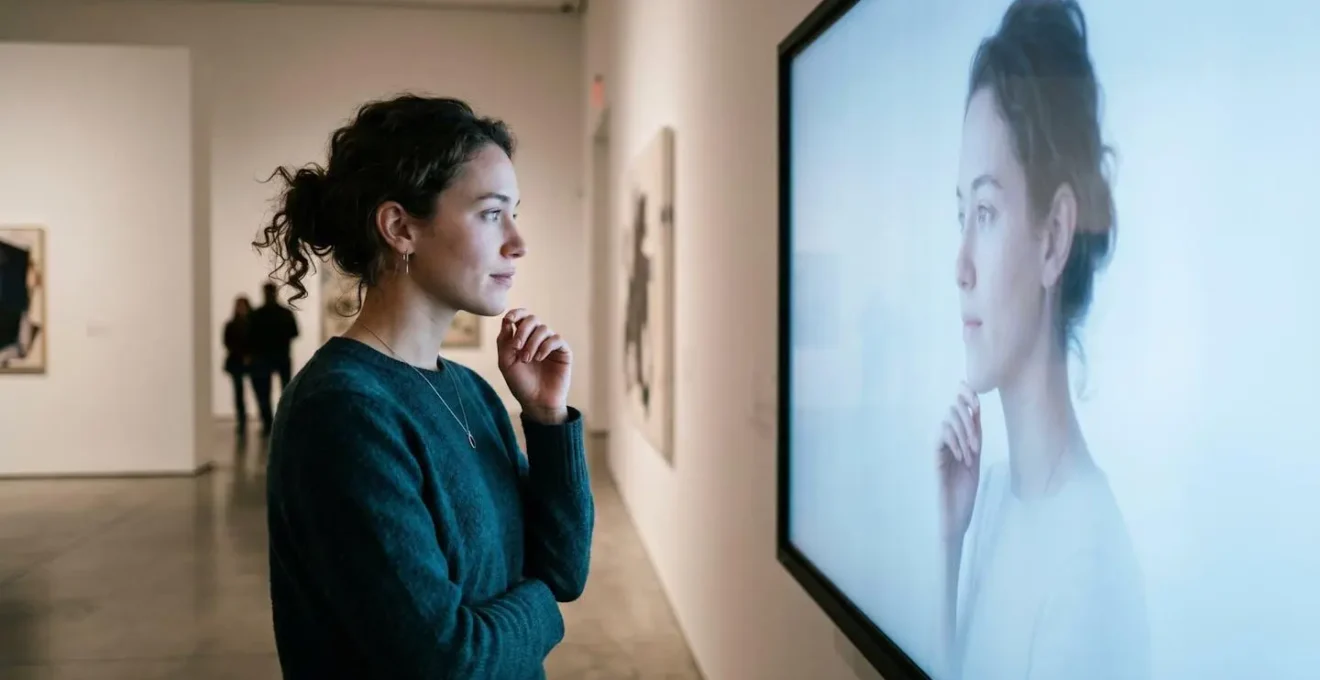
Interactive digital art is far more than just a tech-fueled spectacle; it’s a fundamental shift that redefines the roles of artwork, viewer, and gallery space.
- Artworks no longer just hang on a wall; they use sensors and AI to observe, react to, and even co-create with the audience.
- This creates new challenges in data privacy and long-term conservation, forcing us to rethink the very nature of collecting.
Recommendation: Gallery directors and collectors must embrace a new mindset, moving from preserving static objects to curating dynamic, evolving systems.
The quiet, reverent hush of the traditional art gallery is being disrupted. For decades, the model has been simple: a static object on a wall and a passive observer. But for a generation fluent in the language of interaction and participation, this one-way communication often fails to connect. The art world has responded with spectacle—large, immersive light shows and photo-ready installations—but this is often just a surface-level solution.
The truly profound revolution isn’t just about making art bigger or brighter. It’s happening at a more intimate level, in the space between the viewer and the portrait. A new generation of digital artworks is emerging, equipped with sensors, cameras, and code. These aren’t just pictures; they are systems that watch, learn, and respond. But what if the key to re-engaging audiences isn’t merely to entertain them, but to enter into a dialogue with them? What if the artwork could gaze back?
This article explores this paradigm shift. We will move beyond the spectacle to analyze how interactive portraits are not just capturing attention but are actively recoding the fundamental relationship between observer and observed. We will dissect the technology, confront the ethical questions, and project the future of a gallery that is no longer a silent repository, but a live, responsive environment. This is the shift from passive viewing to active co-creation.
To fully grasp this transformation, we will explore the core mechanisms, the challenges they present, and the cultural shifts they represent. The following sections break down this new, dynamic frontier of art history as it unfolds in real-time.
Summary: The Evolving Role of Digital Portraiture in Modern Galleries
- Motion or Facial Recognition: How Do Portraits “Watch” You Back?
- Is It Safe to Interact with Art that Collects Your Biometric Data?
- How to Collect Digital Art When the Software Might Become Obsolete in 10 Years?
- Gamification: Why Interactive Portraits Teach History Better to Kids?
- AI or VR: What Is the Next Big Leap for Digital Portraiture?
- Why Do Static Exhibits Fail to Engage Visitors under 25?
- Is It Art or a Backdrop: How Instagram Changed Exhibition Design?
- Why Immersive Art Experiences Are Replacing Traditional Gallery Visits for Millennials?
Motion or Facial Recognition: How Do Portraits “Watch” You Back?
The unblinking eyes of a traditional portrait follow you around the room through a trick of perspective. An interactive digital portrait does it with code. This shift from optical illusion to algorithmic observation is the core of the new engagement model. These artworks employ a sensor suite—often including motion detectors, depth-sensing cameras, and facial detection software—to perceive the viewer’s presence, position, and even emotional state. This is the foundation of the mutual gaze, a two-way street of observation where the art is as aware of the viewer as the viewer is of the art.
This technology allows the artwork to react in real-time. A digital face might turn to meet your gaze, its expression shifting based on your proximity, or the entire composition might deconstruct and reassemble as more people enter its field of view. The viewer’s data becomes the medium of the artwork itself, transforming a passive audience into active participants. The line between observer and observed dissolves completely.
As you can see, the technology behind the gaze is a complex array of precision components. It is in this hardware that the artist’s code comes to life, turning a collection of sensors into a responsive, and sometimes provocative, artistic entity.
Case Study: Rafael Lozano-Hemmer’s “Redundant Assembly”
A powerful example of this is Rafael Lozano-Hemmer’s ‘Redundant Assembly.’ In this piece, multiple cameras capture visitors’ faces, but instead of creating a simple mirror image, the system’s face-detection algorithm builds a composite “mongrel selfie” in real-time by combining features from different people. As the artist explains, the work subverts surveillance technology; rather than identifying an individual, it deliberately confuses identity to create a collective portrait. The viewer isn’t just seeing the art; they are literally becoming part of its composite, ever-changing face, as Lozano-Hemmer’s project demonstrates.
Is It Safe to Interact with Art that Collects Your Biometric Data?
When an artwork captures your likeness to create a composite selfie, it is using your biometric data as its palette. This raises profound questions that transcend the gallery walls, touching upon the most sensitive aspects of digital ethics and privacy. The face, fingerprint, or even the unique rhythm of a heartbeat are becoming raw materials for artists. While the intent may be creative expression, the underlying data collection mechanism is often indistinguishable from those used by corporate or state surveillance entities. This creates a critical tension for both curators and visitors.
The primary concern is the permanence of this data. Unlike a password that can be changed, your biometric information is immutable. As privacy researchers highlight, once compromised, biometric data cannot be easily changed or reset, making any potential breach catastrophic. Galleries and museums, by commissioning and displaying such works, are becoming temporary custodians of highly sensitive personal information. They must therefore operate with extreme transparency, clearly communicating what data is being collected, how it is being used, and—most importantly—how and when it is being deleted.
The artistic subversion of surveillance can be a powerful statement, but it walks a fine line. For the experience to remain one of wonder and not anxiety, the viewer’s trust must be paramount. This requires robust data security protocols, clear consent frameworks, and an ethical commitment from both the artist and the institution to protect the very people who give the artwork life. Without these safeguards, the mutual gaze risks becoming a one-way mirror, where the viewer is unknowingly exposed.
How to Collect Digital Art When the Software Might Become Obsolete in 10 Years?
The excitement of collecting a dynamic, interactive portrait is often tempered by a daunting reality: ephemeral permanence. The artwork’s existence is tied to a specific technological moment—a particular operating system, a unique sensor model, a custom piece of software. As technology rapidly evolves, the risk of digital obsolescence becomes the primary threat to the artwork’s survival. A masterpiece of generative art can be reduced to a folder of unrunnable files in less than a decade. This challenges the very notion of a permanent collection.
Digital conservation is an active, ongoing process, not a one-time acquisition. It requires a completely different mindset and skillset from traditional art preservation. According to digital conservation research, conservators must transfer digital artwork information to newer technologies at regular intervals, ideally once every eight years, to prevent data degradation and ensure compatibility. This process, known as migration, is costly, complex, and requires deep technical expertise. It involves not just backing up files, but often reverse-engineering or emulating old hardware and software environments.
As the Museum-iD Conservation Team notes, this is an existential challenge for the medium:
As that technology fails (and it will fail eventually, it’s just a question of when), we must find new ways to enable and deliver the digital content — or the artwork will cease to exist in its original form, perhaps cease to exist all together.
– Museum-iD Conservation Team, Preserving Digital Art: the Innovation Adoption Lifecycle
For collectors and institutions, this means acquisition budgets must now include long-term conservation and migration plans. It also involves working closely with artists to obtain detailed documentation, source code, and “preservation-ready” versions of the work. Acquiring digital art is not just buying an asset; it’s adopting a living system that will require continuous care and feeding to survive.
Your Action Plan: Pre-Acquisition Checklist for Interactive Digital Art
- Technology Audit: List every piece of hardware (sensors, computers, displays) and software (operating system, custom code, libraries) the artwork requires to function.
- Artist’s Intent & Documentation: Obtain a “conservation-ready” package from the artist, including commented source code, technical diagrams, and a statement on acceptable parameters for future migration (e.g., can resolution be increased?).
- Variable Conditions Report: Document the artwork’s behavior under different conditions. What happens with one viewer versus ten? In bright light versus darkness? This defines the “original state.”
- Emulation & Migration Path: Assess the viability of emulating the current software/hardware environment in the future. Identify the first likely point of failure (e.g., a specific sensor model going out of production).
- Long-Term Budgeting: Create a 10-year budget that accounts for a full migration cycle, including hardware replacement, software engineering time, and potential artist consultation fees.
Gamification: Why Interactive Portraits Teach History Better to Kids?
While some interactive art grapples with complex themes of surveillance and identity, another branch uses similar technology for a more direct purpose: education. When applied in a historical context, interactive portraits can transform a dry history lesson into a captivating game. For younger audiences, particularly those under 25 who have grown up with responsive digital interfaces, the ability to “play” with history is a far more effective learning tool than passively reading a plaque.
Imagine a digital portrait of a historical figure that is not static. A child waves a hand, and the figure begins to tell a story from their life. They answer a question on a touchscreen, and the portrait’s costume changes to reflect a different period. This is gamification in action: using game-like mechanics such as discovery, problem-solving, and immediate feedback to drive engagement and knowledge retention. The interaction creates a sense of agency and personal connection; the child is not just being told about history, they are uncovering it themselves.
This hands-on approach bypasses the “museum fatigue” that often sets in with static exhibits. Instead of a quiet, look-but-don’t-touch environment, the gallery becomes a space for active exploration. Each interaction provides a small dopamine hit of discovery, reinforcing the learning process in a way that is both enjoyable and memorable. The portrait is no longer just an image of a person; it becomes a portal to their world, an interactive storyteller that responds to the viewer’s curiosity.
This method leverages the natural inquisitiveness of children, turning them into historical detectives. By becoming a viewer as co-author of their own learning journey, they are more likely to retain information and develop a genuine interest in the subject matter. The technology, in this case, serves as the ultimate teaching assistant, making the past immediately present and personal.
AI or VR: What Is the Next Big Leap for Digital Portraiture?
The current generation of interactive portraits relies heavily on sensor-based reactivity. The next frontier, however, lies in proactivity and full immersion, driven by advancements in Artificial Intelligence (AI) and Virtual/Augmented Reality (VR/AR). We are moving from artworks that *react* to viewers to artworks that can *anticipate*, *personalize*, and *generate* entire experiences in real-time. This isn’t just an incremental step; it’s a quantum leap in the nature of digital art.
Generative AI is poised to become the artist’s ultimate collaborator. Imagine a portrait that doesn’t just have pre-programmed responses but uses a generative model to create unique dialogue based on its conversation with a viewer. It could access historical databases to answer questions with startling depth or generate new visual elements for its own canvas based on the viewer’s perceived mood. The artwork ceases to be a fixed system and becomes a truly emergent, learning entity—a form of algorithmic curation where the piece itself decides what the viewer should experience next.
Simultaneously, VR and AR are set to dissolve the gallery walls entirely. The Augmented Reality (AR) segment in the digital artwork market held the largest share in 2024, indicating a strong trend toward blending digital content with the physical world. An AR portrait could step out of its frame and walk through the gallery with you, narrating its own history. In VR, a viewer could enter the world of the painting, interacting with a fully realized 3D avatar of the subject. This shift from screen-based interaction to spatial immersion will fundamentally alter our physical relationship with art, a trend supported by projections that the Global Digital Artwork Market is projected to surpass USD 23.34 billion by 2034.
The next big leap will likely be a synthesis of both: AI-driven characters inhabiting immersive VR and AR worlds. The portrait will not only be interactive but autonomous, not only responsive but relational. This future promises a level of personal engagement and narrative depth that is currently unimaginable, turning every gallery visit into a unique, unrepeatable performance co-created by human and machine intelligence.
Why Do Static Exhibits Fail to Engage Visitors under 25?
The struggle of traditional museums and galleries to attract and retain younger audiences is not a new phenomenon, but its root cause is shifting. It’s not simply a matter of competing with smartphones for attention; it’s a fundamental misalignment of values. For Millennials and Gen Z, the concept of value has moved away from passive ownership and toward active participation and memorable experiences. A static painting, cordoned off behind velvet ropes, represents a mode of consumption that feels alien to a generation raised on interactive media.
This demographic, far from being uninterested in art, is actually a driving force in the market. Recent art market research shows that 46% of art collectors are aged 18-39, representing the fastest-growing segment. However, their expectations are different. They are not just buying objects; they are buying into narratives, communities, and experiences. They expect to be able to participate, to share, and to feel a personal connection to the work.
The failure of static exhibits lies in their inability to meet this need for active engagement. They operate on a broadcast model—the art speaks, the viewer listens—while younger audiences are accustomed to a conversational model. This is perfectly articulated by a market analysis on the value system of these new consumers:
Millennials and Gen Z are statistically proven to prioritize spending on memorable events over material possessions. Immersive art is the perfect product for this value system.
– Market Analysis Team, Online Art Market Size, Share & Trends Report
Interactive digital art succeeds precisely where static art fails. It invites participation, offers a unique and sharable event, and makes the viewer a co-author of their own experience. It speaks the native language of the digital generation: a language of interaction, personalization, and connection. The static exhibit is a statement; the interactive exhibit is a conversation. For visitors under 25, the choice is clear.
Is It Art or a Backdrop: How Instagram Changed Exhibition Design?
The rise of social media, particularly Instagram, has introduced a powerful and often controversial new force in the art world: the “shareability factor.” Immersive and interactive exhibitions have become prime locations for capturing the perfect selfie, leading to a critical debate among curators and artists. Is the artwork a profound experience, or has it been reduced to a visually pleasing backdrop for a personal photoshoot? The answer is complex and reveals a fundamental shift in how art is consumed and valued in the 21st century.
There’s no denying that exhibition design has been profoundly influenced by the “Instagram effect.” Curators are now more conscious of creating “moments”—specific installations or viewpoints that are perfectly framed for a smartphone camera. This can lead to accusations of pandering, of prioritizing visual spectacle over conceptual depth. The fear is that the viewer’s engagement is shallow, focused more on documenting their presence at the artwork than on experiencing the artwork itself. The phone becomes a barrier, not a bridge, to a deeper connection.
However, a more optimistic perspective sees this behavior not as a distraction, but as a new form of viewer participation. Sharing a photo of an artwork on social media is a modern method of meaning-making and cultural participation. It’s a way for viewers to align their personal identity with the art and to share their experience with a wider community. In this view, the “backdrop” is not the end of the art experience, but the beginning of a digital conversation about it. The visitor becomes a distributor, an ambassador for the exhibition.
The challenge for institutions and artists is to design experiences that function on both levels. They must be visually compelling enough to invite sharing, but also contain deeper layers of meaning that reward sustained attention. The best interactive works manage this balance, offering an immediate “wow” factor that satisfies the Instagrammer, while also providing a rich, multi-layered experience for the visitor who chooses to look beyond their screen.
Key takeaways
- Interactive art is not a monolith; it ranges from educational tools and provocative surveillance critiques to groundbreaking AI-driven entities.
- The shift to interactive art forces institutions to become tech companies, grappling with data privacy, software maintenance, and long-term digital conservation.
- The value system of new art consumers (Millennials & Gen Z) prioritizes participation and memorable events, a need that interactive experiences fulfill perfectly.
Why Immersive Art Experiences Are Replacing Traditional Gallery Visits for Millennials?
The trend is undeniable: large-scale, ticketed immersive art experiences are drawing massive crowds, often dwarfing the attendance of traditional gallery shows. For Millennials and younger generations, the choice to spend a Saturday afternoon at a “Van Gogh: The Immersive Experience” over a quiet museum wing is a deliberate one. This preference isn’t driven by a rejection of art, but by a search for a more holistic form of engagement that traditional galleries are often ill-equipped to provide. Immersive experiences are winning because they deliver on three key pillars: participation, social connection, and narrative.
Unlike the “look but don’t touch” ethos of a traditional gallery, immersive art invites you to step inside the frame. You are not just an observer; you are a participant, a viewer as co-author. Your physical presence affects the environment. This sense of agency is profoundly satisfying for a generation accustomed to being active users rather than passive consumers. It transforms the art experience from a purely intellectual exercise into a full-body, multi-sensory event.
Furthermore, these experiences are fundamentally social. They are designed to be shared with friends and documented online, turning the art visit into a communal event. This directly counters a growing sense of social isolation, a point powerfully made by Dr. Maria Rosario Jackson of the National Endowment for the Arts.
The findings about the arts’ positive links to social connectedness are especially promising in light of a 2023 Surgeon General’s advisory about the adverse health effects of loneliness and social isolation.
– Dr. Maria Rosario Jackson, NEA Chair, National Endowment for the Arts Research Brief on Arts Engagement
Finally, immersive experiences excel at storytelling. By surrounding the viewer with sound, light, and motion, they create a powerful narrative flow that is more akin to cinema or theatre than to a static exhibition. They provide a clear beginning, middle, and end, making complex artistic ideas more accessible and emotionally resonant. For many, this guided journey is more fulfilling than the often-intimidating open-endedness of a traditional gallery. The art world is no longer just about preserving objects; it’s about architecting experiences.
As galleries and artists continue to navigate this evolving landscape, the imperative is clear: embrace interactivity not as a gimmick, but as a new, powerful language for artistic expression and human connection. The future of the gallery is not static; it is a dynamic, responsive space, and the time to start building it is now.