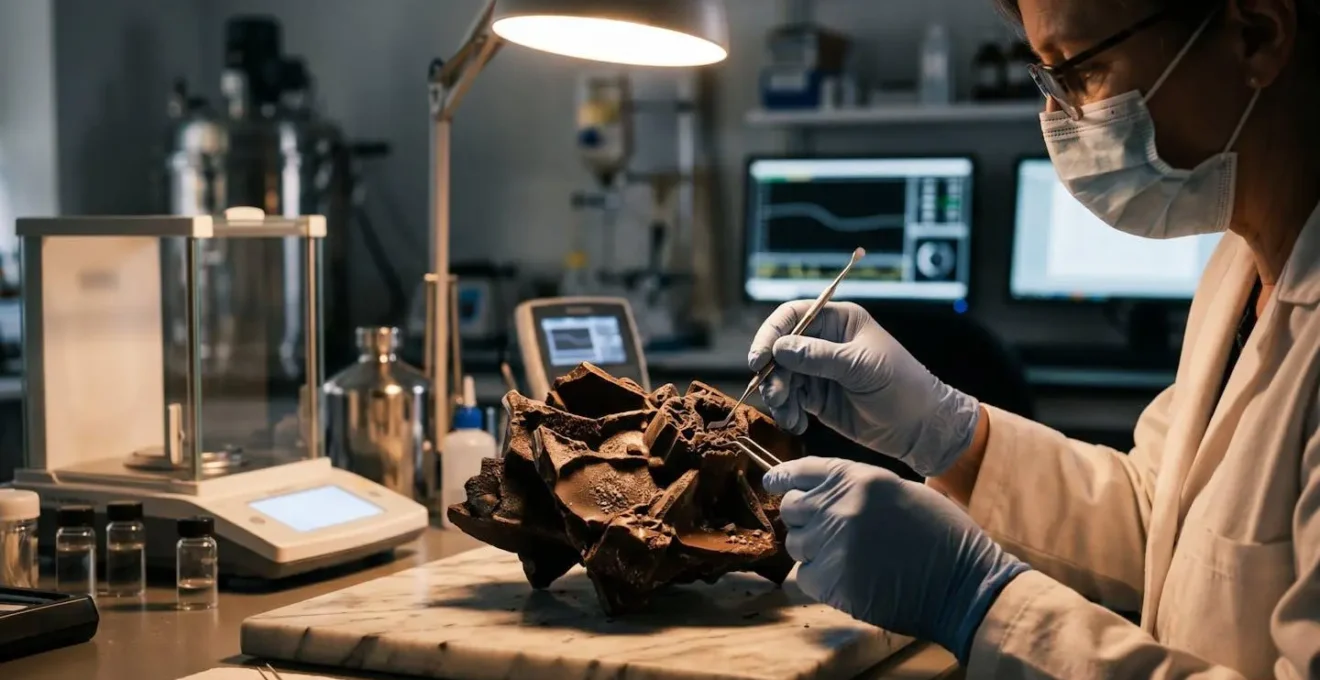
Contrary to the popular belief that art conservation is about “fixing” and stopping time, the reality for ephemeral artworks is far more complex. The preservation of pieces made from chocolate, fat, or other unstable materials is not a battle against decay but a profound negotiation with materiality itself. This involves forensic science to understand an object’s breakdown, ethical dialogues with living artists, and sometimes, the deliberate decision to manage, rather than halt, an artwork’s natural decomposition.
Imagine a sculpture carved from a block of chocolate, slowly sweating under gallery lights, or an installation incorporating animal fat that changes its form and scent over time. For collectors and museum professionals, these works represent a frontier of artistic expression and a significant conservation headache. The conventional wisdom of restoration—to return an object to its original, pristine state—often fails spectacularly when confronted with materials designed to be unstable. The usual methods of repair and stabilization can feel like fighting a losing battle against nature itself.
This challenge pushes the field beyond simple technical skill. It forces a fundamental re-evaluation of what it means to “preserve” an artwork. Is authenticity locked in the original molecules, or does it lie in the artist’s evolving concept? But what if the key wasn’t to “fix” the unfixable, but to embrace a new paradigm? This approach treats conservation less as a rigid set of rules and more as a dynamic collaboration between science, ethics, and artistic intent. It requires a conservator to be part-forensic scientist, part-philosopher, and part-diplomat.
This article will delve into the scientific and ethical frameworks that guide the preservation of these challenging artworks. We will explore the critical decision of when to intervene and when to let an artwork decompose, the complexities of replication, the strategies to prevent infestation, the vital role of the living artist, the technicalities of advanced storage, the concept of a material’s “inherent vice,” and the unique challenges these pieces present for long-term collectors.
To navigate this complex topic, this guide breaks down the core dilemmas and solutions that define contemporary conservation. The following sections provide a detailed roadmap for understanding how professionals approach the delicate art of preserving the perishable.
Summary: The Conservation of Ephemeral Contemporary Art
- Stop or Watch: When Should You Let an Artwork Decompose as Intended?
- Original or Replica: Is It Still the Same Work if You Replace the Rotting Fruit?
- Moths and Mold: How to Protect Food-Based Art from Infestation?
- The Error of “Fixing” a Work without Consulting the Living Artist
- Freezer or Vacuum: How to Store Perishable Art When Not on Display?
- Glue and Acid: Why Do Some Mixed Media Collages Self-Destruct over Time?
- X-Ray Vision: How AR Reveals Underdrawings beneath Famous Paintings?
- Why Do Mixed Media Artworks Present Unique Challenges for Long-Term Collectors?
Stop or Watch: When Should You Let an Artwork Decompose as Intended?
The first and most profound question in conserving ephemeral art is not “how” but “if.” When an artist deliberately chooses materials that decay, the act of preservation can become an act of defiance against the work’s core concept. This creates a fundamental ethical tension: does the conservator’s duty lie in preserving the physical object for posterity, or in honoring the artist’s intent, even if that intent is self-destruction? The answer requires a deep, case-by-case analysis of the artist’s philosophy and the work’s conceptual framework.
In many instances, the process of decay is not a flaw but a feature. It is the fourth dimension of the artwork—time. For these pieces, the role of the conservator shifts from interventionist to a manager of decay. The goal is no longer to stop the process but to control its rate, document its changes, and ensure it unfolds in a way that is safe and consistent with the artistic vision. This is particularly true when, as conservation expert Katherine Bel notes, “the degradation of the material is an expected or intended aspect of the artwork.”
Case Study: Dieter Roth’s ‘Chocolate Sea’ Conservation Debate
Dieter Roth’s ‘Schokoladenmeer’ (Chocolate Sea, 1970) at Barcelona’s MACBA presented conservators with an extreme decay challenge. The artwork, containing Lindt chocolate and typed paper, showed severe insect activity and degradation. Conservators attempted to eliminate pest infestations to delay decay, creating a fundamental ethical tension: should intervention preserve the physical object or honor the artist’s embrace of perishability as conceptual meaning? The debate itself became part of the artwork’s history, highlighting the conflict at the heart of conserving process-based art.
Ultimately, the decision to intervene or to watch is a curatorial and ethical one, made in dialogue with the artist’s statements, their estate, and the institution’s mission. To “fix” a work meant to rot is to fundamentally misunderstand it. The most responsible conservation may be to simply let go, while meticulously documenting the disappearance.
Original or Replica: Is It Still the Same Work if You Replace the Rotting Fruit?
When decay is not the intended focus, but an unavoidable consequence of the materials, the question of authenticity becomes paramount. Consider an artwork that includes fresh bananas, which must be replaced weekly. Is the artwork on display in week fifty the “same” as the one from week one? This dilemma forces us to redefine authenticity, moving it away from the physical material (the “original” banana) and towards the conceptual and procedural integrity of the work.
For many such artworks, the solution is “simple replenishment as per artist’s instructions,” a common practice in museums. The artist provides a set of rules for replacement: the specific brand of candy, the exact variety of fruit, the precise way it should be arranged. Here, authenticity is vested in the faithful execution of the artist’s instructions. The artwork becomes a performance, re-staged with each replacement. The conservator’s role is to ensure these instructions are followed with scientific rigor, maintaining the work’s identity over time.
This process often requires sophisticated material forensics. To replace a degraded component, conservators must first understand its precise composition. This is where the laboratory becomes essential, using techniques like gas chromatography to analyze the chemical signature of the original materials. This ensures that any replacement is not just visually similar but materially identical, preserving the work’s physical and chemical behavior.
As the image above illustrates, this level of analysis goes far beyond a simple visual match. It’s about understanding the material at a molecular level to guarantee a perfect surrogate. This scientific approach ensures that even when components are replaced, the sensory and physical presence of the artwork remains true to the artist’s original vision, blurring the line between the original and the replica in a conceptually sound way.
Moths and Mold: How to Protect Food-Based Art from Infestation?
While philosophical debates about decay are central to contemporary conservation, a more immediate and pragmatic threat looms over food-based artworks: pests and mold. A sculpture made of cheese or a collage of cured meats is not just an art object; it’s a potential ecosystem. Moths, beetles, and microbial growth can rapidly destroy a work, posing risks not only to the piece itself but to the entire museum collection. Preventing and managing these biological threats is a critical, non-negotiable aspect of stewardship.
The primary defense is a strategy known as Integrated Pest Management (IPM). This is a holistic, science-based approach that focuses on prevention rather than chemical intervention. IPM treats the museum as a complete environment, aiming to make it inhospitable to pests. This involves meticulous monitoring, strict housekeeping protocols, and controlling environmental parameters like temperature and relative humidity. For large institutions, this is a significant undertaking; a 2024 study documented that even a moderately sized museum requires systematic monitoring across over 4000 m² of exhibition and storage space to be effective.
The core of IPM is proactive vigilance. It involves sealing building entry points, eliminating potential food and water sources, and using sticky traps to monitor for the early presence of pests. By identifying a potential infestation before it takes hold, conservators can often resolve the issue with non-toxic methods, such as targeted freezing or creating an anoxic (oxygen-deprived) environment for the affected object, which suffocates pests without damaging the artwork. This preventative mindset is the only sustainable way to manage the inherent vulnerability of organic materials.
Action Plan: Implementing Core IPM Prevention Strategies
- Structural Audit: Systematically identify and fix structural problems. Check hidden corners, voids, and dark spaces that can serve as pest hiding spots and breeding grounds.
- Environmental Monitoring: Collect data on and control relative humidity and temperature levels. Aim for stable conditions that are unfavorable for common museum pests and mold growth.
- Strategic Trapping: Deploy and regularly check a grid of sticky traps and other monitoring systems for early pest detection, identification, and population tracking.
- Building Envelope Integrity: Seal the building to prevent pest entry. Address gaps in the structure, around pipes, under doors, and through vents.
- Rigorous Housekeeping: Implement and enforce strict cleaning schedules, including annual deep-cleaning of all storage facilities and exhibition areas to remove dust and organic debris.
The Error of “Fixing” a Work without Consulting the Living Artist
In the realm of contemporary art, perhaps the gravest error a conservator or collector can make is to approach a conservation problem unilaterally, especially when the artist is still alive. Unlike historical art where the creator’s voice is silent, living artists are active stakeholders in the life of their work. To “fix” a piece without their input is not just a technical misstep; it’s a violation of the work’s conceptual integrity. The artist’s intention is not a static memo from the past but a living, evolving dialogue.
The modern conservation paradigm is shifting from a hierarchical model, where the conservator is the sole authority, to a collaborative one. As conservation scholar Nina Quabeck notes in the Journal of the American Institute for Conservation, “Museums are increasingly responsible for the care of highly complex artworks that are often co-produced, co-curated and co-conserved.” This co-conservation model acknowledges that the artist holds the ultimate authority on their work’s meaning and acceptable states of being. An artist might decide that a certain crack is an acceptable part of the work’s history, or they might provide an entirely new solution for replacing a degraded element.
Case Study: Thomas Hirschhorn’s Ongoing Artist-Conservator Collaboration
Thomas Hirschhorn’s ‘Intensif-Station’ (2010) exemplifies contemporary collaborative conservation where the living artist remains actively involved in conservation decisions over time. The preservation no longer hinges solely on material endurance but embraces the active, evolving life of the work through continuous artist-conservator dialogue. This ongoing relationship fundamentally reshapes traditional conservation hierarchies, making the artist a partner in the work’s long-term care and evolution.
For collectors and institutions, this means establishing and maintaining a relationship with the artist is as important as controlling the climate. This dialogue should be documented meticulously, creating a living archive of decisions that will guide future conservators long after the artist is gone. Ignoring this crucial step risks preserving a physical shell while losing the artwork’s soul.
Freezer or Vacuum: How to Store Perishable Art When Not on Display?
When an ephemeral artwork is not on public display, the race against time doesn’t stop. In fact, long-term storage presents one of the greatest challenges for preserving these fragile pieces. The wrong environment can accelerate decay far more quickly than any exhibition. To combat this, museums and sophisticated collectors rely on highly specialized storage solutions, with cold storage being the most effective tool for dramatically slowing down chemical and biological degradation processes.
Think of it as putting the artwork into a state of suspended animation. By lowering the temperature, conservators can significantly reduce the rate of chemical reactions, off-gassing, and microbial growth. For highly unstable materials like cellulose nitrate film or many food-based works, freezer storage is often mandatory. These are not your typical household freezers; they are museum-grade, walk-in vaults with redundant systems and 24/7 monitoring to prevent catastrophic failure. Other methods include anoxic environments—sealed enclosures where oxygen is replaced with an inert gas like argon or nitrogen to halt oxidation.
However, this level of preservation comes at a significant cost. The infrastructure and energy required are substantial. According to technical specifications for specialized vaults, the annual utility cost can range from $2,000 to $3,000 per vault, or around $4 per cubic foot per year. This financial reality is a major barrier for private collectors and smaller institutions, often making museum partnerships the only viable option for the long-term care of such demanding works. Without access to these technologies, the lifespan of a perishable artwork in a private collection can be drastically shorter.
The choice between different storage methods—freezing, anoxia, or simple climate control—depends on a rigorous scientific analysis of the artwork’s materials and their specific vulnerabilities. It’s a calculated decision to invest significant resources to buy the artwork more time, keeping it stable and ready for future exhibition or research.
Glue and Acid: Why Do Some Mixed Media Collages Self-Destruct over Time?
Sometimes, the agent of an artwork’s destruction is not an external force like pests or light, but the very materials from which it is made. This phenomenon, where an object’s own chemical makeup causes it to deteriorate, is known in the conservation world as “inherent vice.” It’s a crucial concept for understanding why many modern and contemporary artworks, particularly mixed-media collages, seem to be self-destructing on a predetermined timeline.
When an artwork’s material makeup causes it to deteriorate on its own, conservators speak of ‘inherent vice’.
– Glenn Wharton, Contemporary Art Conservator, Vice Magazine – Conservation Lab Feature
Inherent vice occurs when artists, often prioritizing aesthetic effect over material stability, combine incompatible substances. For example, using an acidic paper next to a photograph will cause the photo to yellow and degrade. Applying an industrial adhesive not meant for archival purposes can off-gas chemicals that corrode other elements of the collage. Each material has its own rate of aging and its own chemical byproducts, creating a miniature, slow-motion chemical war within the frame of the artwork.
Case Study: The Inherent Vice of Eva Hesse’s Latex Works
Eva Hesse’s pioneering sculptures from the late 1960s, such as ‘Expanded Expansion’ (1969), are textbook examples of the inherent vice crisis. Her use of industrial materials like latex and fiberglass was revolutionary, but these materials were never designed to last. Over the decades, the latex has yellowed, embrittled, and crumbled. Despite extensive research, the degradation is largely irreversible. These works rarely travel and are exhibited with extreme caution. They represent a tragic scenario where the artwork’s material innovation is also the source of its inevitable demise, with some pieces now being “considered effectively dead” and archived for research purposes only.
For collectors, identifying potential inherent vice is a critical part of pre-acquisition due diligence. It requires an understanding of material science and a frank assessment of an artwork’s long-term prognosis. In many cases, the “conservation” of such a piece is not about reversal, but about slowing the inevitable and documenting the work before it’s gone.
X-Ray Vision: How AR Reveals Underdrawings beneath Famous Paintings?
While the title suggests a focus on Augmented Reality (AR), the broader revolution in conservation lies in a suite of advanced imaging techniques that give conservators “X-ray vision.” These non-destructive analysis (NDA) methods allow us to see deep inside an artwork’s structure without ever touching or taking a sample. This ability is paramount when dealing with fragile mixed-media or decomposing works, as it allows for diagnosis and monitoring without causing further stress or damage. It’s the equivalent of a medical MRI for art.
Techniques like X-radiography can reveal underlying compositional changes, hidden damages, or the internal armature of a sculpture. Infrared reflectography can peer through layers of paint to uncover an artist’s original sketches (pentimenti), providing invaluable insight into their creative process. More advanced methods like X-ray fluorescence (XRF) can even identify the specific chemical elements present in pigments, helping to authenticate a work or understand why a certain color is degrading. For a collage, this could mean identifying the type of acidic adhesive causing damage without having to deconstruct the piece.
This move towards non-invasive diagnostics has long been a priority in the field. The goal is to gather as much information as possible about an artwork’s condition and material makeup to make informed conservation decisions. Developing and refining these non-destructive assessment tools is essential for understanding the stability of complex, modern materials. These techniques form the bedrock of any conservation plan, providing the foundational data needed to address issues like inherent vice or plan a complex storage strategy.
While AR is an emerging tool for visualizing this data—for instance, projecting an underdrawing onto the surface of a painting for museum visitors—the core value lies in the initial data acquisition. This forensic, non-destructive approach allows conservators to predict problems before they become critical, monitor slow changes over time, and treat the artwork with the precision of a surgeon rather than the blunt force of a mechanic.
Key Takeaways
- Intent Over Material: The core conflict in conserving ephemeral art is the tension between preserving the physical object and honoring the artist’s conceptual intent, which may include decay.
- Inherent Vice is the Enemy: Many contemporary artworks are designed with materials that are chemically unstable or incompatible, leading to a process of self-destruction that conservation can only slow, not stop.
- Collaboration is the New Paradigm: The era of the lone conservator is over. Effective preservation, especially with living artists, requires a continuous, documented dialogue between the artist, conservator, and owner.
Why Do Mixed Media Artworks Present Unique Challenges for Long-Term Collectors?
For long-term collectors, acquiring a mixed-media or ephemeral artwork is just the beginning of the journey. The unique and often unstable combination of materials in these pieces creates a perfect storm of conservation challenges that go far beyond what is required for traditional paintings or sculptures. These works demand a level of care, resources, and technical expertise that is often on par with that of a small museum. This reality is underscored by the fact that even in major institutions, storage is a massive challenge; a 2024 analysis revealed that, on average, only 3 percent of museum collections are visible at a given time, with the rest requiring precise and costly storage solutions.
The gap between standard residential conditions and museum-grade preservation environments is immense. A private home can rarely replicate the stable temperature, buffered humidity, and specialized systems needed to care for these objects. A work containing organic material may require an anoxic chamber to prevent oxidation, while pieces with unstable plastics might need dedicated freezer storage to halt embrittlement. The lack of such facilities in a private setting significantly shortens the viable lifespan of a sensitive artwork.
The following table, based on professional conservation standards, starkly illustrates the difference between institutional capabilities and the typical challenges faced by a private collector. This highlights the practical and financial hurdles involved in the responsible long-term stewardship of complex contemporary art.
| Storage Requirement | Museum Standard | Private Collector Challenge |
|---|---|---|
| Temperature Control | 64-68°F standard; cold storage down to -80°C for perishables | Residential HVAC typically 68-72°F; industrial freezers prohibitively expensive |
| Humidity Buffering | Sealed preservation cabinets with stable RH monitoring | Difficult to maintain in residential settings without specialized equipment |
| Cellulose Nitrate Film | Mandatory freezer storage in walk-in units | Requires dedicated freezer space; power failure risks catastrophic |
| Anoxic Environments | Oxygen-deprived chambers for organic materials | Specialized gas systems rarely feasible in private homes |
| Emergency Protocols | Backup generators, remote alarms, 24/7 monitoring | Individual collectors typically lack institutional fail-safes |
This disparity makes due diligence and long-term planning essential. Before acquiring a complex work, a collector must have a realistic conservation plan, which may involve partnering with professional conservation studios or museums to ensure the piece receives the care it demands.
For any collector or institution serious about stewarding ephemeral art, the path forward involves a blend of scientific literacy, ethical reflection, and proactive planning. The next logical step is to secure a professional assessment of your collection’s specific needs to create a tailored, long-term conservation strategy.