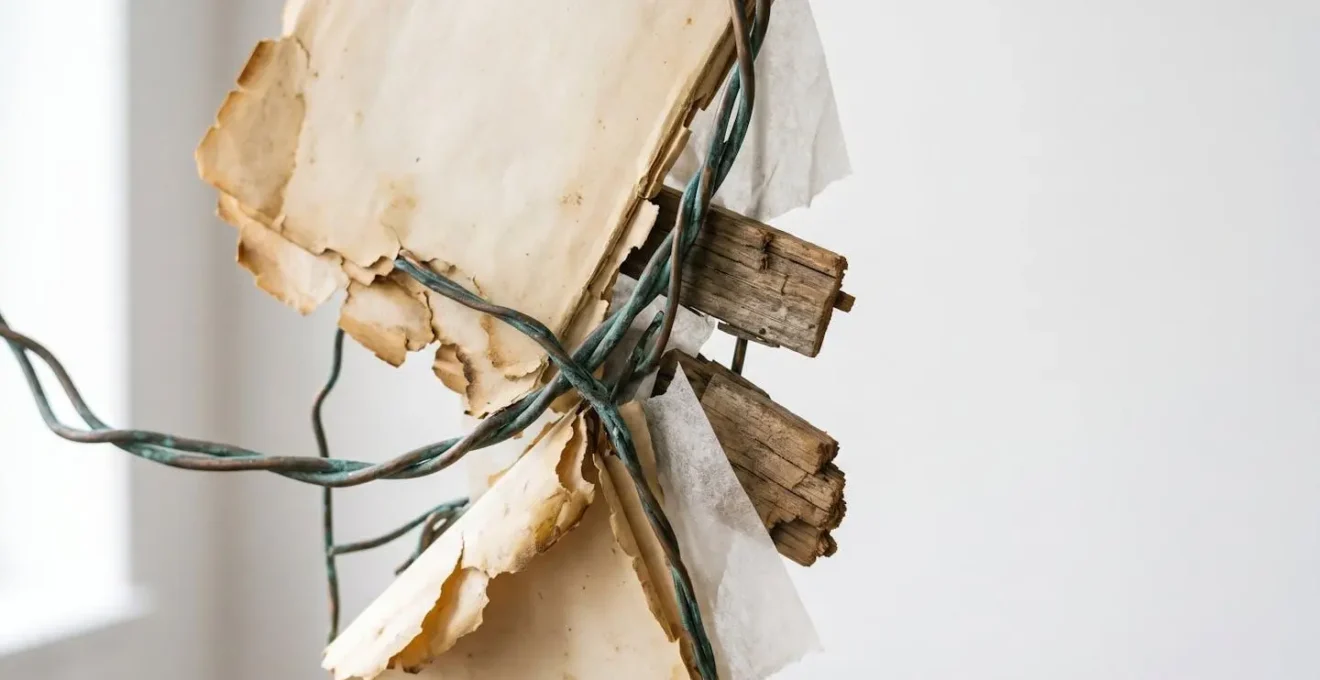
The allure of mixed media art is its material diversity; its greatest risk is the inherent conflict between those same materials.
- Many works contain their own seeds of destruction (a concept known as inherent vice) through acidic components and incompatible materials that degrade at different rates.
- Conservation costs are tied to the time and materials required for repair, not the art’s market value, and can easily exceed initial estimates for complex pieces.
Recommendation: A collector must shift from a mindset of passive preservation to one of active risk management, often accepting that change and decay are part of the artwork’s intended identity.
The appeal of mixed media artwork is immediate and undeniable. The unexpected juxtaposition of materials—paper, plastic, metal, textiles, even organic matter—creates a textural and conceptual depth that traditional painting or sculpture can rarely match. For the discerning collector, these pieces represent a bold frontier of artistic expression. However, this material complexity is a double-edged sword. While collectors are often advised to control light and humidity, this standard guidance barely scratches the surface of the challenges presented by these composite objects.
The fundamental issue is not merely external but internal. Many mixed media works are in a constant, slow-motion battle with themselves. The very materials that give a piece its unique character can also be the agents of its eventual decline. This introduces a significant element of risk that is often underestimated at the point of acquisition. The collector’s role, therefore, must evolve beyond that of a simple custodian.
But what if the key to long-term ownership of mixed media isn’t just about preservation, but about active risk management? This requires a shift in perspective: from viewing the artwork as a static object to understanding it as a dynamic, and sometimes unstable, system. It means learning to think like a preventive conservator, identifying potential failures before they become catastrophic and making informed decisions about intervention versus acceptance.
This guide will deconstruct the unique challenges of collecting mixed media art. We will explore the chemical self-destruction of certain materials, the true financial costs of restoration, the precise environmental needs, the complexities of appraisal, and the critical importance of documentation. Ultimately, we will address the philosophical question of when to intervene and when to let an artwork follow its intended path of transformation or decay.
To navigate these complex issues, this article breaks down the core challenges every mixed media collector will face. The following sections provide a framework for making informed decisions and protecting your investment over the long term.
Table of Contents: A Collector’s Guide to Mixed Media Challenges
- Glue and Acid: Why Do Some Mixed Media Collages Self-Destruct over Time?
- How Much Does It Cost to Fix a Damaged Assemblage Piece?
- Humidity and Heat: What Environment Does Mixed Media Require?
- How to Appraise Art When the Materials Have No Intrinsic Value?
- The Error of Buying Unsigned Mixed Media without a Certificate of Authenticity
- Stop or Watch: When Should You Let an Artwork Decompose as Intended?
- Fade Resistance: How Many Years Will an Inkjet Print Last in Frame?
- How Do Conservators Fix Art Made of Chocolate, Fat, or Decomposing Materials?
Glue and Acid: Why Do Some Mixed Media Collages Self-Destruct over Time?
One of the most insidious threats to a mixed media collection is a phenomenon known as inherent vice: the tendency of an object to destroy itself due to the instability of its own components. This is especially prevalent in collages and assemblages created from the early to mid-20th century, a period when artists often prioritized aesthetic effect over material longevity. The primary culprits are often the paper and adhesives used.
Many older papers, particularly those made from ground wood pulp, are highly acidic. As the Cornell University Library Preservation Team notes, this material “deteriorates especially rapidly because of the chemicals it contains—principally acids and lignin—and soon becomes brittle.” This acidic paper embarks on a process of auto-catalytic degradation. The acids break down the cellulose fibers in the paper, which in turn creates more acid, accelerating a cycle of yellowing, embrittlement, and eventual disintegration. The difference is stark: archival standards show that alkaline, acid-free paper can last for 500 to 1,000 years, whereas acidic paper can show significant decay in a matter of decades.
This problem is compounded when acidic materials are glued to more stable supports. The acid can migrate from the newspaper clipping or cardboard fragment into the archival-quality mat board beneath it, creating a “ghost” image and compromising the entire structure. The adhesives themselves can also fail, losing their plasticity, becoming brittle, and staining the surrounding materials. For a collector, this means a seemingly stable collage is a ticking clock, slowly consuming itself from within.
How Much Does It Cost to Fix a Damaged Assemblage Piece?
When a mixed media piece begins to show signs of distress—delamination, discoloration, or structural failure—a collector’s first instinct is to seek restoration. However, the financial reality of conservation can be surprising. Unlike other service industries, the cost of art conservation is detached from the market value of the artwork itself. Instead, it is based on the time, specialized labor, and materials required to perform the treatment.
This principle is a core tenet of the profession. As the Williamstown Art Conservation Center guidelines state:
Cost is based on time and materials required, not on the value of the object.
– Williamstown Art Conservation Center, Conservation pricing guidelines
For a collector, this means that a minor work purchased for a few thousand dollars could easily require a repair that costs just as much, if not more. A preliminary assessment and condition report, which is necessary to even diagnose the problem and propose a treatment plan, can cost at least $150 from a typical conservation center. Following that, even minor interventions on complex works are labor-intensive. Professional conservators report that repairs for a small, traditionally painted artwork can run from $800 to $1,000 for average restoration. For a mixed media assemblage with multiple failing components, this cost can escalate dramatically.
Factors that drive up the cost include the need for extensive research into unconventional materials, the fabrication of custom mounts, or the delicate process of separating and stabilizing multiple, conflicting layers. This financial reality makes a pre-acquisition condition assessment an invaluable, though often overlooked, investment.
Humidity and Heat: What Environment Does Mixed Media Require?
While all art requires a stable environment, mixed media pieces are uniquely sensitive to fluctuations in temperature and relative humidity (RH). The core issue is differential degradation: different materials expand, contract, and absorb moisture at different rates. A piece that combines wood, plastic, metal, and paper is a complex system where each component reacts to the environment differently. As humidity rises, the paper and wood will swell, while the plastic and metal remain relatively stable. As it falls, they will shrink.
This constant, microscopic tug-of-war places immense stress on the joins, adhesives, and surfaces of the artwork, leading to delamination, cracking, and warping. To mitigate this, a rigorously controlled environment is not a luxury but a necessity. The goal is to find a stable equilibrium that balances the needs of all materials. Conservation standards recommend maintaining a temperature between 68°F to 72°F (20°C to 22°C) for optimal preservation.
Even more critical is relative humidity. Climate control systems in museums and archives aim to maintain a steady level between 45% to 55% relative humidity to prevent damage. Exceeding this range can promote mold growth and chemical degradation, while dropping below it can cause organic materials to become brittle. For the private collector, achieving this level of stability often requires dedicated room humidifiers, dehumidifiers, and precise monitoring equipment, representing a significant and ongoing operational cost.
How to Appraise Art When the Materials Have No Intrinsic Value?
Appraising a traditional painting often starts with considerations of the artist’s market, provenance, and condition. With many forms of mixed media, particularly conceptual works, an additional layer of complexity arises: the materials themselves may be worthless. How do you assign value to an artwork made of dirt, felt, scrap metal, or decaying food? The answer lies in shifting the focus from material integrity to conceptual integrity.
The value of such works is not in their physical substance but in the idea they represent, their historical importance, and the reputation of the artist. A prime example of this principle can be found in the Arte Povera movement, which emerged in Italy in the late 1960s. These artists deliberately chose “poor” or commonplace materials to challenge the commercialization of the art world.
Case Study: The Value of a Concept in Arte Povera
The Arte Povera movement provides a clear model for conceptual value. As one analysis of Arte Povera explains, artists used everyday materials like rags, twigs, and soil to critique the notion that art must be made of noble materials to have value. For instance, Giovanni Anselmo’s work ‘Untitled’ (1968) consists of a block of granite compressing a head of lettuce. The lettuce must be replaced as it wilts. Here, the value is not in the stone or the vegetable but in the conceptual framework of tension, time, and organic process. The artwork’s significance is tied entirely to its place in art history and the artist’s documented intent, completely superseding the cost of its components.
For a collector, this has profound implications. An appraisal must be conducted by a specialist who understands the specific historical and conceptual context of the work. The valuation will depend heavily on factors like the artwork’s exhibition history, its inclusion in critical literature, and its significance within the artist’s oeuvre. The physical object is merely the vehicle for the idea, and its value is contingent on the strength and recognition of that idea in the art world.
The Error of Buying Unsigned Mixed Media without a Certificate of Authenticity
In the world of unique or complex artworks, provenance is paramount. For a simple oil painting, an artist’s signature can often serve as a primary mark of authenticity. For a mixed media assemblage, which may be unsigned or composed of disparate elements, the Certificate of Authenticity (COA) and other supporting documentation become the most critical assets, often more important than any single component of the work itself.
A robust COA, issued by the artist or their official estate, provides definitive proof of authorship. Without it, the artwork’s legitimacy can be perpetually questioned, making it difficult to appraise, insure, or resell. The documentation should ideally go beyond a simple certificate. For complex works, it should include a detailed list of materials used, fabrication notes, and, crucially, the artist’s intent regarding aging and repair. Does the artist expect a certain plastic component to yellow over time? Are there specific instructions for replacing a perishable element?
This information is the collector’s only true guide for long-term care. As independent art conservator Ana Alba notes, “Contemporary artists are creating multimedia works of art, and those are naturally harder to care for than a traditional painting.” The documentation serves as the bridge between the artist’s vision and the conservator’s ethical obligation to preserve it. Acquiring a mixed media piece without this paper trail is an enormous gamble. It forces the collector and any future conservator to make decisions in a vacuum, risking actions that may contradict the artist’s original vision and potentially compromising the work’s integrity and value.
Stop or Watch: When Should You Let an Artwork Decompose as Intended?
The traditional goal of conservation is to arrest decay and preserve an object for posterity. With certain types of mixed media art, however, this impulse can be a fundamental misinterpretation of the work. For artists working with ephemeral materials—such as fat, chocolate, plants, or live animals—the process of change, decay, and transformation is often an integral part of the artwork’s concept. In these cases, the collector is faced with a philosophical choice: preserve the object, or preserve the idea?
This dilemma is central to works from the Arte Povera movement. Giovanni Anselmo’s ‘Untitled (Sculpture That Eats)’ (1968) features a head of lettuce wedged between two granite blocks. The wilting of the lettuce is not a sign of damage to be repaired; it is the event the sculpture was created to enact. The work ‘lives’ through this cycle of decay and renewal, requiring the owner to “feed” it a new head of lettuce periodically. To encase it in a climate-controlled vitrine to stop the wilting would be to kill the piece.
For such artworks, conservation strategies must be radically different. As documented in studies of the movement, “because many works change or perish, exhibitions and publications frequently rely on photographic documentation, reconstructions, and artist instructions.” The ‘artwork’ is not a single, stable object but a set of instructions, a documented event, or a process. The collector’s responsibility shifts from material preservation to faithful re-enactment or documentation. This requires a profound acceptance that you may not be owning a permanent artifact, but rather stewarding a concept through time.
Fade Resistance: How Many Years Will an Inkjet Print Last in Frame?
Mixed media works frequently incorporate photographic or digitally printed elements. While these components can add immense visual power, they also introduce a vulnerability specific to inks and dyes: fading. An inkjet print’s longevity is a function of three things: the quality of the ink, the type of paper, and its protection from environmental factors, especially ultraviolet (UV) light.
Not all prints are created equal. A print made with standard desktop printer inks on low-grade paper can show noticeable fading within a few years, even in moderate light. In contrast, a fine art print made with archival pigment inks on acid-free, 100% cotton rag paper has a much greater life expectancy. According to Wilhelm Imaging Research standards, the industry benchmark for permanence testing, professional archival pigment inks can last for 100 years or more under proper display conditions before significant fading occurs.
However, even the highest quality materials are vulnerable without proper protection. The single greatest threat is UV light, from both sunlight and fluorescent bulbs. This is where archival framing becomes a critical, non-negotiable line of defense. A proper archival frame is not just a decorative border; it is a micro-environment designed to protect the print from external threats.
Action Plan: Key Components of an Archival Framing System
- UV-Filtering Glazing: Choose between UV-filtering acrylic or museum-grade glass to block up to 99% of harmful light wavelengths.
- Archival Mat Board: Use only acid-free, lignin-free matting and mounting boards with an alkaline buffer to prevent acid migration to the artwork.
- Proper Spacers: Install spacers between the print and the glazing to create an air gap, preventing moisture condensation and the risk of the print adhering to the surface.
- Acid-Free Backing: Employ a sealed, moisture-resistant, and acid-free backing board to protect the work from pollutants and humidity from the rear.
- Climate Control: Ensure the framed piece is displayed in a stable environment, ideally within the recommended temperature and humidity ranges for mixed collections.
For a collector, investing in archival framing is as important as acquiring the artwork itself. It is the most effective measure to ensure the vibrancy and integrity of photographic and printed elements for generations.
Key Takeaways
- Inherent Vice is Real: Many mixed media pieces are chemically unstable and are designed, intentionally or not, to self-destruct over time due to acidic materials.
- Cost is Unrelated to Value: The expense of conservation is determined by labor and complexity, not the artwork’s market price, making repairs on affordable pieces potentially cost-prohibitive.
- Conceptual vs. Material Integrity: For many works, especially those using ephemeral materials, the artist’s idea is more important than the physical object. Preservation may mean letting the object decay as intended.
How Do Conservators Fix Art Made of Chocolate, Fat, or Decomposing Materials?
The conservation of artworks made from unconventional, organic, and intentionally unstable materials pushes the boundaries of the profession. When faced with a decaying chocolate sculpture or a rancid fat installation, a conservator’s primary role shifts from restoration to managed care and, most importantly, a deep dialogue with the artist’s original intent. The ethical code of conservation prioritizes reversibility and preserving the artist’s chosen materials, however challenging they may be.
In many cases, a full “fix” is neither possible nor desirable. For an artist like Jannis Kounellis, whose 1969 work ‘Untitled (12 Horses)’ involved stabling live horses in a gallery, the life processes—breathing, eating, excreting—were the medium. A conservator cannot “fix” a living thing. Instead, their role becomes one of documenting the work’s life cycle and ensuring that any re-staging adheres to the artist’s conceptual parameters. For materials like chocolate, conservators might focus on creating precise storage conditions (low temperature, controlled humidity) to slow bloom and degradation, but they would not replace the original material with a more stable look-alike unless specified by the artist.
This approach requires a delicate balance between scientific analysis and art historical interpretation. As conservator Ana Alba explains, the ethics are clear but the reality is complex:
Our code of ethics is to use most things that are reversible because we can’t change the artist’s intent or chosen materials. However, I have treated cardboard before, and no one should expect that to last a thousand years.
– Ana Alba, Independent art conservator, founder of Alba Art Conservation
Ultimately, for collectors of such challenging works, “conservation” may mean creating a cold-storage vault, meticulously documenting the object’s changes over time, and accepting that the artwork’s existence might be finite. The conservator’s job is to manage that process with integrity, not to reverse it.
Approaching the acquisition of a mixed media artwork with this informed, preventive mindset is the single most important step you can take. To ensure the long-term viability of a potential purchase, consider commissioning a pre-acquisition condition report from a qualified conservator to identify risks before you invest.