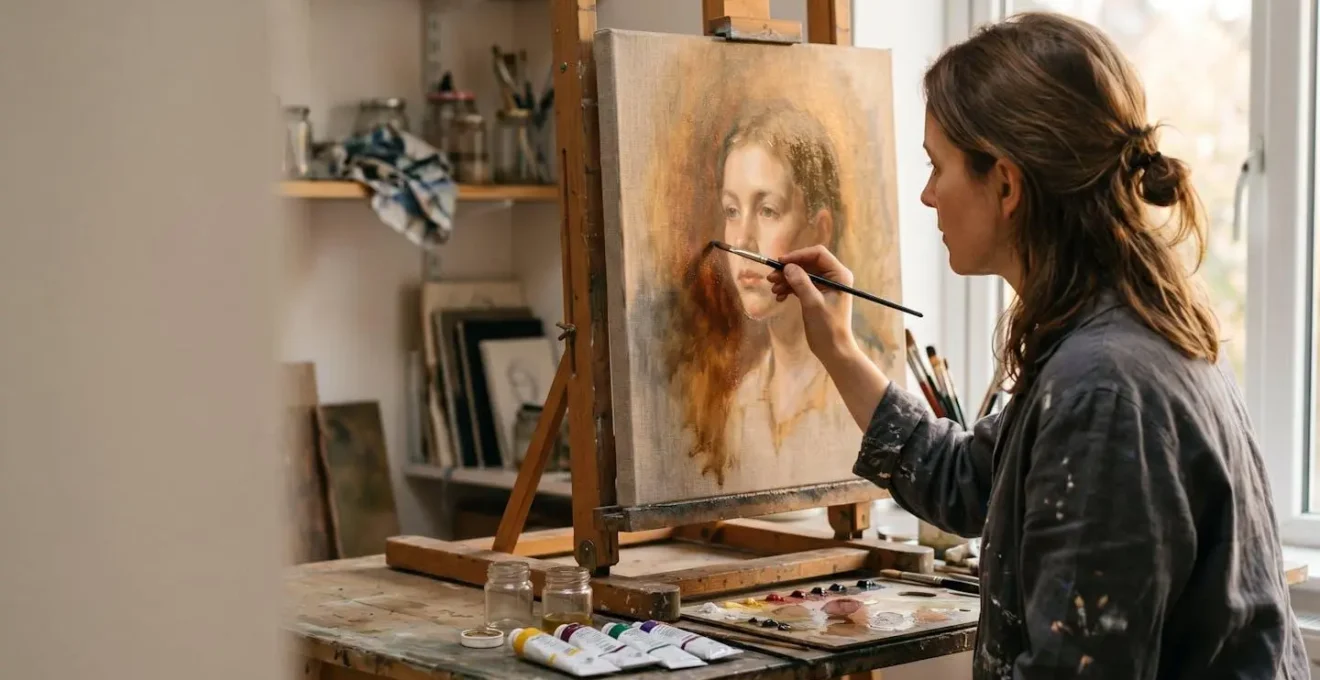
Successfully reinventing classical painting techniques is not a nostalgic act, but a series of deliberate, strategic decisions that solve contemporary visual problems.
- Historical methods like glazing and tempera are chosen for their unique optical properties, offering luminosity and depth that modern materials struggle to replicate.
- Conscious “errors,” such as anatomical distortion, are used as precise tools to convey psychological states, transforming technical inaccuracy into expressive power.
Recommendation: Instead of viewing classical and contemporary practices as opposed, treat historical techniques as a specialized toolkit. Master their ‘why’ to apply them with purpose, not just for imitation.
The contemporary art world often seems locked in a relentless pursuit of the new, valuing digital mediums and conceptual novelty. In this landscape, the idea of a modern artist painstakingly applying layers of oil glaze or grinding pigments by hand can feel like a nostalgic anachronism. The common discourse suggests that artists today simply “blend old and new,” a vague statement that does little to explain the rigorous thought process involved. This perspective misses the crucial point: for a growing number of figurative painters, returning to classical methods is not about imitation, but about strategic acquisition of a more potent visual language.
This is not a retreat into the past. It is a calculated advance. When a painter chooses egg tempera over acrylic, or linen over polyester canvas, they are making a decision rooted in a deep understanding of material science and art history. They are exercising their technical agency to achieve specific outcomes—a certain quality of light, a unique surface texture, or a guarantee of archival permanence—that contemporary alternatives may not provide. This approach moves beyond mere aesthetics and into the realm of applied philosophy, where the medium itself becomes part of the message.
But if the true value lies not in replication but reinvention, what does that look like in practice? The key is to understand that these techniques are not rigid dogmas but flexible systems of logic. The real innovation lies in deconstructing their foundational principles and applying them to contemporary subjects and concerns. It’s about understanding the ‘why’ behind the ‘how’—why chiaroscuro creates drama, why glazing creates luminosity, why life drawing builds a more profound understanding of form than a photograph.
This guide will deconstruct the specific technical decisions that modern artists make when they engage with classical traditions. We will move beyond the surface-level discussion of “inspiration” and delve into the practical mechanics of how these historical methods are being actively re-engineered to create works that are both technically masterful and undeniably contemporary.
Summary: A Technical Guide to Reinventing Classical Painting Methods
- Why Is the Old Master Glazing Technique Still Relevant for Contemporary Oil Painters?
- Accuracy vs Distortion: When Should You Break the Rules of Anatomy?
- Candlelight or LED: How to Light a Sitter for a Modern Baroque Look?
- The Error of Relying Solely on Photos instead of Life Studies
- Cotton or Linen: Which Canvas Choice Ensures Your Tradition-Inspired Work Lasts?
- Bole and Gesso: Why Is Surface Preparation Critical for a Mirror Finish?
- Natural vs Plastic: Why Choose Tempera over Modern Acrylics?
- Why Is Egg Tempera the Best Medium for Luminosity and Detail?
Why Is the Old Master Glazing Technique Still Relevant for Contemporary Oil Painters?
Glazing—the application of thin, transparent layers of paint—is often perceived as a slow, laborious process belonging to a bygone era. Yet, its persistence in modern studios is a testament to its unparalleled ability to create effects of luminosity and depth. The fundamental principle remains unchanged: light travels through the transparent glaze layers, reflects off the opaque underpainting, and refracts back to the viewer’s eye, creating a sense of inner light. As LePrince Charleston Art Galleries notes, “With its long history in oil painting, glazing remains a valuable method for achieving luminosity and depth in paintings today.” This optical richness is a primary reason for its contemporary relevance, particularly as oil paint continues to command a significant 38.21% market share within the paints segment in 2024.
The reinvention of glazing lies not in changing the technique itself, but in its application and context. Modern artists now engage in a form of controlled anachronism, using these ancient methods to render contemporary subjects. Furthermore, the logic of glazing—building an image through transparent layers—has found a direct parallel in digital software like Photoshop. Artists fluent in both digital and traditional media can plan complex layered compositions on a tablet before ever touching a physical brush, using digital studies to resolve color and value relationships with a precision unavailable to the Old Masters.
This image illustrates the conceptual bridge between a modern digital workflow and the traditional, hands-on execution of oil glazing. It visualizes the artist’s ability to translate layered digital concepts into the tangible, luminous reality of a physical painting.
This hybrid approach represents a profound shift. The contemporary artist is not simply copying a historical process; they are leveraging modern tools to amplify and refine a classical one. The choice to glaze is a deliberate act of technical agency, a decision to invest time in a process that yields a unique visual quality—a depth and subtlety that impasto or direct painting cannot replicate. It’s a choice to prioritize optical complexity over speed of execution.
Accuracy vs Distortion: When Should You Break the Rules of Anatomy?
Academic training has, for centuries, drilled into artists the importance of anatomical accuracy. A mastery of bone structure, musculature, and proportion was considered the bedrock of figurative art. However, many of the most powerful works of the 20th and 21st centuries—from Picasso and Bacon to contemporary painters—derive their impact precisely from the deliberate distortion of the human form. For the modern artist, the question is not *if* one should break these rules, but *when* and *why*. The decision to distort is not a sign of incompetence; it is a sophisticated tool for conveying psychological and emotional states that strict mimesis cannot access.
As painter Blanche Ellis articulates, “Distortion of the body is the most emotional thing you can depict. Because everyone has a body they know how it feels to be in one.” This insight is the key: distortion works because it triggers a visceral, empathetic response in the viewer. We understand the feeling of being stretched, compressed, or fragmented on a primal level. The modern artist uses this as a formal language. Elongating a neck can signify elegance or vulnerability; exaggerating the size of hands can denote anxiety or power. Each deviation from anatomical reality is a calculated decision intended to amplify the painting’s conceptual core.
Recent research even suggests a neurological basis for this artistic choice. A 2024 study on contemporary painters revealed a movement toward what researchers termed ‘disrupted realism’. It found that 85% of painters who use distortion reported experiencing positive disorders of perception, suggesting artists may be translating their own unique perceptual experiences into their work. This moves the act of distortion from a purely stylistic choice to a form of authentic phenomenological reporting. It is a profound act of perceptual translation, where the artist’s internal vision is rendered with more fidelity than the external world.
Candlelight or LED: How to Light a Sitter for a Modern Baroque Look?
The dramatic interplay of light and shadow known as chiaroscuro is one of the most enduring legacies of the Baroque period. The high-contrast, tenebristic worlds of Caravaggio and de La Tour continue to fascinate artists and viewers alike. While the Old Masters relied on the single, unstable flame of a candle or a strategically placed window, the contemporary painter has an arsenal of advanced lighting tools at their disposal. The challenge—and the opportunity—is to achieve that same dramatic, sculptural effect without creating a pastiche. The goal is a modern Baroque look, not a historical reenactment.
The key is to control the quality, not just the direction, of the light. A single, hard light source is the essence of chiaroscuro. In a modern studio, this is best achieved not with an array of softboxes, but with a single, focused LED panel or a spotlight with barn doors. By carefully controlling the light’s spread and position, an artist can carve a figure out of darkness, creating the sharp falloff and deep shadows characteristic of the style. The use of a modern LED offers significant advantages: consistent color temperature, adjustable intensity, and the absence of fire risk, allowing for prolonged and safe life-painting sessions.
This setup demonstrates how a single, controlled modern light source can create the dramatic contrast and sculptural form reminiscent of classical chiaroscuro, translating a historical aesthetic into a contemporary studio practice.
The reinvention comes from the subject matter and composition. Applying this dramatic lighting to a contemporary sitter in modern attire, or within a minimalist environment, creates a powerful tension between the classical lighting style and the current-day subject. The choice is a deliberate one: the artist uses a controlled anachronism to imbue a modern scene with a sense of timeless drama and psychological weight. It is a way of accessing a historical emotional register and applying it to the present moment.
The Error of Relying Solely on Photos instead of Life Studies
In an age of high-resolution digital cameras and infinite online image resources, the temptation to work exclusively from photographs is immense. It offers convenience, stillness, and access to subjects that would be impossible to paint from life. However, this convenience comes at a significant cost. The fundamental error lies in mistaking a photograph for reality. A camera is not a neutral observer; it is a machine with a single lens that flattens space, distorts perspective, alters color, and simplifies value relationships. As the Artsy Editorial team warns, “Artists who rely solely on photos may spend their time recreating a camera’s view of the world, instead of their own uniquely human one.”
The act of drawing or painting from life is a multi-sensory, three-dimensional experience. With two eyes, we perceive true depth and volume. We see how light wraps around a form and how subtle shifts in atmosphere affect color over a distance. This process of perceptual translation—of converting the 3D world into a 2D image through the filter of our own perception and intellect—is the very essence of figurative art. It builds a deep, intuitive understanding of form that working from a pre-flattened, pre-composed photograph can never replicate. Relying only on photos risks training the hand but starving the eye.
The most effective modern approach is not a dogmatic rejection of photography but a hybrid model. Photographs are an invaluable tool for capturing fleeting moments, complex details, or compositional ideas. Life studies, in turn, are essential for building the foundational understanding of form, light, and space. One practice informs and corrects the other. The artist uses life drawing to understand the principles of volume and light, and then uses that knowledge to interpret and correct the inherent distortions within their photographic references. This creates a richer, more authentic result that is neither a slave to the photograph nor a purely academic exercise.
Action Plan: Hybrid Realism Workflow
- Reference Capture: Use photographs to capture fleeting moments, unusual compositions, or references for complex details that would be impossible to observe in real-time.
- Volumetric Study: Schedule dedicated life drawing sessions to reintroduce volumetric understanding: observe how light wraps around three-dimensional forms in real space rather than flattened photographic values.
- Distortion Correction: Identify and correct photographic distortions by comparing your photo reference to life observation to recognize lens compression, flattened depth of field, and artificial color temperature shifts.
- Atmospheric Integration: Integrate atmospheric perspective and ‘air’ around subjects. Life studies reveal the subtle tonal shifts in the space between viewer and subject that photographs often eliminate, adding presence.
- Visual Memory Development: Develop visual memory through timed life sketches. These quick observational studies train you to prioritize essential forms and gestures over photographic details.
Cotton or Linen: Which Canvas Choice Ensures Your Tradition-Inspired Work Lasts?
The choice of support—the surface upon which a painting is made—is one of the most fundamental decisions an artist makes. While seemingly a simple technical detail, it is a choice imbued with conceptual weight and profound implications for the artwork’s longevity and final appearance. For artists consciously engaging with classical traditions, the dialogue between cotton duck canvas and premium linen is a central one. It is a decision that pits modern practicality against historical authenticity and archival intent.
Cotton canvas is the ubiquitous, accessible choice of the modern era. It is affordable, widely available, and its smooth, mechanical weave provides a uniform surface suitable for many styles of painting. With proper sizing and priming, a good quality cotton canvas can be a perfectly acceptable archival support. Its primary voice is one of democratic accessibility and contemporary pragmatism. However, its fibers are shorter and less robust than linen, making it more susceptible to expansion and contraction due to changes in humidity, which can stress the paint film over time.
Linen, on the other hand, is the historic support of the Old Masters. Made from the fibers of the flax plant, it is renowned for its strength, durability, and beautiful, irregular weave. The individual fibers are much longer and stronger than cotton, giving the canvas superior dimensional stability and resistance to degradation. For an artist using techniques like glazing, the visible, organic texture of the linen can become an integral part of the artwork’s character. Choosing linen is a statement. It is a material dialogue with history, a decision to align one’s work with a centuries-long tradition of fine craftsmanship. It prioritizes archival permanence and a specific textural quality over cost and convenience.
The following table breaks down the key differences not just in material properties, but in the conceptual voice each support brings to a finished work of art. The choice of support is the first word in the conversation your painting will have with its viewer and with history.
| Support Type | Archival Quality | Texture Character | Conceptual Voice | Cost Consideration |
|---|---|---|---|---|
| Premium Linen | Excellent (centuries-proven) | Irregular, organic weave with visible tooth | Historical continuity, connects to Old Master tradition | High cost (premium material) |
| Cotton Canvas | Good (with proper priming) | Regular, mechanical weave, smoother surface | Democratic accessibility, contemporary practicality | Moderate cost (widely available) |
| Archival Polyester | Excellent (superior dimensional stability) | Uniform, controlled texture options | Modern performance, challenges material orthodoxy | Moderate to high (specialized product) |
| Aluminum Composite / Dibond | Exceptional (impervious to environmental degradation) | Perfectly smooth, industrial flatness | Radical contemporary choice, maximum tension with traditional medium | High cost (specialized substrate) |
Bole and Gesso: Why Is Surface Preparation Critical for a Mirror Finish?
Before a single drop of pigment is applied, the character of a painting is already being determined. The preparation of the support is not a mere preliminary chore; it is the foundational act that dictates the final painting’s luminosity, texture, and permanence. In classical traditions, particularly for panel painting, this process was an elaborate ritual involving layers of gesso and bole. For the contemporary artist seeking to emulate the jewel-like finish of early Renaissance or icon paintings, understanding this process is non-negotiable. The mirror finish of the final work is a direct reflection of the obsessive perfection of its ground.
Traditional gesso, a mixture of an animal glue binder (like rabbit skin glue) and an inert white pigment (like chalk or gypsum), creates a brilliant, white, and absorbent ground. Unlike modern acrylic “gesso,” which is essentially a flexible plastic primer, true gesso is rigid and best suited for inflexible supports like wooden panels. The process involves applying numerous thin layers, sanding between each application with progressively finer grits. This meticulous labor creates a surface that is flawlessly smooth and highly absorbent, which is critical for the crisp detail and luminous color of mediums like egg tempera.
Case Study: Gesso Preparation as Meditative Practice
Contemporary classical realist painters continue to use meticulous gesso preparation techniques borrowed from historical icon painting. The process involves applying multiple thin layers of gesso, sanding each layer progressively finer (from 220 to 600+ grit), and burnishing the final surface. This labour-intensive ritual, which can take days, transforms surface preparation from mere technical necessity into a meditative practice that imbues the work with intentionality before a single stroke of paint is applied.
For techniques like water or oil gilding, an additional layer of refined clay, known as bole, is applied over the gesso. This clay cushion allows the gold leaf to be burnished to a brilliant, mirror-like sheen. The color of the bole (traditionally red, yellow, or black) also influences the final tonality of the gold. In oil painting, the legacy of this preparation is seen in the use of a colored ground, or imprimatura, which serves a similar purpose of unifying the painting and influencing the subsequent color layers. As historian Damian Osborne points out, the Flemish tradition directly carried over these layering principles from tempera to oils, applying transparent glazes on top of opaque underpaintings on meticulously prepared panels.
Natural vs Plastic: Why Choose Tempera over Modern Acrylics?
In a world dominated by the convenience and versatility of acrylics, the decision to work with egg tempera seems almost perversely difficult. Acrylics are stable, waterproof when dry, and adhere to nearly any surface. Egg tempera is brittle, water-sensitive, and demands a rigid, absorbent ground. So why would a contemporary artist choose this demanding, ancient medium? The answer lies in its unique optical properties, its distinct mark-making, and the profound material dialogue it fosters.
Unlike acrylics, where pigments are suspended in a plastic polymer, egg tempera uses the yolk of an egg as its binder. This protein-based emulsion creates a paint film that is incredibly durable yet optically distinct. Because the binder is lean, the pigment particles are more densely packed and less enveloped than in oil or acrylic. This results in a unique, semi-matte surface with a subtle, satiny glow. The light interacts with the pigment more directly, creating a clarity and vibrancy of color that acrylics, with their slightly cloudy polymer binder, struggle to match. The choice is a trade-off: an artist forsakes the convenience of plastic for the luminous purity of protein.
The working properties of tempera also force a different approach. The paint dries almost instantly, making the wet-on-wet blending of oils or modern acrylics impossible. Instead, the artist must build forms through a meticulous network of fine, cross-hatched strokes. This enforced discipline results in a highly controlled, graphic quality. It is a medium that rewards patience and precision, compelling the artist to slow down and build the image with deliberate, rhythmic marks.
This image captures the tactile, organic ritual of preparing egg tempera paint. It emphasizes the artist’s direct connection to raw materials—pure pigment and egg yolk—a fundamental departure from using pre-mixed, synthetic paints.
Choosing tempera is an act of archival intent and a conceptual statement. It is a rejection of the speed and homogeneity of modern materials in favor of a method that is deeply connected to the history of art and the natural world. It is a choice to engage in a ritualistic process, where the artist is not just a consumer of materials but a maker in the truest sense.
Key Takeaways
- Mastery of classical techniques is not about imitation, but about acquiring a specialized toolkit to solve contemporary visual problems with precision.
- The choice of materials—from the canvas support to the paint binder—is a conceptual act that informs the painting’s meaning and ensures its archival future.
- The most powerful contemporary work often emerges from a hybrid practice, using life studies to correct the distortions of photo references and modern tools to refine classical processes.
Why Is Egg Tempera the Best Medium for Luminosity and Detail?
While oil glazing is renowned for its depth, egg tempera holds a special place in the history of art for its unparalleled combination of luminosity and capacity for fine detail. Its unique qualities stem directly from the physics of its composition: pigment bound in a lean egg yolk emulsion, applied in thin, semi-opaque layers to a bright, absorbent gesso ground. The resulting luminosity is not just a surface effect; it is a structural phenomenon built from the ground up. The bright white gesso acts as a mirror, reflecting light back through the delicate layers of paint, creating a glow that seems to emanate from within the panel itself.
This structural luminosity is different from that of oils. As noted by Fine Art Tutorials, oil glazing’s glow comes from “light refracting through the layers of glaze, then reflecting off of the opaque layer beneath.” In tempera, the layers themselves are less transparent than an oil glaze but are applied so thinly that the light can penetrate multiple layers before reflecting off the brilliant white gesso. This creates a softer, more diffuse luminosity, a signature characteristic of masters like Fra Angelico and Botticelli. This method allows for a unique kind of optical color mixing, where layers of different colors interact to create a complex, vibrant final hue.
Furthermore, the rapid drying time and the lean nature of the binder allow for an extraordinary level of detail. The artist can lay down precise, crisp lines that do not bleed or soften. This makes egg tempera the ideal medium for rendering intricate patterns, fine hair, and delicate textures. The traditional method of building form with a web of fine cross-hatching is a direct result of these properties. This enforced discipline of mark-making gives tempera paintings their characteristic linear clarity and graphic strength, a quality that is very different from the soft, blended sfumato achievable with oils.
Case Study: Bouguereau’s Systematic Glazing
Though an oil painter, 19th-century Academic painter William-Adolphe Bouguereau exemplified the systematic use of layering for luminosity, a principle shared with tempera. His process involved building paintings slowly through numerous transparent layers over meticulous underpaintings. This demonstrates how the core principle—building light through transparent layers over a reflective ground—remained central to achieving luminosity, even as mediums evolved. Bouguereau’s work is a testament to the power of methodical layering to create a signature atmospheric quality.
By deconstructing and understanding these classical techniques, from the ground up, you are not looking backwards. You are arming yourself with a set of proven, powerful tools. The true task of the contemporary figurative artist is to wield this historical knowledge with intention, creating work that resonates with the depth of the past while speaking clearly to the complexities of the present.