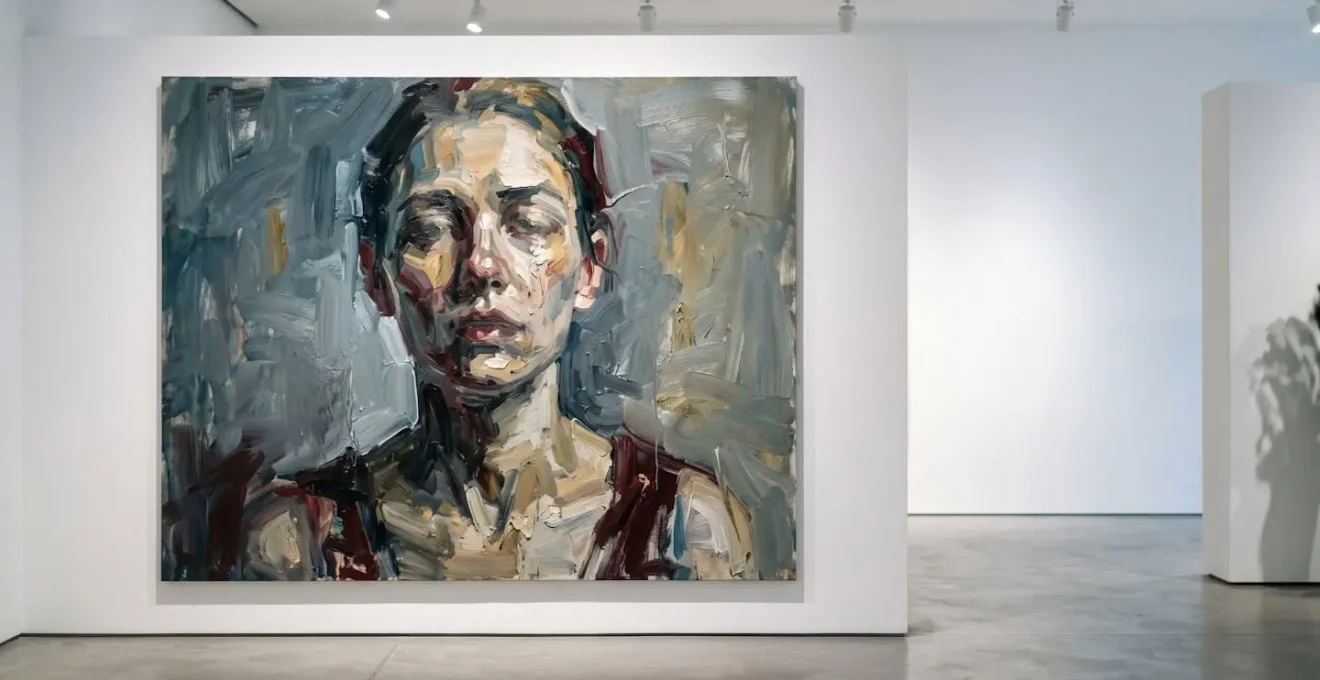
The resurgence of figurative art is not a simple backlash against digital life; it is a complex sociological negotiation where the human form becomes the primary medium for exploring modern identity, status, and emotional truth.
- It serves as a tool for critiquing fluid, post-industrial class structures that abstraction cannot easily articulate.
- It offers a space for representing nuanced psychological states and anxieties that defy simple digital expression.
- It empowers historically marginalized voices, particularly female artists, to reclaim and redefine narratives around the human body.
Recommendation: To truly understand this movement, look beyond mere technical skill and view each piece as a document of our collective search for authenticity in a digitally saturated world.
In an era saturated with ephemeral digital images, abstract NFTs, and algorithm-driven aesthetics, a powerful counter-current has emerged from the most traditional of sources: figurative art. The return of the human form to the forefront of the contemporary art scene is often explained as a simple, nostalgic reaction—a desire for something tangible and relatable in a world that feels increasingly virtual. This view, however, misses the profound sociological shift at play. The renewed focus on the figure is not a retreat to the past but a sophisticated and urgent response to the present.
This isn’t merely about artists rediscovering old techniques. It’s about using the body as a canvas to dissect the very fabric of our modern existence. We are witnessing the human form become a battleground for re-negotiating identity, a mirror reflecting our collective anxieties, and a tool for challenging established power structures. The resurgence is driven by a deep-seated need for what can be termed “somatic authenticity”—a hunger for the kind of emotional truth and nuance that only the complex, imperfect human figure can convey, a stark contrast to the curated perfection of our digital selves.
This analysis will move beyond surface-level market trends to explore the critical functions of this new wave of figurative art. We will examine how it critiques social structures, dissects psychological states, and reshapes market dynamics. By understanding the “why” behind this movement, we can begin to appreciate its true significance as a defining cultural phenomenon of our time.
This article explores the key facets of this complex return to the figure, from its role in social critique to its deep-seated psychological motivations and its impact on the art market itself.
Summary: Why Is Contemporary Figurative Art Making a Comeback in a Digital-First Era?
- How Do Modern Portraits Critique British Class Structure differently than in the past?
- Hyperrealism or Expressionism: Which Style Better Captures Modern Anxiety?
- Why Are Female Figurative Painters Dominating the Current London Gallery Scene?
- The Error of Confusing Technical Skill with Emotional Depth in Portraiture
- Where to Start When Building a Contemporary Figurative Art Collection with £5,000?
- From Van Dyck to YBA: How Has the “Selfie” Evolved in British Art History?
- The Mistake of Looking Down on Illustrators in the Art World
- Why Do Artists Paint Self-Portraits in an Age of Instant Selfies?
How Do Modern Portraits Critique British Class Structure differently than in the past?
Historically, British portraiture was a direct instrument of class affirmation. As noted by the Royal Society of Portrait Painters, early masters like William Hogarth expertly balanced depictions of “rank and personality,” making social status immediately legible through codified symbols of wealth, power, and lineage. The subject’s role in society was the portrait’s primary message. This direct representation of a fixed, landed hierarchy, however, is no longer relevant to the complexities of modern Britain.
The very nature of the British class system has been fundamentally reconfigured. The old world of inherited titles and industrial wealth has been largely replaced by a new structure forged in the crucible of post-Thatcherite policies. Sociological analysis points to deindustrialization, the rise of the service economy, and a surge in self-employment as the forces that have created a more fluid, yet arguably more precarious, social landscape. Status legibility is no longer about displaying land or titles; it’s about navigating cultural capital, educational background, and the subtle codes of consumerism.
Modern figurative portraiture critiques this new reality not by depicting overt symbols of wealth, but by exposing the anxieties and contradictions of this system. Artists now focus on the subtle signifiers: the brand of trainers, the tension in a subject’s posture, the blandness of a corporate background, or the defiant gaze that challenges the viewer’s assumptions. The critique has shifted from a declarative statement of “who I am” to a more interrogative exploration of “where do I fit?” It’s a move from portraying static identity to capturing the performance of class in a fragmented, service-driven society.
Hyperrealism or Expressionism: Which Style Better Captures Modern Anxiety?
Modern anxiety is a defining condition of our time, characterized by a constant, low-level hum of uncertainty, information overload, and social pressure. The question of how to represent this internal state visually leads to a fascinating divergence in figurative art, primarily between hyperrealism and expressionism. Each style offers a different, yet potent, lens on the psychological landscape of the 21st century. One depicts its flawless mask, the other its chaotic internal reality.
Hyperrealism, with its meticulous, photographic precision, captures the surface of anxiety. It renders the unnervingly smooth skin, the vacant, glass-like eyes, and the perfectly composed settings that often belie an inner turmoil. The uncanny valley effect of a hyperrealist portrait can be deeply unsettling, reflecting a world where appearances are maintained with strenuous, almost pathological, effort. It is the style of the curated self, the public-facing persona polished for social media, where every flaw is erased, creating a perfection that is itself a source of profound unease. It shows us the symptom, the flawless container holding a churning interior.
Expressionism, conversely, bypasses the surface entirely to depict the raw, visceral experience of anxiety. It uses distorted forms, jarring colors, and aggressive brushwork to translate an internal state directly onto the canvas. This approach sacrifices literal reality to achieve a higher emotional granularity, showing not what anxiety *looks like*, but what it *feels like*. The resulting image is often chaotic and fragmented, mirroring the fracturing of the self under psychological stress. The tension is not hidden beneath a perfect veneer but is made manifest in the very fabric of the paint.
As the image above suggests, the violent energy of the brushstroke itself becomes a direct conduit for psychological release. While hyperrealism presents a chilling diagnosis from the outside, expressionism offers a cathartic testimony from within. Ultimately, expressionism may better capture the *experience* of modern anxiety, refusing the composure that society demands and instead laying bare the turbulent emotional core of our age.
Why Are Female Figurative Painters Dominating the Current London Gallery Scene?
A stroll through London’s leading contemporary art galleries reveals a clear and powerful trend: the rise of female figurative painters. This is not a fleeting moment but the culmination of a significant structural shift in the art world, supported by both market data and a profound cultural recalibration. The dominance is rooted in a confluence of growing economic power and the unique capacity of figurative art to challenge and rewrite historical narratives.
First, the market itself is undergoing a long-overdue correction. Collectors are increasingly investing in work by female artists, a trend that has been steadily gaining momentum. For instance, a recent UBS report indicates that the share of works by female artists in HNWI collections surveyed reached a seven-year high with a ratio of 44% versus male artists’ works in 2024. This growing financial backing provides a solid foundation for visibility and institutional support, moving these artists from the periphery to the center of the art market conversation.
More importantly, this trend is not just about representation in general; it is specifically tied to the power of the figure. An analysis from the Artsy Market Report notes that of the top-performing women artists, a significant number are choosing the human form as their primary subject. As the report states in its analysis of market trends, “Eleven of these artists, including Laura Berger, who leads the list, work primarily in figurative painting.” This is no coincidence. For centuries, the female form in Western art was predominantly depicted by male artists, for male patrons. The body was an object of the “male gaze.” Today, female painters are reclaiming the figure as a subject, a vessel for their own stories, psychologies, and social critiques. They are using it to explore themes of domesticity, identity, power, and vulnerability from an unapologetically female perspective, creating a new and compelling visual language that resonates deeply with contemporary audiences.
The Error of Confusing Technical Skill with Emotional Depth in Portraiture
In the age of high-resolution digital cameras and AI image generators, the ability to create a photorealistic likeness has become increasingly commoditized. This has led to a critical error in judgment among some viewers and collectors: the conflation of meticulous technical skill with genuine emotional depth. A portrait that looks “just like a photograph” may be a feat of technical prowess, but it often fails to achieve the primary goal of great portraiture, which is to reveal a deeper, less visible truth about the subject.
The true power of a portrait lies not in its ability to replicate a surface, but in its capacity to convey a psychological or emotional state—to capture what it feels like to be a particular person. Consider the work of Edvard Munch. As an Artsy editorial points out, ” Munch saw beyond his own personal history, trauma, and mental illness to capture the universal, nuanced psychological manifestations of the human condition.” His figures are distorted and technically “incorrect,” yet they possess a staggering emotional power because they prioritize psychological truth over anatomical accuracy. This is the essence of emotional depth: an artistic intelligence that selects, exaggerates, and omits details to construct a compelling inner world.
The contemporary art market, in its most discerning and forward-looking segment, has clearly understood this distinction. The phenomenal growth of the market is not solely driven by technically perfect works. The data shows the contemporary art market has grown 1,800% since 2000, a validation that value is increasingly found in conceptual and emotional rigor, not just slavish execution. Collectors are seeking “somatic authenticity”—the sense of a real, flawed, and complex human presence. An artist who can render every eyelash perfectly is a skilled technician; an artist who can make you feel the weight of their subject’s gaze, even with a few rough brushstrokes, is a master of portraiture.
Where to Start When Building a Contemporary Figurative Art Collection with £5,000?
The idea of collecting art can be intimidating, often associated with astronomical prices and exclusive auction houses. However, the contemporary art market has become significantly more accessible, especially in the figurative realm. With a budget of £5,000, an emerging collector has a wealth of strategic opportunities, provided they approach the market with knowledge and a clear plan. The key is to focus on high-potential segments rather than trying to acquire a major work from a blue-chip artist.
The entry-level market is not just viable; it’s booming. According to Artprice, contemporary art saw a record 132,000+ auction transactions in 2024, with the vast majority falling under the $5,000 mark. This explosion in volume demonstrates that it’s possible to acquire authentic, compelling works without a millionaire’s budget. The challenge is navigating this vast landscape to find quality and value. For a new collector, this means focusing on specific, accessible formats and platforms where a £5,000 investment can go far.
Building a collection is about more than just purchasing; it’s about research, passion, and making informed choices. The following steps provide a practical framework for entering the contemporary figurative art market with confidence.
Action Plan: Building Your Figurative Collection
- Target the Affordable Core: Focus on the segment where over 80% of contemporary art sales occur: works priced under £5,000. This is the most active and accessible part of the market.
- Prioritize Editions and Works on Paper: Look for limited edition prints, drawings, and sketches from both emerging and established artists. These formats offer a more direct connection to the artist’s process at a fraction of the cost of a major painting.
- Explore the “Sweet Spot”: Investigate the £5,000 to £50,000 price bracket for unique pieces. While at the entry point of this range, your budget allows you to secure compelling, smaller-scale original works from rising talents.
- Leverage Online Galleries: Follow and research artists directly through dealers’ own websites and curated online platforms. These channels are growing rapidly and often provide transparent pricing and direct access to inventory, bypassing some traditional gallery barriers.
- Educate Your Gaze: Visit graduate shows, follow art school accounts on social media, and read art journals. The most important investment you can make is in your own knowledge to identify artists whose work resonates with you personally and has long-term potential.
From Van Dyck to YBA: How Has the “Selfie” Evolved in British Art History?
The modern selfie—instant, ubiquitous, and endlessly reproducible—seems a world away from the formal, commissioned portraits of art history. Yet, it is the logical endpoint of a centuries-long evolution in the technology and sociology of self-representation. In Britain, this trajectory can be traced from the exclusive aristocratic courts of Van Dyck to the provocative self-examinations of the Young British Artists (YBAs), culminating in the smartphone in everyone’s pocket. The core impulse—the desire to control one’s own image—has remained, but the audience and means have been radically transformed.
Case Study: The Democratization of the Portrait
The historical transformation of British portraiture demonstrates a clear shift in social power. Initially, commissioning a portrait was the exclusive domain of royalty and the highest aristocracy. However, as one historical overview explains, the significant growth of the middle class from the late 17th century created a new client base of merchants, professionals, and politicians who all required recognition. This pivotal moment moved portraiture from a private status symbol to a more public form of self-representation, fundamentally altering the artist’s task from pleasing a single patron to engaging with a broader, more critical audience.
This democratization of the portrait accelerated over centuries, but it was the YBAs in the 1990s who truly prefigured the age of the selfie. Artists like Tracey Emin and Sarah Lucas turned the camera on themselves not to create a flattering image, but to deconstruct the very notion of selfhood. Their work was raw, confessional, and confrontational, treating the self as a site of investigation rather than an object of admiration. They laid the conceptual groundwork for a culture in which self-documentation would become a primary mode of expression.
The modern selfie, therefore, is not a new phenomenon but a technological fulfillment of this historical arc. It represents the ultimate democratization of the portrait, placing the tools of self-creation in the hands of everyone. However, as the image above poignantly suggests, this has created a new tension between the instantaneous digital image and the slow, contemplative gaze of traditional self-portraiture, a theme artists continue to explore today.
The Mistake of Looking Down on Illustrators in the Art World
For much of the 20th century, the art world maintained a rigid and often snobbish hierarchy that placed “fine art” on a pedestal, far above the supposedly commercial and derivative world of “illustration.” Illustrators, who often worked with narrative, clear communication, and reproducible media, were seen as tradespeople rather than true artists. This distinction, however, is rapidly becoming obsolete, a relic of a bygone era being dismantled by a new generation of collectors with a radically different set of values.
The primary driver of this change is a massive demographic shift in the collector base. The art market is no longer the exclusive playground of an older, traditionally-educated elite. Recent data reveals that 46% of art collectors are aged 18-39, representing the fastest-growing segment in the market. This is a generation that is digitally native and culturally omnivorous. They grew up on a rich visual diet of graphic novels, animated films, video games, and street art—all mediums where the line between illustration and art is not just blurred, but entirely irrelevant.
This new cohort of collectors values narrative accessibility and cross-media fluency over the arcane distinctions of the past. They are drawn to work that tells a story, creates a world, and demonstrates technical skill in service of a compelling vision. Artists who have honed their craft in illustration, like James Jean or KAWS, are now major figures in the contemporary art market precisely because their work resonates with this new sensibility. Their ability to create iconic characters and build compelling narratives is seen as a strength, not a commercial compromise. The old prejudice against illustration is a mistake because it fails to recognize that the very definition of cultural value is being rewritten by those who now hold the market’s attention and, increasingly, its capital.
Key takeaways
- The return of figurative art is a sociological response to digital life, not just a stylistic trend.
- Modern portraiture critiques social structures by exposing anxiety and performance, rather than depicting static wealth.
- The value of a contemporary artwork is increasingly located in its emotional depth and conceptual rigor, not just its technical execution.
Why Do Artists Paint Self-Portraits in an Age of Instant Selfies?
In a world where one can take, filter, and post a dozen self-portraits (selfies) in under a minute, the act of painstakingly rendering one’s own likeness in oil paint over weeks or months seems anachronistic, even irrational. Why engage in such a slow, laborious process when a perfect image is just a click away? The answer is that artists paint self-portraits today not *in spite of* the selfie, but precisely *because of* it. The painted self-portrait has become a radical act of resistance against the culture of instantaneity that the selfie represents.
The selfie is a performance for an external audience. Its primary function is communication: to say “I am here,” “I am happy,” “I am with these people.” It is an image created for rapid consumption and immediate validation in the form of likes and comments. The painted self-portrait, by contrast, is an act of introspection. It is a process of sustained self-examination, a dialogue with oneself that unfolds over time. Each brushstroke is a decision, each layer a revision. It is a search, not a statement.
This process embraces the very things the selfie seeks to erase: time, imperfection, and ambiguity. The evidence of this labor—the ghost layers of previous attempts (pentimenti), the texture of the paint, the visible marks of the artist’s hand—becomes part of the work’s meaning. It is a testament to the difficult, ongoing work of constructing a self, as opposed to the instant presentation of a finished product. This dedication to process embodies the concept of the “slow gaze”, inviting the viewer to engage in a contemplative act that is the polar opposite of the quick scroll of a social media feed.
Ultimately, artists turn to the painted self-portrait to find a form of somatic authenticity that the fleeting digital image cannot provide. It is a way to anchor oneself in the physical world, to grapple with the material of paint and the reality of one’s own face, away from the disembodied and performative space of the internet. It is a declaration that the self is not something to be captured in an instant, but something to be discovered through a slow, deliberate, and deeply human process.