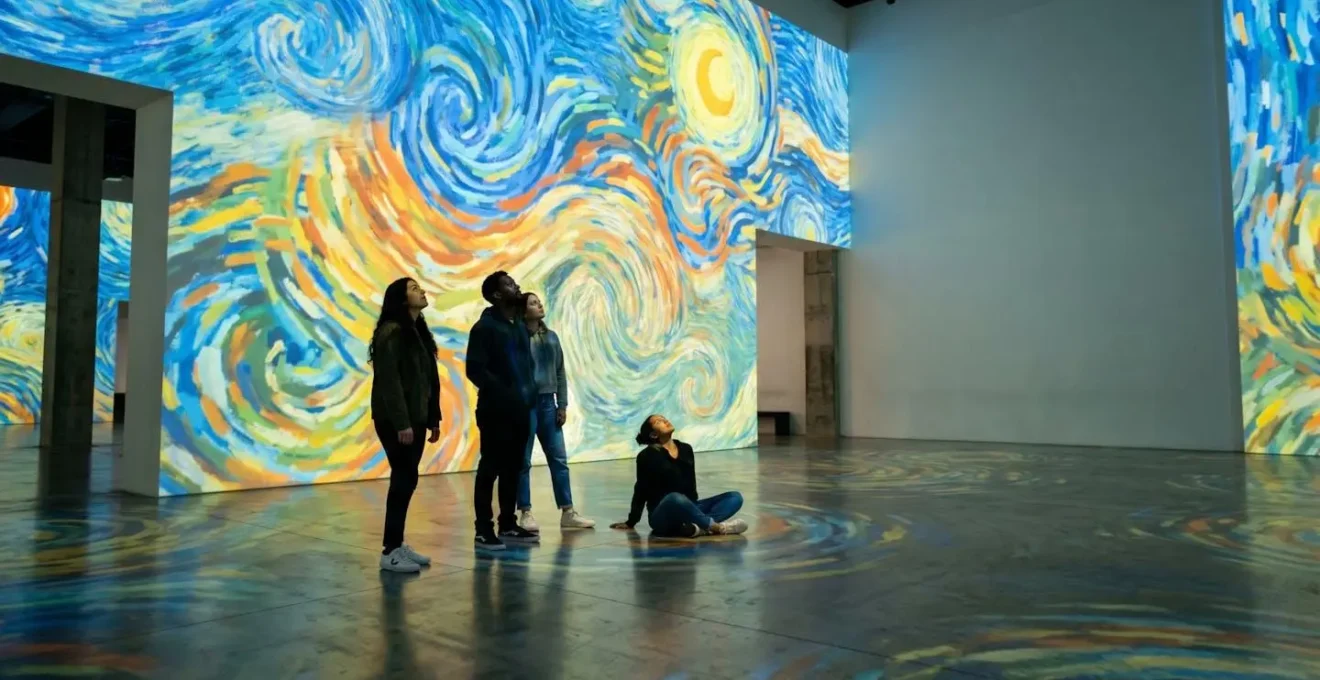
The success of immersive art isn’t about replacing galleries; it’s a powerful critique of their historical failure to grant audiences meaningful agency over their own cultural experiences.
- High ticket prices create a value crisis, forcing a distinction between shallow spectacle and experiences with genuine narrative depth.
- The trend’s longevity depends on its ability to evolve from reproducing old masters to creating original, “born-immersive” works.
Recommendation: Evaluate these experiences based on their narrative architecture and interactive potential, not just their visual appeal. True value lies in agency, not just aesthetics.
The scene is now a cultural cliché: a darkened room, swirling projections of impossibly vibrant colours, and the ubiquitous silhouette of someone trying to capture the perfect, art-infused selfie. Immersive art experiences, from glowing Van Gogh sunflowers to kaleidoscopic digital wonderlands, have exploded into a dominant force in popular culture, particularly among younger, digitally native audiences. For many, they represent a fun, accessible entry point into a world of art that once felt stuffy and remote.
The debate rages on. Are these events the dynamic future of cultural consumption, or are they glorified Instagram backdrops, hollowing out the contemplative purpose of art? Critics lament the shift from quiet reflection to performative documentation, while proponents celebrate a newfound engagement from a generation that traditional galleries have struggled to attract. This debate, however, often misses the more profound shift occurring beneath the surface.
But what if the core issue isn’t about spectacle versus substance? The rise of immersive art is better understood as a fundamental crisis of value and agency. It signals a deep-seated desire from audiences to move from being passive spectators to active participants, co-creators, and distributors of their own cultural moments. This isn’t just about taking a photo; it’s about claiming a role in the narrative.
This analysis will dissect this phenomenon from multiple angles. We will scrutinize the economic model behind these high-cost tickets, evaluate the critical difference between empty spectacle and meaningful storytelling, consider the often-overlooked questions of accessibility, and explore whether this trend is a fleeting fad or the “silent film” era of a genuinely new art form.
To navigate this complex cultural landscape, this article delves into the key questions surrounding the immersive art phenomenon. The following sections provide a structured analysis of its impact, value, and future.
Summary: The Immersive Art Revolution and Its Critics
- Is It Art or a Backdrop: How Instagram Changed Exhibition Design?
- £25 for 45 Minutes: Are Immersive Van Gogh Shows Worth the High Cost?
- Dizziness and Noise: Who Should Avoid Intense Immersive Projections?
- Storytelling vs Spectacle: How to Spot a Shallow Immersive Experience?
- Fad or Future: Will Immersive Art Survive beyond the Hype Cycle?
- Gamification: Why Interactive Portraits Teach History Better to Kids?
- Soup on Sunflowers: Is Vandalism in Galleries Effective Protest or Alienation?
- How Interactive Digital Portraits Are Changing Viewer Engagement in Galleries?
Is It Art or a Backdrop: How Instagram Changed Exhibition Design?
The accusation most frequently levelled against immersive art is that it’s designed less for artistic appreciation and more for social media. The data, however, suggests this isn’t an unintended side effect but a core driver of its success. Research indicates that museums incorporating Instagram-friendly installations can see significant attendance boosts, with some reporting that over 30% of their annual attendance is driven by such features. This has fundamentally altered the calculus of exhibition design.
This shift prioritizes visual elements that are easily shareable and instantly recognizable on a small screen. Cultural analytics pioneer Lev Manovich observed that what appeals to the Instagram generation are “iconic shapes, simplicity, good lighting.” Consequently, designers now engineer spaces with built-in “photo moments,” considering angles, lighting, and reflective surfaces not just for the in-person experience, but for the experience of the person viewing it on a follower’s feed. The art is no longer just the object; it’s the potential for user-generated content.
This creates a complex feedback loop. The visitor is no longer a passive observer but an active agent in the art’s dissemination. By capturing and sharing, they become a micro-broadcaster for the exhibition. This grants a powerful sense of audience agency, a feeling that one is participating in and shaping the cultural conversation, rather than just consuming it. The question then becomes whether this agency comes at the cost of the art’s original intent, transforming it into a flexible backdrop for personal branding.
£25 for 45 Minutes: Are Immersive Van Gogh Shows Worth the High Cost?
The question of whether an immersive art show is “worth it” is a significant source of debate, hinging on a deeply personal calculation of value. With adult tickets for major touring shows often priced around £25-£30 for an experience that can last under an hour, these events demand a financial commitment far exceeding that of most traditional museum admissions. This high cost creates a value proposition crisis: the experience must justify its premium price tag with more than just dazzling visuals.
When the spectacle fails to connect to a deeper substance, audiences often feel short-changed. This was evident in visitor feedback for some early-generation immersive experiences. A compelling example is The National Portrait Gallery’s ‘Unframed’ experience, which demonstrated the risks. A detailed analysis of the £15-£23 event noted that while parts were narratively strong, many visitors felt it lacked the expansive, boundary-blurring quality suggested by the format and pricing. The experience, confined to a 45-minute loop, didn’t always deliver the perceived value compared to a traditional gallery visit where time and exploration are self-directed.
Ultimately, the “worth” of these shows is determined by what the audience is seeking. If the goal is a novel social outing and a few striking photos, the price may be justifiable. However, if the expectation is a profound or educational engagement with an artist’s work, the experience must be built on a strong narrative foundation. Without it, the high cost can leave a lingering sense of it being a transaction rather than a transformation, where the primary product being sold is the spectacle itself, not the art within it.
Dizziness and Noise: Who Should Avoid Intense Immersive Projections?
Beyond the philosophical debates, immersive art presents a very real, physical challenge of accessibility. The very elements that create the “immersion”—360-degree moving projections, powerful, multi-layered soundscapes, and disorienting spatial design—can create a hostile environment for many individuals. This includes people with photosensitive epilepsy, vestibular disorders, autism, or sensory processing sensitivities. The industry’s focus on “wowing” a neurotypical audience often sidelines the needs of a significant portion of the population.
The issue of accessibility extends beyond sensory overload. As one research team noted in a study on multi-sensory art, the exclusion of entire groups is a critical failure in a world striving for inclusion. They point out that ” around 1.3 billion people worldwide live with some form of blindness,” a staggering reminder of how visually-dependent experiences can perpetuate exclusion. True immersion should aim to engage multiple senses, not just overwhelm one or two. This calls for a greater degree of what can be termed sensory sovereignty—giving the visitor control over their experience.
Case Study: The D.R.E.A.M. Centre’s Inclusive Design
A positive model for the future can be found at the D.R.E.A.M. Centre in Sussex, UK. Designed specifically for children and young adults with complex disabilities, this facility uses immersive technology inclusively. Projection, audio, scent, and tactile elements are integrated into flexible zones where lighting and sound levels can be adapted in real-time to meet individual sensory needs, proving that immersion and accessibility are not mutually exclusive goals.
For potential visitors, understanding one’s own sensory tolerances is crucial before purchasing a ticket. While some venues are beginning to offer “sensory-friendly” sessions with reduced light and sound, this is not yet standard practice. Proactive self-assessment is therefore the best tool for avoiding a negative or overwhelming experience.
Your Sensory Self-Assessment Checklist
- Visual Intensity: Assess your tolerance for flashing lights, rapidly changing projections, and high-contrast visuals that may trigger photosensitive responses.
- Auditory Load: Evaluate your sensitivity to loud or sudden sounds, multi-layered soundscapes, and unpredictable audio triggers common in immersive installations.
- Spatial Orientation: Consider your susceptibility to disorientation from 360-degree projections, moving floor patterns, or environments that obscure traditional spatial cues.
- Crowd Density: Determine your comfort level with enclosed, often dark spaces filled with other visitors, as immersive venues can have limited exit visibility.
- Duration Management: Plan for breaks and identify ‘chill-out zones’ if available, recognizing that sensory overload can accumulate over the typical 30-60 minute experience length.
Storytelling vs Spectacle: How to Spot a Shallow Immersive Experience?
The most significant dividing line in the immersive art world is between experiences that use technology to tell a story and those that use it merely for spectacle. As analysts from CTConsults succinctly put it, “immersion works best when it leads us somewhere meaningful.” A shallow immersive experience feels like a screensaver; a profound one feels like a journey. The key difference lies in what can be termed narrative architecture—the underlying structure that guides the audience’s emotional and intellectual engagement.
A shallow experience often relies on a “greatest hits” approach, looping famous imagery without context or connection. You see the sunflowers, then the starry night, then the self-portraits, all set to a dramatic but generic classical score. There is no build-up, no discovery, and no conclusion. In contrast, a well-constructed immersive narrative uses its technology to build a world. Sound design, for instance, is a critical and often overlooked element. It’s not just background music; it’s spatial audio that can guide attention, create tension, and evoke emotion.
To spot a shallow experience, look for a lack of coherence. Do the visuals connect in a logical or emotional sequence? Does the audio add a new layer of meaning, or is it just filler? Does the experience offer moments of quiet contemplation, or is it a relentless sensory assault? The best experiences balance periods of high-intensity spectacle with moments of quiet discovery, allowing the audience to process what they are seeing and feeling.
Case Study: Meow Wolf’s Narrative-Rich Universe
Collectives like Meow Wolf exemplify narrative-rich design. Their installations are not about showcasing a single artist; they are about building entire fictional universes that visitors can explore. Experiences like their ‘Radio Tave’ in Houston are built on a sophisticated narrative framework, combining visuals, soundscapes, and physical objects to tell a complex story. This approach demonstrates how immersive technology can be a medium for original, multi-dimensional storytelling, elevating it far beyond a simple digital art gallery.
Fad or Future: Will Immersive Art Survive beyond the Hype Cycle?
With the proliferation of copycat exhibitions and the looming threat of audience fatigue, the ultimate question is whether immersive art is a sustainable art form or a passing trend. Many industry analysts argue that the current, dominant form of these experiences—projecting the work of long-dead masters onto walls—is merely the nascent stage of the medium. It’s a powerful metaphor to suggest this is just the “‘silent film’ era of immersive art.” It’s accessible and popular, but it barely scratches the surface of the medium’s true potential.
The future, according to this view, does not lie in reproducing the past. It lies with contemporary digital artists creating born-immersive works—art conceived from the ground up for this specific medium. These pieces don’t adapt a painting for a 3D space; they use the 3D space, interactivity, and real-time data as their very canvas. This represents a crucial shift from reproduction to generation, where the technology is not just a display mechanism but an integral part of the creative process.
This evolution is essential for the genre’s survival. As audiences become more sophisticated, the novelty of simply being surrounded by moving pictures will wear off. The demand will shift towards experiences that are unique, responsive, and unrepeatable. The long-term viability of immersive art depends on its ability to cultivate its own artists, develop its own critical language, and create its own masterpieces, rather than endlessly borrowing from the art historical canon.
Case Study: TeamLab and the Generative Future
The art collective TeamLab is a pioneer of this future. Their installations worldwide are not static loops; they are generative artworks that use algorithms to respond to visitor interaction in real-time. In one work, flowers bloom and decay based on the movement of people in the room; in another, the art is literally drawn by the visitors. As an analysis on the evolution of immersive experiences highlights, TeamLab’s approach shows how the medium is maturing. Each visit can generate a unique artistic outcome, securing a future where the audience doesn’t just see the art, but helps create it.
Gamification: Why Interactive Portraits Teach History Better to Kids?
Beyond pure spectacle, immersive technology offers powerful new tools for education, particularly when combined with principles of gamification. For younger audiences, who are often disengaged by the static, text-heavy displays of traditional museums, adding interactive, game-like elements can transform a passive learning experience into an active quest for knowledge. This isn’t about making history less serious; it’s about making it more engaging by speaking a language that children intuitively understand: the language of play.
Imagine an interactive portrait of a historical figure. Instead of reading a plaque, a child might be prompted to answer a question, and a correct answer causes the portrait to reveal a new piece of its story or a hidden visual element. This creates a feedback loop of curiosity, action, and reward. This approach leverages a key psychological insight confirmed by academic research. A study on museum tourism promotion found that ” with higher experience immersion levels, there are higher levels of affective and conative performance” in young people. In simple terms, the more immersed a child feels, the more they connect emotionally (affective) and the more motivated they are to act (conative).
This method of teaching is effective because it reframes the viewer’s role. They are not a passive recipient of facts but an active detective uncovering a story. By giving them tasks, choices, and a sense of progression, gamified exhibits empower children with a sense of mastery and agency over their own learning. History ceases to be a list of dates and names and becomes a puzzle to be solved, a world to be explored, and a story in which they, the viewer, play a vital part.
Key Takeaways
- The rise of immersive art is fueled by a fundamental audience desire for agency and participation, not just passive viewing or selfie opportunities.
- A significant value crisis exists: high ticket prices are only justifiable when the experience offers deep narrative architecture, not just shallow visual spectacle.
- The future of the medium lies not in endlessly reproducing old masters, but in fostering “born-immersive” works from contemporary digital artists like TeamLab.
Soup on Sunflowers: Is Vandalism in Galleries Effective Protest or Alienation?
On the surface, the act of throwing soup on a Van Gogh seems to be the polar opposite of taking a selfie with a projected version of it. One is an act of protest and apparent destruction, the other an act of appreciation and social sharing. However, a deeper analysis reveals they may stem from the same root cause: a profound and desperate desire for audience agency within institutions that have historically demanded passivity. Both acts are a rebellion against the “look, but don’t touch” ethos of the traditional gallery.
The museum has always been a space of controlled behaviour. Signage dictates where you can go, what you can photograph, and how you should behave. The climate activist throwing soup is rejecting this control, using a priceless artwork as a platform to force a conversation the institution is not having. They are inserting their own urgent narrative into the gallery space. While the methods are wildly different, this impulse is not entirely divorced from the visitor at an immersive show who curates and broadcasts their own experience via social media.
A fascinating case study from the British Museum illuminates this tension. During the ‘World of Stonehenge’ exhibition, the ancient Nebra Sky Disc became the most-posted object on Instagram, despite clear signs prohibiting photography. As the research notes, this conflict between institutional rules and audience desire demonstrates a form of rebellion. Both protest vandalism and unauthorized photography represent points on a spectrum of audience defiance. They are attempts to assert control and participate actively in a space that often tries to render the visitor powerless. They are a cry for a role beyond that of silent, obedient consumer.
How Interactive Digital Portraits Are Changing Viewer Engagement in Galleries?
The traditional portrait gallery experience is one of quiet contemplation. You look at the subject; the subject, frozen in time, stares back. Interactive digital portraits shatter this one-way relationship, transforming the viewer from a passive observer into an active collaborator. These are not static images on a screen; they are dynamic artworks that see you, hear you, and react to your very presence, fundamentally redefining the nature of engagement.
This new form of portraiture uses sensors, cameras, and sophisticated software to create a real-time dialogue between the art and the audience. Your movement might alter the colours of the portrait, the sound of your voice could change its expression, or your position in the room might determine the piece’s composition. It’s an approach that turns the gallery from a silent hall of faces into a responsive, playful environment. This technology brings the concept of audience agency to its most literal and personal conclusion.
Practitioners of this generative art form, like Refik Anadol or Daniel Rozin, are pioneering a medium where the art is incomplete without the viewer. As one analysis of their work notes, “the viewer’s presence, movement, or even biometric data is used to actively generate or alter the artwork in real-time.” This leads to a profound conclusion that encapsulates the entire shift in modern art consumption. With this technology, “the viewer is no longer an audience; they are part of the medium.”
This is more than just an interactive gimmick; it is the ultimate fulfillment of the audience’s desire to participate. The artwork literally cannot exist without you. This creates a uniquely personal and memorable connection that a static painting, however beautiful, can rarely replicate. It suggests a future where art is not something you just look at, but something you experience and create in partnership with the artist.
So, the next time you consider an immersive experience, look beyond the marketing. Scrutinize its narrative architecture, question its value proposition, and decide if it offers you genuine agency or just a pretty backdrop. The power to shape the future of art, it turns out, is in your hands—and your wallet.