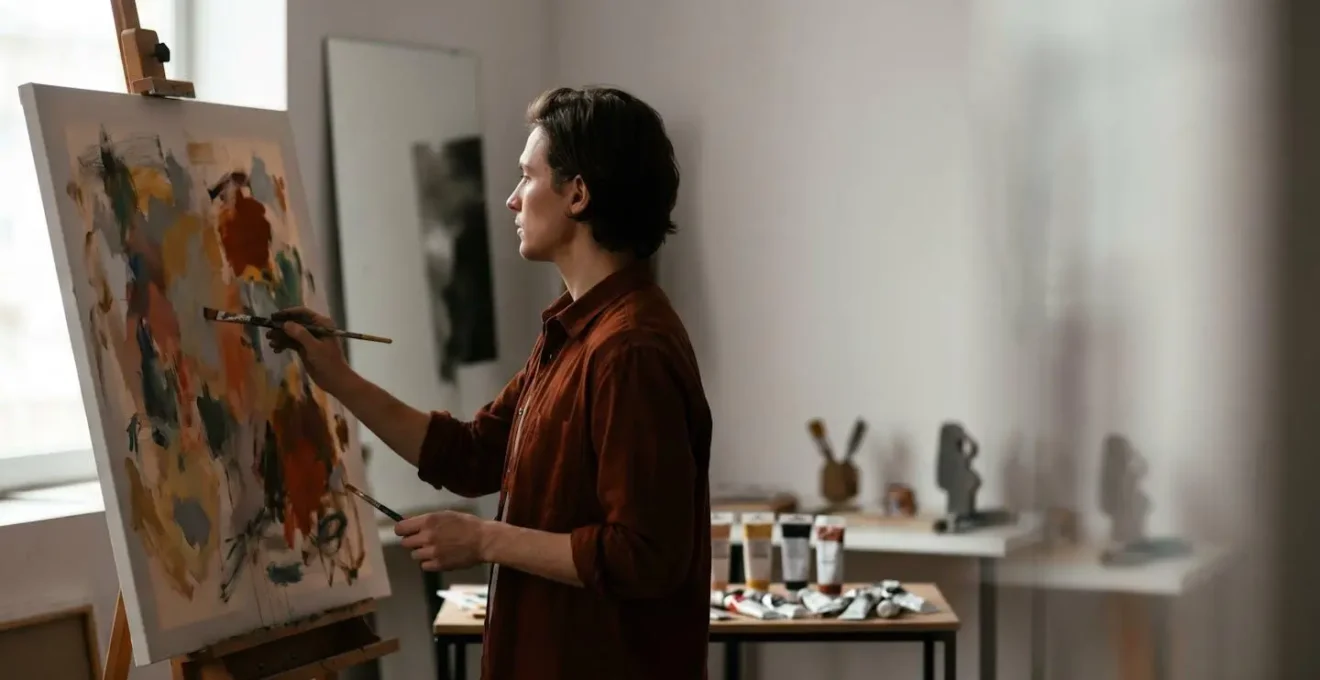
Contrary to the belief that a self-portrait is an act of vanity, it is fundamentally a procedural act of psychological integration and self-knowledge.
- The physical process of painting is a form of non-verbal dialogue that fosters mental well-being and emotional regulation.
- Unlike the selfie, which captures a fleeting persona for an external audience, the self-portrait constructs a durable understanding of the self for an internal one.
Recommendation: View the self-portrait not as a static image, but as the tangible residue of a profound, time-based psychological journey.
In an era defined by the fleeting immediacy of the digital image, the question feels almost paradoxical. With smartphones capturing and broadcasting our likeness in an instant—part of a deluge of 93 million selfies taken globally every day—why would an artist invest hundreds of hours in the slow, solitary, and often grueling act of painting their own face? The common assumption frames the self-portrait as an anachronistic form of vanity, a precursor to the modern selfie. This view, however, misses the fundamental psychological distinction between the two acts.
From a clinical perspective, the value of the self-portrait lies not in the final product but in the process itself. It is not about *showing* the self but about *constructing* it. The selfie is a declaration aimed outward, curated for immediate social validation. The painted self-portrait, by contrast, is an interrogation aimed inward. It is a slow, methodical excavation of one’s own psyche, a non-verbal dialogue between the hand, the eye, and the mirror. This act of sustained observation forces a confrontation with the self that is impossible to achieve in the blink of a camera shutter.
This is not merely about achieving a likeness; it is about engaging in what psychologists call embodied cognition—the idea that thinking is an active, physical process. The mixing of paint, the feel of the brush on canvas, and the constant negotiation between what is seen and what is felt become a form of thinking in themselves. This article will explore the self-portrait not as an image, but as a profound tool for psychological work—a mechanism for mental health recovery, a stage for exploring identity, and a quiet rebellion against the superficiality of the digital gaze. We will examine how this centuries-old practice offers a unique path to self-knowledge that the instantaneous selfie can never replicate.
This exploration will unpack the deep psychological drivers behind the artist’s gaze. The following sections delve into the therapeutic power of self-portraiture, its historical evolution as a statement of identity, and its enduring relevance in a world hungry for authenticity.
Contents: Why the Self-Portrait Is More Than a Prehistoric Selfie
- How Can Self-Portraiture Serve as a Tool for Mental Health Recovery?
- Mirror or Mask: What Do Props Reveal in Famous British Self-Portraits?
- Sight-Size vs Memory: Which Method Produces the Most Honest Self-Image?
- The Error of Confusing Artistic Introspection with Social Media Vanity
- From Van Dyck to YBA: How Has the “Selfie” Evolved in British Art History?
- The Error of Confusing Technical Skill with Emotional Depth in Portraiture
- Form or Function: Can a Chair Be a Sculpture in a Fine Art Context?
- Why Is Contemporary Figurative Art Making a Comeback in a Digital-First Era?
How Can Self-Portraiture Serve as a Tool for Mental Health Recovery?
The act of creating a self-portrait is far more than an artistic exercise; it is a profound therapeutic intervention. From a clinical standpoint, it functions as a powerful tool for externalizing internal states, creating a tangible object from the often chaotic and abstract world of emotion. This process of giving form to feeling allows for a degree of separation and observation, enabling individuals to engage with their mental state from a safer, more manageable distance. The slow, repetitive, and physical nature of painting—the mixing of colors, the application of paint, the focused observation—induces a state of mindfulness that can quiet the ruminative noise of anxiety and depression. It is a structured, non-verbal outlet for experiences that are often too complex or painful to articulate in words.
This is the principle of embodied cognition at work: the mind and body are not separate entities, and the physical act of creation directly impacts psychological well-being. The efficacy of such practices is well-documented; a comprehensive 2024 meta-analysis revealed significant improvement across 86 different psychiatric symptom measures with the use of active visual art therapy. A self-portrait, in this context, becomes a record of a psychological journey. The final image may reflect turmoil, resilience, or quiet contemplation, but its true therapeutic value lies in the hours of focused engagement required to produce it. It transforms the artist from a passive sufferer of their mental state into an active author of their own narrative.
An Action Plan for Self-Exploration Through Portraiture
- Points of Contact: Identify what you want to explore. Is it a specific emotion (anxiety, joy), a life event, or your sense of identity? Gather reference photos or simply use a mirror.
- Collect Materials: Gather simple tools—paper, a pencil, charcoal, or basic paints. The medium is less important than the act of making a mark.
- Confront the Blank Page: Begin without judgment. Focus on a single feature—the shape of an eye, the line of the mouth. The goal is observation, not perfection.
- Track Emotion and Sensation: As you work, notice what feelings or thoughts arise. Does a certain color or line feel angry, sad, or calm? Let the marks on the page become a record of this internal weather.
- Plan for Integration: After a session, step back. What do you see? Don’t analyze the “quality” of the art, but ask what the process revealed. Write down one observation about your internal state that you weren’t aware of before you started.
Ultimately, self-portraiture offers a form of self-sovereignty. In a world where our image is often captured and judged by others, the act of painting oneself is an act of reclaiming one’s own gaze.
Mirror or Mask: What Do Props Reveal in Famous British Self-Portraits?
A self-portrait is never just a face; it is a constructed stage upon which the artist presents a version of themselves. The objects an artist chooses to include are not mere background details but carefully selected symbols that function as either a mirror, reflecting an inner truth, or a mask, projecting a desired public persona. From a psychological perspective, these props are condensations of identity, revealing how the artist wishes to be seen by the world—as a scholar, a craftsman, a revolutionary, or a member of a particular social class. The inclusion or exclusion of certain items speaks volumes about their values, aspirations, and the internal conflicts they navigate between their private self and their public role.
Case Study: William Hogarth’s Self-Portrait with Pug (c. 1745)
William Hogarth’s self-portrait is a masterclass in symbolic self-representation. By placing his own painted portrait within a frame, resting on a pile of books by Shakespeare, Milton, and Swift, he aligns himself with the great minds of English literature. More tellingly, his pug, Trump, sits beside the portrait. The pug, known for its pugnacious and homely character, served as a deliberate foil to the refined, elegant dogs often seen in aristocratic portraits. Hogarth uses the dog as a symbol of his own plain-spoken, satirical, and quintessentially British character. As detailed in analyses of his work, this self-portrait was a bold assertion of his identity as a gentleman, an intellectual, and a professional artist who championed a native British school of painting against Continental fashions. The props are not accessories; they are the argument.
This deliberate construction of a public self through symbolic objects is a recurring theme in art history. The skull in a “vanitas” portrait serves as a memento mori, reminding the viewer of mortality and positioning the artist as a philosopher. The palette and brushes declare the artist’s identity as a skilled laborer, a master of their craft. In this way, the self-portrait becomes a complex negotiation between autobiography and performance. It raises a crucial question for the viewer: are we being invited to see the artist as they truly are, or as they desperately wish to be seen? The props are the clues that help us unravel this psychological puzzle.
In the end, whether a mirror or a mask, the objects in a self-portrait reveal the artist’s profound awareness that identity is not a fixed state but a continuous performance, carefully staged for an audience.
Sight-Size vs Memory: Which Method Produces the Most Honest Self-Image?
The debate between painting from direct observation versus painting from memory strikes at the heart of what we consider “truth” in a portrait. The Sight-Size method, where the artist places their canvas next to the subject (in this case, their reflection) to paint it at a 1:1 scale, is a pursuit of optical fidelity. It is a rigorous, scientific process aimed at capturing the external, measurable facts of a face with as little subjective interference as possible. This method treats the eye as a dispassionate recording device, aligning with the understanding that our visual system is composed of highly specialized analyzers. As one patent on visual perception methods notes:
Cortical cells are highly specialized and optimized as image analyzers, responding only to a limited range of parameters such as orientation, location in the visual field, and spatial frequency.
– US Patent on Visual Perception Methods, Method and apparatus for improving visual perception – USPTO
Painting from memory, however, is an entirely different psychological endeavor. It is not an act of transcription but of reconstruction. When an artist paints from memory, they are not reproducing what their eye saw, but what their mind has processed, filtered, and imbued with emotional significance. This process elevates certain features and diminishes others, distorting objective reality to serve a more profound psychological truth. The remembered face is a landscape shaped by emotion, self-concept, and subconscious biases. A crooked smile might be exaggerated to reflect a sense of self-deprecation, or the eyes might be rendered with an intensity that reflects an inner turmoil invisible in the mirror.
Therefore, the question of which method is more “honest” becomes a philosophical one. Sight-Size produces an honest record of one’s external appearance at a specific moment in time. Memory, on the other hand, produces an honest record of one’s internal experience of the self. From a clinical psychologist’s viewpoint, the latter is often more revealing. It shows not just how the artist looks, but how they *feel* about how they look, and ultimately, how they feel about who they are. The most “honest” self-portraits may, in fact, be those that are the least optically “accurate.”
The choice of method, then, is not merely technical but philosophical, defining whether the artist’s goal is to document the shell or to excavate the soul.
The Error of Confusing Artistic Introspection with Social Media Vanity
The most common and fundamental error in the contemporary discourse around self-representation is the conflation of the self-portrait with the selfie. While both capture a likeness, their psychological functions are diametrically opposed. The selfie is an act of performative communication, designed for rapid consumption and external validation. Its currency is the “like,” the “share,” the immediate social feedback loop. The process is one of frantic curation toward an idealized, often filtered, public-facing persona. In contrast, the self-portrait is an act of procedural introspection, a slow, solitary process of inquiry where the audience is, first and foremost, the artist themself.
The difference lies not in the tool—a brush or a phone—but in the temporal and psychological investment. The selfie is about the final, perfected moment; the self-portrait is about the cumulative hours of struggle, doubt, and discovery. This distinction is sharply drawn in the world of digital art itself, where artists use the language of the internet to subvert its superficiality. As one analysis of the work of digital artist Petra Cortright observes:
While selfies often focus on face, ego, and body, self-portraits are rather opposite. Selfies are taken by the 10’s and 20’s, until the perfect head tilt, hair style, puckered lips, and background are captured in a single shot. In contrast, Cortright’s videos are uploaded after a single take.
– Digital Art Analysis of Petra Cortright’s work, I’m a Selfie — 21st Century Digital Art
This “single take” mentality is the essence of the self-portrait. It accepts imperfection, honors the process, and values authenticity over aesthetic perfection. A self-portrait is not about looking good; it is about looking, period. It is about the sustained, unflinching gaze in the mirror, which inevitably moves past the surface—the hair, the skin, the smile—to the more uncomfortable truths beneath. It is a confrontation with one’s own mortality, vulnerability, and complexity. To confuse this profound psychological work with the fleeting vanity of a selfie is to mistake a deep-sea dive for paddling in the shallows.
Ultimately, the selfie asks, “How do you see me?” The self-portrait asks, “How do I see myself?” The answers to these two questions lead to entirely different understandings of the self.
From Van Dyck to YBA: How Has the “Selfie” Evolved in British Art History?
The impulse to document, brand, and mythologize oneself through a self-image is not a modern invention. The history of British self-portraiture reveals a long and complex evolution of the artist’s public persona, a historical “selfie” that has shifted in function from a certificate of status to a tool of conceptual rebellion. This trajectory traces the artist’s changing role in society, from courtly servant to market-savvy celebrity and provocative thinker. The self-portrait has consistently been the primary medium through which artists have defined and broadcasted their brand.
In the 17th century, artists like Anthony van Dyck used the self-portrait to craft an image of aristocratic elegance and divine skill. His portraits, as noted in a history of British portraiture by the Royal Society of Portrait Painters, established the self-portrait as a powerful tool for certifying one’s status and technical mastery, aligning the artist with the power of their patrons, like Charles I. Two centuries later, the Romantics used it to project an image of the artist as a solitary, brooding genius in communion with nature. By the 20th century, the function had shifted again.
Case Study: The Young British Artists (YBAs) and the Conceptual Self
The Young British Artists (YBAs) of the 1990s completely redefined the self-portrait. Artists like Tracey Emin and Sarah Lucas moved beyond the painted face to use their own lives, bodies, and experiences as the raw material for their art. Emin’s “My Bed” (1998) is, in a sense, a self-portrait—a raw, unflinching depiction of a period of deep depression, using the actual artifacts of her life. Here, the self-portrait is no longer a representation of the self but a direct presentation of it. As art historians from institutions like the National Portrait Gallery have noted, this shift from formal demonstration to conceptual challenge is a hallmark of modern art. The self-portrait evolved from asking “How skillful am I?” to asking “What is a self?”
This historical arc demonstrates that the tension between authenticity and performance, between the inner self and the public brand, has always been at the core of self-representation. From Van Dyck’s silken doublets to Tracey Emin’s unmade bed, artists have used their self-image to negotiate their place in the world, challenge viewer expectations, and write themselves into history.
The modern selfie, then, is not a new phenomenon but the latest, democratized iteration of a very old human impulse: the desire to control one’s own narrative.
The Error of Confusing Technical Skill with Emotional Depth in Portraiture
A common misconception, especially among those new to art, is to equate technical skill with photorealism. A “good” portrait, in this view, is one that most accurately resembles a photograph. This perspective completely misses the psychological function of technique in the hands of a master. For an artist like Lucian Freud, technical mastery was not an end in itself but the very language required to articulate the complex, often brutal, emotional and psychological truths of his subjects, including himself. The thickness of his paint, the “impasto,” was not a stylistic flourish but the physical equivalent of psychological weight. His technique was the vehicle for his unflinching introspection.
Case Study: Lucian Freud’s Psychoanalytic Gaze
The self-portraits of Lucian Freud, grandson of the psychoanalyst Sigmund Freud, are a testament to this principle. His notoriously long sessions, sometimes lasting thousands of hours for a single painting, have been compared to the slow, methodical process of psychoanalysis. His evolving technique, from early, linear works to his signature fleshy, heavily worked impasto style, was a necessary development to convey the raw, visceral reality of aging, vulnerability, and mortality. In his 1963 self-portrait, for instance, straight vertical brushstrokes suggest form rather than detailing it, creating a sense of a face being both revealed and concealed by the paint itself. The paint is not just depicting skin; it *is* skin, with all its weight and history.
Freud’s own words reveal this internal struggle between optical reality and psychological truth. His process was a fight against the simple “information” provided by the mirror in favor of a deeper, more unsettling reality. This is the essence of emotional depth in portraiture. It is born from the “trouble” that begins when an artist rejects the easy answer of a perfect likeness and instead uses their technical skill to dig into the messy, contradictory, and profoundly human truths that lie beneath the surface. It is a process of translation, not transcription.
When asked if he was a good model for himself Freud replied, ‘No, I don’t accept the information that I get when I look at myself, that’s where the trouble starts’. It is precisely this ‘trouble’ that makes Freud’s self-portraits so intensely compelling.
– Lucian Freud, Royal Academy of Arts exhibition: Lucian Freud: The Self-portraits
Therefore, to judge a portrait by its photorealism is to praise a novel for its grammar while ignoring its story. The true skill lies in making the viewer feel the weight of a life, not just recognize a face.
Form or Function: Can a Chair Be a Sculpture in a Fine Art Context?
At first glance, this question seems to diverge from our focus on the human face. Yet, it serves as a powerful metaphor for understanding the self-portrait’s modern function. A chair is defined by its utility: to be sat upon. A sculpture is defined by its form and concept: to be contemplated. The moment a chair is placed in a gallery, stripped of its functional purpose, it forces us to see it in a new light—to consider its lines, its material, its presence in space, its history. It transitions from a mundane object to a subject of aesthetic and intellectual inquiry. This is precisely what happens in the act of self-portraiture.
The human face has a primary function: it is our interface with the world for communication, identification, and social interaction. We use it to signal emotion and to recognize others. When an artist chooses to paint their own face, they are, in effect, taking it out of its everyday functional context. They are treating it not as an interface but as a formal object, much like a sculptor treats a block of marble or a conceptual artist treats a chair. This act of de-functionalizing the face allows for a new kind of investigation. The artist can explore its shapes, textures, and asymmetries not for social signaling, but for their purely aesthetic and psychological resonance.
This process aligns with findings in cognitive neuroscience, which suggest our brains are wired to appreciate form beyond function. As neuroscientist Anjan Chatterjee notes, “Intriguing parallels exist between the concerns and techniques of artists and the organization of the visual brain.” In his analysis, he argues that some components of visual aesthetics can be understood through empirical methods. The self-portrait, then, becomes an experiment in perception. It asks: what remains of a face when you strip it of its social job? The answer is a landscape of form, light, and shadow—a sculpture built of flesh and bone, ready for psychological excavation.
Just as a chair can become a sculpture, the artist’s face can become a landscape, a still life, or a raw psychological artifact, transcending its own biology to become pure art.
Key Takeaways
- The primary value of a self-portrait is not the final image but the psychological process of its creation—an act of embodied cognition and self-regulation.
- Unlike the performative selfie, the self-portrait is an introspective tool for confronting and integrating complex internal states, prioritizing authenticity over idealization.
- Technique in masterful portraiture, such as Lucian Freud’s, serves not to achieve photorealism but to articulate emotional and psychological depth.
Why Is Contemporary Figurative Art Making a Comeback in a Digital-First Era?
The enduring relevance of the self-portrait does not exist in a vacuum. It is part of a larger, significant cultural shift: the powerful resurgence of figurative art in a world saturated by digital abstraction and ephemeral images. After decades where conceptual and abstract art dominated the mainstream, art market analysts observe a remarkable renaissance in art that depicts the human form. From a psychological viewpoint, this comeback is not driven by nostalgia but by a profound and collective hunger for authentic human connection, tangible reality, and narrative depth—qualities that are often perceived as lacking in our increasingly disembodied digital lives.
Figurative art, and the self-portrait as its most intimate expression, offers an antidote to the speed and superficiality of the digital image stream. As writer Margherita Dessanay argued in The Collector, the slow, deliberate nature of painting has found a new purpose in our media-saturated culture. A painting demands time—both from the artist who creates it and the viewer who contemplates it. It offers a “full-resolution” image of humanity that stands in stark contrast to the pixelated, fleeting, and often anonymous nature of online interaction. This need for grounding in the real and the human is a powerful psychological driver.
Furthermore, the comeback of figuration is also a potent political and social act. For artists from historically marginalized communities, painting the figure is a radical act of assertion. It is a way to literally paint themselves and their communities into an art history that has long excluded them. Artists like Jordan Casteel, who creates vibrant portraits of Black and brown figures, use the human form as a tool for “representational justice,” demanding visibility and celebrating identities that have been sidelined. In this context, the self-portrait becomes more than personal introspection; it is a declaration of existence, a powerful statement of “I am here.”
The renewed interest in the self-portrait is therefore a symptom of a deeper need: a desire to anchor ourselves in the tangible, to explore the complexities of human identity, and to connect with stories that feel authentic and resonant in a world that often feels the opposite.