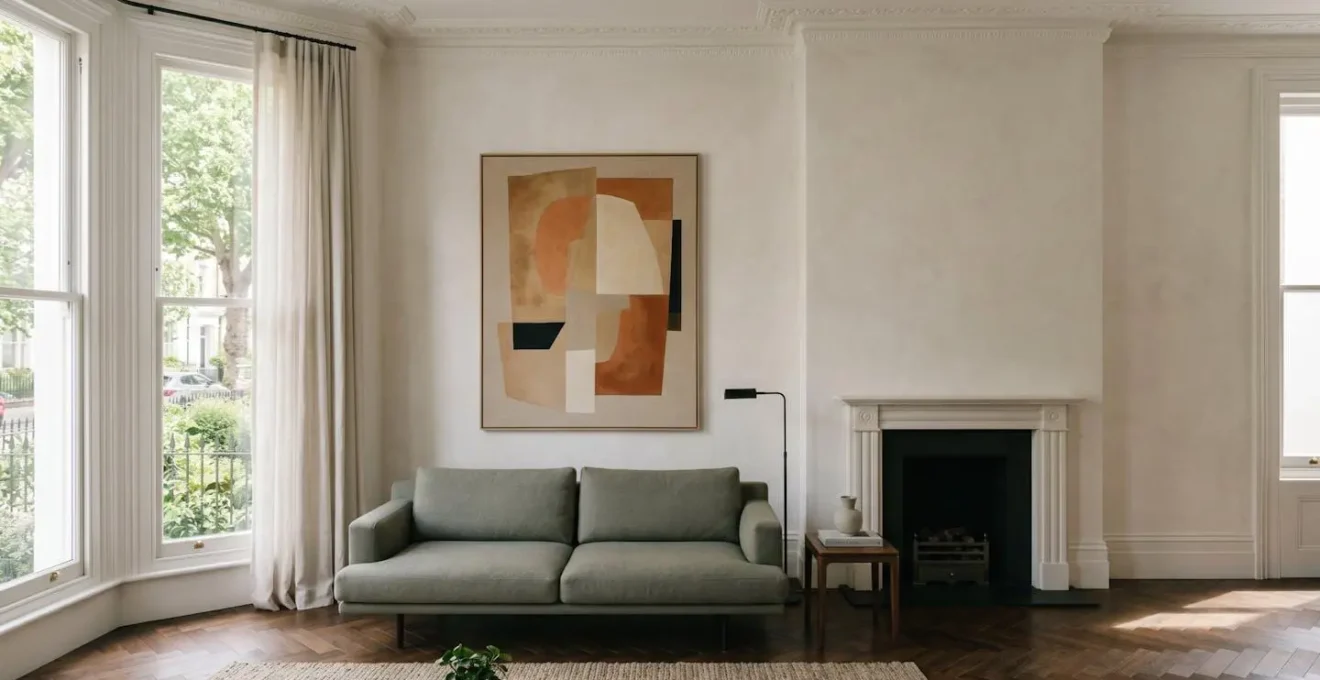
The secret to selecting abstract art isn’t matching it to your sofa, but curating a dialogue between the art, your space, and your soul.
- Prioritize emotional resonance over simple colour coordination to find a piece with lasting personal meaning.
- Use your home’s unique architectural features—from Victorian hallways to new-build walls—to inform your layout choices.
Recommendation: Adopt a ‘curatorial mindset’ to transform your home with art that becomes a central part of your story.
Choosing abstract art for your home can feel like a high-stakes decision. You stand in a gallery or scroll online, captivated by a piece, but a wave of doubt washes over you: “Will this actually work in my living room?” For many homeowners and design enthusiasts, the default advice is to play it safe—find a painting with a splash of the same blue as your cushions or a size that neatly fills a blank wall. This approach turns art into a mere accessory, an afterthought designed to coordinate rather than inspire.
But what if the goal wasn’t just to decorate, but to curate? What if selecting art was less about matching colours and more about creating a meaningful dialogue between the piece, your home’s architecture, and your own personality? This is the curatorial mindset. It elevates the process from a simple purchase to a thoughtful act of storytelling. It requires moving beyond the surface-level “rules” to understand the deeper principles of harmony, light, and emotional connection that make an interior feel truly resolved and personal.
This guide provides a practical framework for adopting that mindset. We will explore how to work with the unique qualities of British light, master layout solutions for characteristic London homes, and navigate the art market with confidence. Ultimately, you will learn to choose art not to match your sofa, but to connect with your soul—and in doing so, create a space that is uniquely and beautifully yours.
To guide you on this journey, this article breaks down the selection process into key, manageable stages. Discover how to tackle everything from colour palettes to commissioning your own bespoke piece.
Contents: A Practical Guide to Curating Abstract Art for Your Home
- Warm or Cool: How to Match Abstract Art with Your Wall Paint?
- Oversized or Gallery Wall: Which Layout Suits a Small London Apartment?
- Spotlights or Natural Light: How to Illuminate Textured Abstract Paintings?
- Float Frame or No Frame: Which Style Best Suits Contemporary Canvas?
- The Mistake of Buying Art to Match the Sofa instead of Your Soul
- Style vs Budget: How to Shortlist Portraitists for Your Specific Vision?
- The Error of Thinking All London Art Is Too Expensive for Beginners
- How to Commission a Contemporary Portrait That Captures Personality, Not Just Likeness?
Warm or Cool: How to Match Abstract Art with Your Wall Paint?
The first rule of pairing art with paint is to abandon the idea of a perfect “match.” Instead, strive for a harmonious conversation. In modern British interiors, this conversation is heavily influenced by the famously changeable natural light. A neutral paint that looks warm and inviting in the morning can appear cool and flat by dusk. This is where understanding undertones becomes your most valuable skill. As interior designers know, heritage paint brands popular in the UK, like Farrow & Ball, are masters of complex undertones that shift beautifully throughout the day. Your goal is to find a “bridge colour”—a subtle hue present in both the artwork and the wall paint’s undertone—that ties the two together seamlessly.
For example, a painting dominated by deep blues and ochre might harmonize beautifully with a wall painted in ‘Skimming Stone’, a warm neutral that lacks a yellow cast but carries enough warmth to connect with the ochre. The key is to test rigorously in situ. Never choose a paint colour from a tiny chip in a store. You must see how it interacts with your art and the specific light in your room.
To do this effectively, follow a professional process:
- Purchase sample pots of your shortlisted colours and apply large swatches to the wall where the art will hang.
- Observe the swatches at different times: bright morning, midday, and under artificial evening light. Note how the colours shift.
- Place your chosen artwork directly against the swatches to see how the undertones interact. Does the wall colour drain the art of its vibrancy or enhance it?
- Consider the room’s orientation. North-facing rooms in the UK receive cool, indirect light that will amplify blues and greys, while south-facing spaces get warmer, more direct light that intensifies reds and yellows.
By treating colour pairing as a science of light and undertones, rather than simple matching, you create a sophisticated backdrop that allows your abstract art to truly sing.
Oversized or Gallery Wall: Which Layout Suits a Small London Apartment?
When decorating compact urban spaces, like many London apartments, there’s a common misconception that small art is the only option. In reality, the choice between a single, oversized statement piece and a thoughtfully curated gallery wall can dramatically alter the perception of space. The right layout creates an “architectural dialogue,” using the art to enhance the room’s best features or solve its inherent challenges, from the narrowness of a Victorian hallway to the expansive feel of a new-build’s open-plan living area.
A single, large-scale abstract canvas can paradoxically make a small room feel bigger by creating a powerful focal point that draws the eye and simplifies the visual landscape. It minimizes clutter and conveys confidence. Conversely, a gallery wall offers flexibility and personality, allowing you to tell a story with a collection of smaller works. In a narrow hallway, for example, a vertical hang draws the eye upward, emphasizing ceiling height and creating a sense of spaciousness. The key is to tailor the strategy to your specific type of home.
As the image demonstrates, a vertical gallery wall is a brilliant solution for the narrow hallways common in Victorian conversions. It transforms a transitional space into a destination in its own right. To help you decide which strategy best suits your property, the following table breaks down layout solutions for common London housing types.
| London Housing Type | Oversized Single Piece Strategy | Gallery Wall Strategy | Best Use Case |
|---|---|---|---|
| Victorian Hallway (Narrow) | Vertical orientation piece leaning on picture rail | Vertical gallery hang (3-5 pieces stacked) | Gallery wall maximizes narrow vertical space |
| New-Build Plasterboard Walls | Large canvas leaning on floor (no drilling) | Wall-mounted art ledges (IKEA-style, damage-free) | Oversized leaning piece creates illusion of space |
| Georgian Conversion (High Ceilings) | Dramatic single statement piece at eye-level | Salon-style hang filling vertical expanse | Oversized piece anchors room, prevents emptiness |
| Open-Plan Flat | Large piece as ‘zone anchor’ for dining area | Cohesive gallery wall defining living zone boundary | Both effective; depends on furniture arrangement |
Ultimately, whether you choose a singular statement or a curated collection, the goal is the same: to use the art’s placement to control focus, define zones, and make your space feel more expansive and intentional.
Spotlights or Natural Light: How to Illuminate Textured Abstract Paintings?
Lighting is the silent partner to your artwork; it can either bring it to life or render it invisible. For abstract paintings, especially those with rich texture and impasto, the interplay of light and shadow is everything. The choice is not simply between natural and artificial light, but about how to harness each to reveal the soul of the piece. Natural light, particularly the soft, diffused light common in the UK, can beautifully render an artwork’s colours. However, it’s a double-edged sword. Direct sunlight is the enemy of art, causing irreversible fading and damage over time. It is a core tenet of art preservation to avoid harsh direct lighting or excessive sunlight placement, a best practice recommended by contemporary gallery lighting guides.
This is where a strategic artificial lighting plan becomes essential. Forget the single, central ceiling pendant that casts a flat, uninspiring wash over everything. To truly celebrate a textured abstract painting, you need directional light. Adjustable spotlights or picture lights mounted on the ceiling or wall are your best tools. The magic happens when you angle the light to “graze” the surface of the canvas from above or the side. This technique creates micro-shadows across the paint’s peaks and valleys, throwing the artist’s every brushstroke and palette knife mark into dramatic relief. It transforms the painting from a flat object into a dynamic, three-dimensional landscape.
When selecting bulbs, look for a high Colour Rendering Index (CRI) of 90+ to ensure colours appear true and vibrant. The colour temperature is also crucial; a warm white (around 2700K-3000K) typically creates a cozy, inviting atmosphere suitable for a home setting, complementing the art without making it feel like it’s in a sterile gallery. By carefully controlling both the angle and quality of your lighting, you’re not just illuminating the art—you’re actively sculpting its presence in the room.
Proper illumination is a final, transformative act of curation that unlocks the full depth and character of your chosen piece, ensuring it commands attention day and night.
Float Frame or No Frame: Which Style Best Suits Contemporary Canvas?
To frame or not to frame? For a contemporary canvas, this decision fundamentally shapes the artwork’s relationship with its environment. It’s a choice that can make a piece feel like an integrated part of the room or a dominant, standalone object. The modern default for abstract art is often no frame at all (a “gallery wrap” where the canvas extends around the stretcher bars) or a minimalist float frame. A float frame, or tray frame, creates a small gap between the canvas and the frame, giving the artwork the illusion of “floating” within it. This creates a clean, contemporary finish that respects the objecthood of the painting without confining it.
However, in the context of modern British interiors, which often blend period architecture with contemporary living, a more daring strategy has emerged: the deliberate clash. This involves placing a hyper-modern abstract canvas within a traditional, ornate, or even gilded frame. This juxtaposition creates a powerful visual tension that can be incredibly effective.
Case Study: The Modern British Clash
Design experts frequently use the high-impact strategy of placing a contemporary abstract work in a traditional, ornate frame within UK period properties. This intentional conflict works exceptionally well with Britain’s eclectic mix of historic architecture and modern life. The psychological impact is profound: a minimalist float frame allows the art to ‘breathe’ and integrate with the room, while no frame gives it a more immersive, dominant presence. The deliberate clash of a gilded frame around a raw, abstract piece, however, turns the artwork into a conversation piece, highlighting both the history of the frame and the modernity of the art.
Beyond these primary options, several bespoke choices can elevate your artwork:
- Box or Tray Frames in Bold Colours: Using a frame in a contrasting colour can act as an extension of the artwork itself, adding another layer of abstract form.
- Custom Mounts for Prints: For works on paper, a custom mount is essential. A wide white mount can give breathing space to an intricate design, allowing the eye to appreciate the details without visual crowding.
- UV-Protective Glazing: For any framed piece, especially prints, using UV-protective glass or acrylic is a non-negotiable investment to prevent fading from light exposure over time.
Ultimately, the right framing choice honours the artwork and enhances its conceptual and aesthetic impact within your home, transforming it from a simple canvas into a finished, intentional statement.
The Mistake of Buying Art to Match the Sofa instead of Your Soul
This is the most common and critical error in acquiring art: treating it as a decorative accessory. The quest for a painting with the “right” shade of teal to match a throw pillow is a path to a home that is coordinated, but ultimately lifeless. Art that is chosen purely for its decorative qualities will always remain just that—decoration. It will never become a cherished part of your home’s story. True art curation begins when you shift your priority from aesthetic harmony to emotional resonance. You must buy art that speaks to you on a personal level, that evokes a memory, a feeling, or a challenge. This is the art that you will still love long after the sofa has been replaced.
An artwork that has a genuine emotional connection for you will radiate that energy into the space. It becomes a focal point not just visually, but emotionally. It invites conversation, prompts reflection, and imbues your home with a unique personality that cannot be replicated from a catalogue. The texture, the artist’s gesture, the subtle shift of colours—these are the details that foster a deep, lasting connection.
But how do you balance this emotional pull with the practical need for a cohesive interior? The key is to develop a framework that honours both the soul and the sofa, while ensuring the soul always has the final say. This requires a structured approach to your decision-making.
Your Action Plan: The Soul & Sofa Scorecard Framework
- The Soul & Sofa Scorecard: When considering a piece, rate it on two separate scales from 1-10: ‘Emotional Resonance’ (How much does it move you?) and ‘Aesthetic Harmony’ (How well does it fit the room?). Your goal is to ensure the ‘Soul’ score is always the higher of the two. Never buy a piece where the harmony score outweighs the emotional one.
- The Three Visits Rule: For significant gallery purchases, apply this rule. Visit 1: Allow for the initial, gut-level attraction. Visit 2 (a few days later): See if the piece is still “calling” to you, or if the infatuation has faded. Visit 3: Make your final practical evaluation in person before committing.
- Use Soul-Searching Prompts: Ask yourself deeper questions. ‘What memory or feeling does this evoke?’ ‘If this were music, what would it sound like?’ ‘Does it challenge me or comfort me—and which do I need right now?’
- Connect with the Artist’s Story: Research the artist via the gallery, their website, or social media. Understanding the intent and narrative behind the work transforms it from a decorative object into a piece with a personal story you can connect with.
- Embrace the Dialogue: Remember that abstract art is an excellent conversation starter. Its inherent ambiguity invites diverse perspectives, stimulating engagement and making your living space more dynamic.
When you choose from the heart, the harmony often follows in unexpected ways. A piece you truly love has a way of commanding its own space and making the rest of the room fall into place around it.
Style vs Budget: How to Shortlist Portraitists for Your Specific Vision?
While shortlisting a portraitist involves unique considerations of likeness, the core principles of balancing style, vision, and budget are directly applicable when you’re navigating the world of abstract artists. The London art market can seem intimidating, with headline-grabbing auction prices suggesting art is only for the ultra-wealthy. However, the reality is a diverse and layered ecosystem with accessible entry points for every budget, if you know where to look. Your task is to align your budget with the type of artist or work that will fulfill your creative vision, whether that’s an original canvas from an emerging star or a limited-edition print from an established name.
The UK art market is a significant global player; a 2024 report confirmed the UK accounted for 18% of global art sales. This vast market is not monolithic. It operates in distinct tiers, from graduate shows where you can discover the next big thing for a few hundred pounds, to established Mayfair galleries where prices reflect an artist’s long career and investment potential. Understanding these tiers is the first step to shortlisting artists effectively and managing your expectations.
The following table provides a map to the UK’s abstract art ecosystem, helping you identify where to search based on your budget level.
| Budget Level | Price Range (GBP) | Where to Find | Type of Artist/Work |
|---|---|---|---|
| Entry-Level | £100-£500 | Graduate shows (Central Saint Martins, Slade, Royal College of Art), The Other Art Fair, Affordable Art Fair Battersea | Emerging talent, limited edition prints, small originals |
| Mid-Range | £500-£3,000 | Curated online platforms (Partnership Editions, Rise Art), Peckham/Deptford studios, Jealous Gallery prints | Mid-career artists, larger originals, established limited editions |
| Investment Level | £3,000+ | Established London galleries (Mayfair, Shoreditch, Hoxton), Phillips ‘New Now’ auctions, Christie’s ‘First Open’ | Recognized contemporary artists, gallery-represented originals |
By strategically targeting the right segment of the market, you can find exceptional abstract art that aligns with both your soul and your wallet, turning the daunting task of budgeting into a smart curatorial strategy.
Key Takeaways
- The most profound interiors are built on emotional resonance; choose art that speaks to your soul, not just your sofa.
- Let your home’s unique architecture guide your layout, using oversized pieces or gallery walls to enhance space and create dialogue.
- The London art market is more accessible than you think, with exciting, affordable works found at graduate shows, art fairs, and local artist studios.
The Error of Thinking All London Art Is Too Expensive for Beginners
The biggest psychological barrier for aspiring art buyers is the perception of price. Stories of multi-million-pound sales at London auction houses create a powerful but misleading narrative that original art is an exclusive luxury. This is a fundamental error. The London art scene is not a single, impenetrable fortress of high prices; it’s a sprawling, vibrant city with distinct neighbourhoods, each with its own price point and personality. The secret for a beginner buyer is to bypass the glamour of Mayfair and head towards the creative heartlands where art is made and sold at ground-floor prices.
Your journey as a buyer can be mapped geographically across the city, moving from the highest end of the market to the most accessible.
Case Study: A Buyer’s Map of London’s Art Market
London’s art market operates across distinct price tiers defined by geography. Mayfair galleries like Gagosian represent the pinnacle, with investment-grade works at premium prices. A step down, the commercial galleries of Shoreditch and Hoxton feature mid-career artists, often in the £500-£3,000 range. The real opportunity for beginners, however, lies in the emerging artist studios in areas like Peckham and Deptford. Annual Open Studios events like Deptford X or Hackney Wicked allow you to buy directly from artists, cutting out gallery commission. Finally, affordable print specialists like Jealous Gallery in Crouch End democratize access to famous artists through limited-edition prints—the single best way to own work by a known name for a fraction of the cost of an original.
Armed with this knowledge, you can develop a clear strategy to access the market. Here are some actionable steps for any beginner buyer in London:
- Attend Graduate Shows: Visit the summer exhibitions at London’s top art schools (Central Saint Martins, Slade, Royal College of Art) to find fresh work from the next generation at highly reasonable prices.
- Visit the Affordable Art Fair: Held in Battersea and Hampstead, this fair brings together over 100 galleries with a strict price ceiling, making it a comfortable environment to browse and buy.
- Explore Art Markets: Places like Spitalfields Market and Brick Lane are hubs for independent makers selling screen-prints and sketches, perfect for starting a collection.
- Join Open Studios Events: Follow local listings for events like Deptford X or Hackney Wicked. It’s a chance to meet the artists, see their workspace, and buy direct.
- Consider Prints and Editions: For a small budget, a limited-edition print from a gallery like Jealous or a curated platform like Partnership Editions is an excellent way to acquire high-quality work.
Thinking of art as inaccessible is a self-fulfilling prophecy. By actively exploring these entry points, you’ll discover a thriving, affordable, and welcoming art world waiting to be discovered.
How to Commission a Contemporary Portrait That Captures Personality, Not Just Likeness?
While commissioning a portrait focuses on capturing a person’s likeness, the ultimate curatorial act for your home is to apply the same principle to abstract art: commissioning a piece that captures your home’s unique personality. This is the pinnacle of the curatorial mindset. Instead of searching for the perfect piece, you collaborate with an artist to create it. It’s a process that ensures the final work is not only in perfect harmony with your space but is also imbued with your personal story, memories, and emotions. Many assume this is a prohibitively expensive process, but initiatives exist to make it surprisingly accessible.
Schemes like the Arts Council England-backed Own Art make higher-value purchases, including commissions, financially manageable. Through this program, over 50,000 art buyers have been supported with interest-free loans available at hundreds of participating UK galleries. As explained by participating galleries like Jealous Gallery, you can borrow up to £25,000 and spread the cost over 10 months, turning a significant one-off expense into manageable monthly payments. This democratizes the commissioning process, bringing it within reach for many enthusiasts.
The key to a successful commission is a phenomenal brief. It is your job to translate the intangible “personality” of your home and the emotions you want to evoke into concrete information an artist can work with. A great brief goes far beyond “I’d like something blue.” It’s a rich document that provides sensory and emotional guidance.
Your Commissioning Brief: A Template for Success
- Define Core Emotions: List 2-3 primary feelings the piece should create (e.g., ‘calm energy,’ ‘grounded warmth,’ ‘contemplative focus’).
- Provide a Physical Colour Palette: Give the artist physical paint chips, fabric swatches from furniture, and photos of the room to show the exact tones and light.
- Share Inspirational References: What captures the desired mood? List music tracks, poetry excerpts, or specific places (e.g., ‘A feeling of calm after a walk on the Cornish coast’ suggests moody blues, horizontal compositions, and rough textures).
- Describe Key Textures: Detail the dominant tactile elements in the space—linen, velvet, rough plaster, smooth glass—to guide the artist’s textural choices.
- Agree on the Process: A standard commission involves an initial deposit (30-50%), approval of a preliminary sketch or colour study, a mid-point check-in, and final payment upon completion.
- Ask Crucial Questions Upfront: Clarify the artist’s revision policy, a realistic timeline with milestones, copyright ownership, and how to care for the finished piece.
By investing your time and thought into a detailed brief, you are not just buying a painting; you are co-creating a deeply personal artifact that will resonate within your home for years to come. Begin the journey today by researching artists whose style you admire and exploring whether they accept commissions.