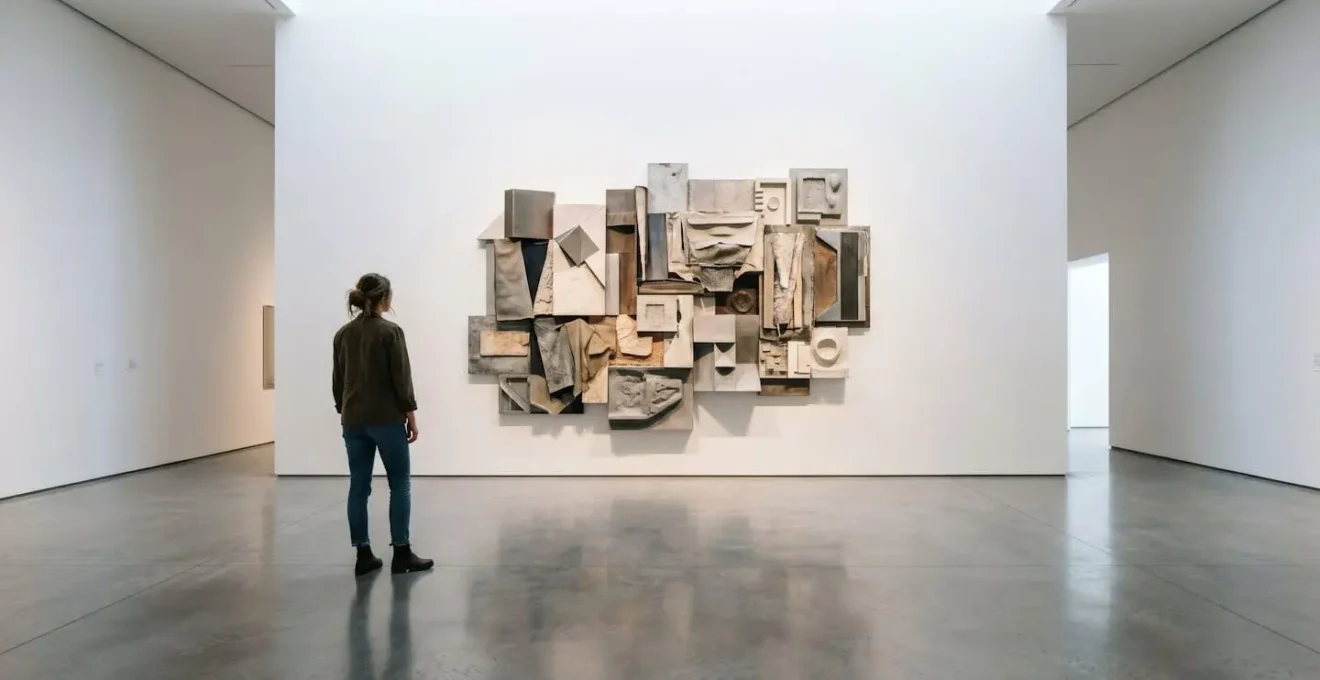
The key to understanding avant-garde art isn’t having a special degree, but learning to see it as a system with rules you can decode.
- “Weirdness” in art is often a deliberate question posed by the artist, not a mistake or a lack of skill.
- The materials, the context of the gallery, and even your own reaction are frequently part of the artwork’s intended mechanism.
Recommendation: Instead of immediately asking “What does this mean?”, start by asking a more powerful question: “How does this work?”.
That feeling of walking into a modern art gallery and being confronted by a pile of rubble, a flickering video, or a seemingly empty room can be daunting. It’s easy to feel like you’re missing the joke or that you need a PhD in art history to even begin to understand what’s going on. The common advice—”read the wall label” or “art is subjective”—often falls short, leaving you feeling just as confused as before. You might be tempted to dismiss it all as pretentious or meaningless, a common reaction for a casual gallery-goer feeling overwhelmed.
But what if the confusion itself is part of the point? Avant-garde and contemporary installations are rarely designed to be beautiful or straightforward in the way a classical painting is. They are often experiments in communication, pushing the boundaries of what art can be and do. They challenge our expectations about materials, form, and even the role of the viewer. Instead of being a passive object of contemplation, the artwork is often an active system waiting for you to engage with it.
This guide offers a different approach. We won’t just tell you to “feel your feelings.” Instead, we will provide you with a set of practical tools and mental frameworks to actively decode these complex works. The goal is to shift your perspective from that of an intimidated observer to a curious detective, empowering you to find your own meaning and appreciate the radical ideas at play. We’ll explore the methods behind the madness, from shock tactics and recycled materials to immersive experiences and conceptual portraits that have no face at all.
This article provides a structured approach to demystify even the most challenging installations. The summary below outlines the key frameworks we will explore to build your confidence and change the way you see contemporary art.
Summary: How to Decode Avant-Garde Art
- Why Do Avant-Garde Artists Use Shock Tactics in Public Spaces?
- Trash or Treasure: How to Evaluate Art Made from Recycled Materials?
- Sound and Light: How to Navigate Immersive Installations Safely?
- The Mistake of dismissing “Weird” Art immediately instead of asking “Why?”
- Which 3 British Avant-Garde Works Changed Art History Forever?
- Why Is a Pile of Candy Considered a Portrait of a Lover?
- Storytelling vs Spectacle: How to Spot a Shallow Immersive Experience?
- How to Decode Conceptual Portraits That Have No Recognizable Face?
Why Do Avant-Garde Artists Use Shock Tactics in Public Spaces?
Confronting an artwork that seems designed to provoke, disgust, or offend can be deeply unsettling. From Andres Serrano’s “Piss Christ” to Maurizio Cattelan’s “Comedian” (the banana duct-taped to a wall), shock has long been a tool in the avant-garde arsenal. The immediate impulse is often to dismiss it as a cheap ploy for attention. However, this reaction overlooks the strategic purpose of shock. It’s not just about the object itself, but about the conversation—and controversy—it generates. Shock acts as a cultural litmus test, forcing a society to confront its own values, taboos, and anxieties.
The artwork becomes a catalyst, and the public and media reaction become part of the piece’s performance. As noted in Artsper Magazine, when discussing the legacy of “shock art,” the provocation is often less about the physical art piece and more a statement about the audience’s cultural values and pressing social issues. For example, the 1997 ‘Sensation’ exhibition at the Royal Academy of Arts, which featured the Young British Artists, became infamous for its use of shocking imagery. The subsequent media frenzy and public debate were not a side effect of the exhibition; they were arguably its primary medium and legacy. The controversy itself revealed deep-seated anxieties about class, morality, and the role of art in modern Britain.
When you encounter a shocking piece, instead of asking “Why did they make this?”, try asking, “What reaction is this designed to provoke in me, and in society at large?” The art isn’t just the object on display; it is the entire dynamic system of provocation and response. By understanding this, you can move past your initial gut reaction and begin to analyze the work as a form of social commentary, where the real subject is not what’s on the wall, but the cultural fabric it pokes and prods.
Trash or Treasure: How to Evaluate Art Made from Recycled Materials?
Walking into a gallery and seeing an installation made of what appears to be garbage—plastic bottles, scrap metal, old tires—can trigger the classic “my kid could do that” response. This reaction is understandable, but it misses the conceptual leap the artist is making. When an artist chooses to work with discarded materials, they are doing more than just assembling objects; they are engaging in a form of alchemy, transforming the worthless into the valuable. The material itself is loaded with meaning. It speaks of consumer culture, waste, environmental decay, and the hidden histories of objects we use and throw away.
As the Sustainability Directory notes in an analysis of the practice, contemporary sculpture made from recycled materials actively “questions the definition of waste and, by extension, the linear economic model that produces it.” The artist isn’t just making a sculpture; they are making an argument. To evaluate this kind of art, you must look beyond the initial appearance of the materials and ask a series of questions. What is the history of these objects? What does their transformation from trash to art say about value? Is the artist commenting on mass production, sustainability, or memory? The skill is not just in the physical construction but in the conceptual reframing.
Artists like El Anatsui, who weaves magnificent tapestries from thousands of bottle caps, or Tom Sachs, who reconstructs modernist icons from plywood and foamcore, are not just recycling. They are using the material as a language to tell stories about trade, labor, and cultural identity. The texture, the wear, the faded branding on these “worthless” items become a rich vocabulary. By learning to read this language, you can see these works not as piles of trash, but as complex, layered narratives about the world we live in.
Sound and Light: How to Navigate Immersive Installations Safely?
Immersive installations, from Yayoi Kusama’s “Infinity Mirror Rooms” to the large-scale digital projections of teamLab, promise to transport us to other worlds. They use light, sound, and space to create powerful sensory experiences. While often breathtaking, these environments can also be disorienting or overwhelming. Flashing lights, loud or repetitive sounds, and enclosed spaces can be physically and psychologically challenging. Knowing how to navigate these experiences safely is a crucial part of appreciating them, and recognizing your own limits is a valid form of interpretation. Feeling uncomfortable isn’t a sign of failure; it’s data about your own relationship with the stimuli the artist is using.
The power of these installations lies in their ability to affect us on a primal level. However, this power comes with responsibility. As research on extended reality safety highlights, applications simulating horror, heights, or confined spaces can trigger genuine anxiety or panic. The same principles apply to physical art installations. Bright, fast-moving visual effects can trigger migraines or even epileptic seizures in susceptible individuals, while intense audio can overwhelm those with sensory processing sensitivities. Your well-being is paramount. Choosing to leave an installation that makes you feel unsafe or unwell is an empowered decision, not a defeat.
To engage with these works confidently, it’s helpful to perform a quick mental audit before and during the experience. Being aware of both the environment and your own reactions allows you to stay in control and focus on the artist’s intent, rather than just being swept away by sensory overload. A conscious approach ensures that your experience is both profound and positive.
Your Personal Safety Audit for Immersive Art:
- Points of Contact: Before entering, quickly list all the sensory channels the work will engage. Are you walking into a dark room? Will there be loud sounds or strobe lights mentioned in the warning?
- Collect Data: As you experience the work, inventory the physical elements around you. Note potential hazards like cables on the floor, reflective surfaces that cause disorientation, or crowded pinch points.
- Check for Coherence: Continuously compare the sensory input with your own personal comfort levels. Is the feeling of unease a deliberate, interesting part of the art (e.g., a sense of awe or smallness) or is it a genuine stress signal from your body?
- Assess Malleability vs. Emotion: Distinguish between a powerful, memorable artistic effect (a beautiful, swelling sound) and a sensation that is physically jarring or emotionally draining (a high-pitched, painful frequency).
- Plan Your Integration: Know your exit. Identify the way out and give yourself permission to leave at any moment. Your path through the work, including the decision to exit, is your unique interpretation.
The Mistake of dismissing “Weird” Art immediately instead of asking “Why?”
Perhaps the biggest barrier to enjoying avant-garde art is our own brain. We are wired to seek patterns, recognize familiar forms, and make quick judgments. When an artwork defies all our expectations—when it’s just plain “weird”—our first instinct is to dismiss it. “This is stupid,” “This isn’t art,” or “I don’t get it.” This immediate dismissal is a defense mechanism against confusion, but it’s also a missed opportunity. Avant-garde art is often weird on purpose. It intentionally breaks the rules to make us question what the rules were in the first place.
As TheArtStory’s analysis points out, the “avant-garde often aspired to shock the viewer in order to create an awareness of the alienation underlying modern reality.” That feeling of strangeness or disconnection you experience isn’t a failure of the artwork; it might be its primary goal. The art is holding up a distorted mirror to the world. Instead of turning away, the most productive response is to get curious and ask, “Why?” Why this specific form of weirdness? Why these materials? Why is it presented in this way, right now?
To combat the instinct to dismiss, you can use a simple framework to guide your engagement. The goal is not to instantly “like” or “understand” the work, but to spend a few moments actively decoding it. This structured approach forces you to move beyond your gut reaction and start thinking like a critic. It transforms a moment of confusion into an act of intellectual discovery. By treating weirdness not as a flaw but as a clue, you open yourself up to the radical, challenging, and sometimes profound ideas that avant-garde art has to offer.
- Minute 1: Document Your Gut Reaction. Acknowledge your first impression without judgment. Is it boring, confusing, unsettling, funny? Write it down mentally. “My first thought is that this is a mess.”
- Minute 2: Identify the Broken Rule. What specific convention is this artwork breaking for you? “Art isn’t supposed to be made of decaying food,” or “A sculpture shouldn’t be something I can’t touch.”
- Minute 3: Catalog Sensory Input. Shift from judgment to observation. List everything you see, hear, or even smell. “I see wires, a flickering screen, a pile of dust. I hear a low hum.”
- Minute 4: Ask “Why This, Why Now?” Consider the context. Why is this work in this museum today? What does that say about what the art world currently values? Is it a comment on technology, politics, or something else?
- Minute 5: Consider the Curatorial Choice. The artwork’s presence is a decision. What does its inclusion reveal about the curator’s thesis for the exhibition or the museum’s mission?
Which 3 British Avant-Garde Works Changed Art History Forever?
The history of avant-garde art is punctuated by moments where a single artwork rips a hole in the fabric of public taste, forever changing what is considered possible. Britain, particularly in the late 20th century, was a fertile ground for such disruptions. While countless works could be cited, three stand out for how they fundamentally altered the public’s relationship with art by leveraging controversy and conceptual rigor.
First, there is Richard Hamilton’s 1956 collage, “Just what is it that makes today’s homes so different, so appealing?” This small but dense work is widely considered the foundational piece of the Pop Art movement. It broke from the abstract expressionism of the time by incorporating images from mass media and consumer culture, treating advertisements and magazines as a valid artistic medium. It didn’t just depict modern life; it was made from the very language of modern life, changing the rules of artistic material forever.
Second, the work of the Young British Artists (YBAs) in the 1990s cannot be overlooked. As the Tate museum notes, avant-garde artists and artworks often go hand-in-hand with controversy, and no one exemplified this better than Damien Hirst with “The Physical Impossibility of Death in the Mind of Someone Living” (1991). A 14-foot tiger shark suspended in formaldehyde was a gesture of immense spectacle and conceptual audacity. It forced the art world and the public to debate the very definition of sculpture, life, death, and the role of the artist as a showman-philosopher. It made conceptual art a mainstream media event.
Case Study: Tracey Emin’s ‘My Bed’ (1998)
Perhaps no single work captured the spirit of the YBAs more than Tracey Emin’s “My Bed.” The piece, a literal presentation of her unmade bed surrounded by the detritus of a depressive episode—including empty vodka bottles, cigarette butts, and used condoms—was shortlisted for the Turner Prize in 1999 and created a media firestorm. Critics and the public were polarized. Was it a brave act of confessional art or a narcissistic display of filth? The work’s true power, however, lay not in the physical object but in the conversation it sparked. It made raw female experience, vulnerability, and mental health struggles a valid subject for a major art institution. The legacy of ‘My Bed’ is the public debate it generated about authenticity, intimacy, and the boundaries of what can be called art.
Why Is a Pile of Candy Considered a Portrait of a Lover?
Among the most confusing yet poetic forms of conceptual art is the “portrait” that contains no recognizable human form. A prime example is Felix Gonzalez-Torres’s “Untitled” (Portrait of Ross in L.A.) from 1991. The work consists of a pile of brightly colored, individually wrapped candies, with an “ideal” weight of 175 pounds. To the uninitiated, it’s just a pile of candy in a museum corner. But once you understand the rules of the system the artist created, it becomes one of the most moving portraits of the 20th century.
The 175-pound weight corresponds to the healthy body weight of Gonzalez-Torres’s partner, Ross Laycock, before he died from an AIDS-related illness. The portrait is not the static pile itself; it is the entire process. Viewers are invited to take a piece of candy. As people take the candy, the pile dwindles, a heartbreakingly simple metaphor for a body wasting away from illness. However, the gallery is instructed to periodically replenish the pile, an act of love, memory, and defiance against the finality of loss. The portrait is a dynamic system of depletion and regeneration, of public participation in a private act of mourning and remembrance.
The System of Felix Gonzalez-Torres’s “Untitled (Portrait of Ross in L.A.)”
This iconic candy work transforms portraiture from a fixed image into a living process. The artist uses abstract data (body weight) as the primary medium and makes audience interaction the core mechanism of meaning. By taking a piece of candy, the viewer is no longer a passive observer. You become a participant, complicit in the narrative of loss. Yet, the sweetness of the candy is also an act of communion, a way of sharing in the memory of Ross. The work exists in this beautiful, tragic tension between disappearance and endurance, making the viewer’s choice a central part of the artwork’s continuous performance.
This work teaches us a crucial lesson: to decode conceptual art, we must look for the rules of the game. The meaning is not in the object (the candy) but in the system of interactions the artist has designed around it. It’s a portrait not of a face, but of a life process, of love, and of loss.
Storytelling vs Spectacle: How to Spot a Shallow Immersive Experience?
The rise of “Instagrammable” pop-ups and ticketed immersive events has blurred the line between profound artistic experience and shallow entertainment. Many so-called immersive art experiences are little more than a series of disconnected, spectacular photo opportunities engineered for social media sharing. They offer a quick hit of visual “wow” but lack any deeper narrative or emotional resonance. A truly deep immersive artwork, by contrast, uses spectacle not as an end in itself, but as a tool for storytelling. It creates a cohesive world that rewards exploration and leaves a lasting psychological impact.
The difference lies in intentionality and visitor agency. A shallow experience funnels you along a predetermined path, from one selfie-ready backdrop to the next. Your role is simply to capture the spectacle. A deep experience gives you the freedom to explore, make choices, and form your own path. The narrative unfolds through your interaction with the space, and the environment often reveals new layers of meaning on repeat visits. As some research from 2024 demonstrates that immersive light installations promoted psychological restoration, it’s clear these works can have a significant effect. A deep experience aims for this kind of lasting impact, while a shallow one settles for a momentary distraction.
So how can you, as a visitor, tell the difference? It comes down to asking critical questions about your own experience. Are you being guided toward a specific photo-op, or are you encouraged to explore freely? Does the experience build a sustained emotional arc, or does it just offer a series of disconnected “wow” moments? Is the primary goal to make you think and feel, or is it to make you post? The following table breaks down the key indicators of quality, providing a tool to evaluate the depth and integrity of an immersive experience.
| Quality Indicator | Deep Immersive Experience | Shallow Immersive Experience |
|---|---|---|
| Repeat Visit Value | Reveals new layers and meanings on second visit; rewards repeat viewing | Relies on one-time ‘wow’ factor; diminishing returns on repeat exposure |
| Visitor Agency | Provides choice to explore, make decisions, form own path through space | Funnels visitors along predetermined route designed for specific photo-ops |
| Emotional Journey | Builds sustained emotional arc with narrative progression over time | Offers disconnected spectacular ‘spikes’ engineered for social media shares |
| Engagement Type | Fosters deeper cognitive and emotional engagement; induces reflection | Prioritizes sensational visual impact over meaningful contemplation |
| Long-term Impact | Can change attitudes, priorities, daily habits and core principles | Provides momentary entertainment without lasting psychological effect |
Key Takeaways
- Avant-garde art is often a system to be decoded, not a mystery to be solved. Focus on “how it works” before “what it means.”
- The artist’s choice of material (even trash), the context of the gallery, and the public’s reaction are all part of the artwork.
- Your own safety, comfort, and decision to engage or disengage are valid parts of your interpretation of an immersive work.
How to Decode Conceptual Portraits That Have No Recognizable Face?
We’ve seen with Felix Gonzalez-Torres’s candy pile that a portrait can be a powerful emotional experience without including a single facial feature. This type of conceptual portraiture challenges our most basic understanding of what a portrait is. It asks us to see a person not through their physical likeness, but through their data, their possessions, or the traces they leave behind in the world. This approach can feel abstract and cold at first, but it offers a surprisingly intimate way of knowing a subject.
To decode these faceless portraits, we need to abandon our search for a likeness and instead look for a system of representation. The artist has replaced the visual language of facial features with a different code. Our job as viewers is to identify that code. Is the artist using a person’s belongings to tell their life story? Are they translating a life into a series of charts and graphs? Or are they representing a person through a symbolic object or a significant absence? Identifying the method is the first step to unlocking the meaning.
Felix Gonzalez-Torres’s groundbreaking installations are famous for their simplicity and affective impact, embedding poetic meditations on love and loss in the mundane material of everyday life.
– TheArtStory, Felix Gonzalez-Torres Biography
This quote highlights the power of using “mundane material” to achieve profound emotional effect. The following three methods are common systems artists use to create these compelling, faceless portraits.
Three Methods for Reading Faceless Portraits
- Portrait as Archive: This method involves creating a portrait from a subject’s actual possessions, letters, or a curated collection of objects. The artwork becomes a biographical archive, and we read the life story through the artifacts they left behind. Each object—a worn book, a stack of letters, a collection of records—becomes a chapter in their biography.
- Portrait as Data: Here, artists use abstract information as their medium. You might see charts of a person’s daily routines, visualizations of their DNA sequence, lists of their lifetime purchases, or other numerical data. This method reframes identity as a set of measurable data points rather than a physical appearance, questioning how we define a person in the digital age.
- Portrait by Proxy: This approach portrays a subject through a significant place, a symbolic object, or a notable absence—like an empty chair, a pair of clocks, or a specific room. The proxy object is so deeply intertwined with the subject’s life that it becomes a stand-in for their entire being. Gonzalez-Torres’s candy works, representing body weight and life process, are a perfect example of portrait by proxy.
By moving beyond the intimidating surface of avant-garde installations and equipping yourself with these frameworks for decoding, you transform from a passive spectator into an active participant. The gallery ceases to be a place of confusion and becomes a playground for the mind, where every “weird” object is an invitation to a new way of seeing the world.